Funding Capital-Intensive Companies
Reducing your company’s pre-money valuation can make it more attractive to potential investors. Here’s how to do it.
What if you have a great idea for a company, but to launch it you need a huge amount of capital, say $10 million to $15 million? First, for this column to work, make sure your company has the following characteristics:
- The company must provide a basic product or service that’s sold directly to the consumer.
- To protect your competitive advantage, you should have one or more approved patents.
- The principle reason for needing so much startup capital should be to acquire equipment that’s necessary for the company to launch its business. You shouldn’t need most of your money for R&D, personnel or regulatory approvals.
- The company should have an exceptionally experienced management team with an impressive track record in the same field that the company will focus its efforts.
Assuming the above apply, this is your dilemma:
- The company needs $15 million just to get things off the ground.
- Most investors won’t want to own more than 40 percent of the company in their first round of investment. So, if $15 million buys 40 percent, then the pre-money valuation–the company’s valuation before the financing–would have to be $22.5 million.
- How does a company with no sales, no track record and no prospects justify a pre-money valuation of $22.5 million when most similar companies have, at best, a pre-money value of $5 million?
Typically, an investor will value a company as follows:
- An excellent, proven management team is worth $1 million.
- Each fully owned, approved patent deemed central to the success of the company is worth $1 million.
- Then, if the company is operating within a niche that is either huge–greater than $1 billion–or is growing at a rate in excess of 20 to 40 percent per year, and the company is perceived to have the best and most competitive product to enter this niche in recent memory, then it might be worth an additional $1 to $2 million.
Under no circumstances will an investor consider a $22.5 million pre-money valuation unless the deal has one or more of the following characteristics:
- Exceptionally high returns in the range of 8x to 15x. This might come from a product that has a superb profit margin and/or one that can leverage one sale with several others (e.g., the “razor” and “blade” concept).
- Fairly quick and predictable payouts, preferably less than three years so the risk is minimized. Generally, this isn’t possible with most technology companies as they usually take five to 10 years to mature to a liquidity event. So, for you to qualify in this category, you’ll need to show that either the company can make enough money to pay back the investors in two to three years or will be ripe to sell in that same period.
- The potential to reduce the pre-money valuation by substituting debt for equity.
The first two are self-explanatory. But the last one involves a funding technique that’s little known and often overlooked by both entrepreneurs and investors. Here’s how it works.
Let’s assume that the company has 10 million shares authorized. Under the classical investment scenario, the transaction would look like this:
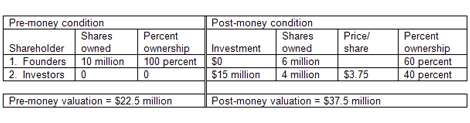
Now, what would happen if we wanted to make this deal more attractive to the investors through the creative use of debt? First, we must emphasize one of the key parameters of this example: The main thing driving up the company’s need for capital is the huge amount of capital equipment needed to open the doors. Here’s where we turn a negative into a positive.
Typically, if you can show a bank that you can raise two-thirds of the money needed to launch your company, then the bank will agree to finance the final third if it’s being used to buy capital equipment. The bank will get its money back on fees and interest and, in the extreme case, by repossessing the equipment. But, here’s the magic: If the bank agrees to finance $5 million of your raise, then you only need to raise $10 million. Now, yes, you could do that by selling one-third fewer shares, but remember the goal here is to reduce the pre-money valuation and make the deal more attractive to the investors.
Thus, here’s how we’d propose structuring this deal with this new information:
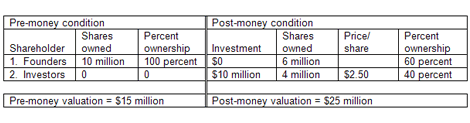
By using this strategy, you’ve effectively lowered the pre-money valuation by 33 percent, and although it’s still not in the range you’d like, if the investor believes that you can deliver the returns forecast above in the timeframe you’ve estimated, you have a much better chance of selling this deal.
Jim Casparie is the “Raising Money” coach at Entrepreneur.com and the founder and CEO ofThe Venture Alliance, a national firm based in Irvine, California, that’s dedicated to getting companies funded.
What if you have a great idea for a company, but to launch it you need a huge amount of capital, say $10 million to $15 million? First, for this column to work, make sure your company has the following characteristics:
- The company must provide a basic product or service that’s sold directly to the consumer.
- To protect your competitive advantage, you should have one or more approved patents.
- The principle reason for needing so much startup capital should be to acquire equipment that’s necessary for the company to launch its business. You shouldn’t need most of your money for R&D, personnel or regulatory approvals.
- The company should have an exceptionally experienced management team with an impressive track record in the same field that the company will focus its efforts.
Assuming the above apply, this is your dilemma:
- The company needs $15 million just to get things off the ground.
- Most investors won’t want to own more than 40 percent of the company in their first round of investment. So, if $15 million buys 40 percent, then the pre-money valuation–the company’s valuation before the financing–would have to be $22.5 million.
- How does a company with no sales, no track record and no prospects justify a pre-money valuation of $22.5 million when most similar companies have, at best, a pre-money value of $5 million?
Typically, an investor will value a company as follows: