
Giorgi Agladze: "Innovation becomes real value when customers see its impact in their own finances" The co-founder of Kursi.ge on state institutional support, the GITA grant, 200,000+ customers, approximately GEL 350 million in savings for the economy, and the next stage of Georgian fintech
Opinions expressed by Entrepreneur contributors are their own.
You're reading Entrepreneur Georgia, an international franchise of Entrepreneur Media.
 Building an innovative financial business in Georgia is not just a question of technology — it requires customer trust, a high-quality product, a regulatory framework and institutional support. Kursi.ge is one of the clearest examples of this process: the company began operating in March 2024, went through the National Bank of Georgia's regulatory sandbox and received a full operating licence in October 2025. Today the platform has more than 200,000 registered users, including 6,000 businesses, and has converted the equivalent of GEL 8.4 billion since launch. The savings created for the Georgian economy — for individuals and businesses — amount to approximately GEL 350 million.
Entrepreneur spoke with Giorgi Agladze about how the support of state institutions — the Government, GITA and the National Bank — translated into measurable economic results: customer savings, new jobs and new business.
One of the key milestones in Kursi.ge's development was the National Bank's regulatory sandbox, after which a new regulatory framework for fully digital currency-exchange platforms was established, and in October 2025 you received a full operating licence. What did this process mean for you, and how important is it that the regulator creates room for innovation to develop?
In the financial sector, innovation cannot develop independently of regulation. On the contrary — if we want a new financial model to become scalable, trusted and sustainable, a practical dialogue between technological innovation and the regulator is essential. For us, the regulatory sandbox was exactly that mechanism: the idea was not only assessed in theory, but tested in a real environment, under supervision.
In September 2023 the National Bank opened applications for innovative digital currency-exchange platforms; in March 2024 our participation in the sandbox was approved; and in July 2025 a new regulatory framework for fully digital currency-exchange businesses came into force. In October of the same year, Kursi.ge received its full operating licence. It was a very important signal — in Georgia, innovation can not only be created, but can also mature into a fully fledged, regulated financial product.
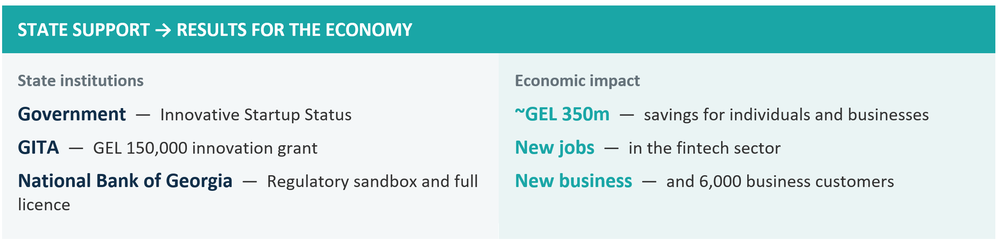
Our case shows clearly what consistent support from state institutions can achieve. The Government created a favourable environment for growth through Innovative Startup Status; GITA backed us with a grant at the hardest, earliest stage; and the National Bank, through the sandbox and licensing, gave innovation a path into the regulated market. These steps complemented one another, and together they became the foundation for responsible growth.
This support did not remain the success of a single company — it returned to the economy as tangible results. The opportunity created by state institutions has delivered approximately GEL 350 million in savings to individuals and businesses, created new jobs, brought new business to the market and expanded the range of financial products available to customers. That means lower financial costs for households and companies, an additional contribution to economic development and a stronger innovative fintech sector. For me, this is the true measure of state support — how far it is converted into real economic impact.
"The support of state institutions has delivered approximately GEL 350 million in savings, new jobs and new business to the economy."
 In November 2024 you won a GEL 150,000 innovation grant from GITA, and today the company's internal valuation stands at approximately GEL 100 million. What role did this first institutional support play in Kursi.ge's rapid growth and in validating its business model?
The value of the GITA grant went well beyond GEL 150,000. At an early stage, validation matters as much as money — a signal that your idea has development potential and that an independent state institution sees it too. For us it was at once a financial resource, a mandate of trust and a responsibility to turn the idea into a real product and tangible value for customers.
A grant should never be seen as the finish line of success — its value is measured by what is built after it. In our case, the initial support was followed by a full operating licence, EBRD's Star Venture award of EUR 40,000, Innovative Startup Status, international financing and an internal company valuation of approximately GEL 100 million. But the most important thing is still the market outcome — how many people use the product and what financial benefit they receive.
That is why today I see GITA's initial support in a broader, economic context. A journey that began with GEL 150,000 of initial support is now returning to the economy as approximately GEL 350 million in savings, new jobs and new business. The state created the opportunity for a startup to receive resources and trust at the very beginning; our responsibility was to turn those resources into a business. When an innovative company expands its product offering, employs people, saves customers money and develops new financial technologies, the initial state support returns to the economy many times over.
Kursi.ge's scale is now visible in concrete numbers: the equivalent of GEL 8.4 billion converted, more than 200,000 registered users including 6,000 businesses, 440,000 Open Banking transactions and approximately GEL 350 million in savings for customers. In your view, what built such rapid trust in a fully digital model?
Customer trust does not start with technology — it starts with results. For individuals and businesses alike, a few questions ultimately decide everything: Am I getting a better rate? Is the process simple and fast? Are the terms transparent? If the answer is yes, a digital channel very quickly becomes the everyday choice.
We built the model from day one without branches — with online onboarding, digital processes and Open Banking infrastructure, built on the framework introduced by the National Bank. To date we have completed more than 440,000 Open Banking transactions, which makes us the largest Open Banking user in Georgia. On average, around 6,500 transactions are completed and 5,500 customers are served every day. This shows that the digital model has moved beyond the experimental stage and become part of mainstream financial behaviour.
The most important result, however, is the economic benefit to customers. In 2025, total customer savings amounted to approximately GEL 203.4 million; in the first seven months of 2026, a further GEL 139.4 million — more than GEL 342.8 million in total. So when we speak of approximately GEL 350 million, this is not an abstract estimate, but real money that stayed in the pockets of households and businesses — in other words, in the Georgian economy: both as the direct effect of better rates and as lower spreads and costs resulting from an expanded product offering.
In this sense, Kursi.ge's core product is not just currency exchange. Our product is choice, transparency and accessibility — and that is what creates the greatest value for customers. This result would not have been possible without the institutional foundation the state built for innovation.
"Customer trust does not start with technology — it starts with results."
At the next stage of the company's development, the trust of international institutions also became visible — the EBRD Star Venture award and USD 1.75 million of unsecured financing from Symbiotics. What do international investors see in Georgian fintech, and what signal does such a deal send to the international market?
International institutional capital does not finance a good idea alone. It requires regulatory clarity, transparent data, strong governance, risk-management standards and a proven growth model. That is why the USD 1.75 million of unsecured financing from Symbiotics is not just capital for us — it is an independent international assessment that a fintech company built in Georgia can be a trusted partner for an institutional investor.
It was preceded by EBRD's EUR 40,000 Star Venture award and other institutional milestones. Each such step concerns more than Kursi.ge alone. When an international financial institution finances Georgian fintech — especially on an unsecured basis — it gives the entire ecosystem additional reputational capital.
Georgia's advantage is that technology can be adopted quickly in a relatively small market, while the right regulatory environment created by the National Bank allows a company to test its product on real customers and then prepare it for scale. That is the key signal for global investors: in Georgia it is possible not only to create an idea, but to build a regulated, data-proven financial business that international capital understands.
Looking ahead, what will Kursi.ge's next phase of development be through the end of 2026 — what new financial products could be added to the platform, and how realistic is regional expansion, including into neighbouring markets?
For us, the next stage is developing Kursi.ge beyond currency exchange. By the end of 2026 we plan to add new services in Georgia — remittances, innovative savings products and modern payments. The goal is to offer customers broader financial functionality in a single digital environment, while preserving the principles our growth was built on: transparency, favourable terms and a simple customer experience. Every new service also means new jobs and new expertise in Georgia.
We do not measure scaling only by the number of new features. As we grow, infrastructure, Open Banking integrations, operational resilience, security and compliance processes must all be strengthened. When you process thousands of transactions every day, the quality of growth matters as much as its speed.
The regional agenda is also on the table — Armenia is being considered as a possible first market in 2027. But here too our approach is pragmatic: expansion should not be just geographic. We need to prove that the technology, the business model and the compliance framework are replicable in another market. If we get this right, Kursi.ge's ambition will be far broader than a successful local FX platform — we want to build, from Georgia, a financial technology business that delivers measurable benefits to customers and grows successfully across regional markets.
"The quality of growth matters as much as its speed."
KURSI.GE — KEY FIGURES
 Editor's note: figures are based on Kursi.ge's September 2026 information pack. The precise cumulative customer savings figure is GEL 342.8 million; in the interview it is rounded to "approximately GEL 350 million".


