Contact Information
502 E. Boone AvenueSpokane, WA 99258
Phone: (509) 313-6572
Fax: (509) 313-5780
View Website
Gonzaga University Says...
Gonzaga University, founded in 1887, is an independent, comprehensive university with a distinguished background in the Catholic, Jesuit, and humanistic tradition. Gonzaga emphasizes the moral and ethical implications of learning, living, and working in today's global society. Through the University Core Curriculum, each student develops a strong liberal arts foundation, which many alumni cite as a most valuable asset. In... Read More...Statistics
Enrollment: 4805
Average ACT: 26
Most Popular Majors: Business/Commerce, General,Political Science and Government, General,
Regular Application Deadline: 02/01
Student Faculty Ratio: 11:1
Average ACT: 26
Most Popular Majors: Business/Commerce, General,Political Science and Government, General,
Regular Application Deadline: 02/01
Student Faculty Ratio: 11:1
Scholarships & Financial Aid
Undergraduate Receiving Need-Based Financial Aid: 40
Average Freshman Total Need-Based Gift Aid: $17,924.96
Rankings & Lists
Everyone Plays Intramural Sports
Students Pack the Stadiums
School Says - General InformationStudents Pack the Stadiums
Gonzaga University, founded in 1887, is an independent, comprehensive university with a distinguished background in the Catholic, Jesuit, and humanistic tradition. Gonzaga emphasizes the moral and ethical implications of learning, living, and working in today's global society. Through the University Core Curriculum, each student develops a strong liberal arts foundation, which many alumni cite as a most valuable asset. In addition, students specialize in any of more than 75 academic programs and majors. Gonzaga enrolls approximately 4,729 undergraduates and 2,908 graduate and law students.
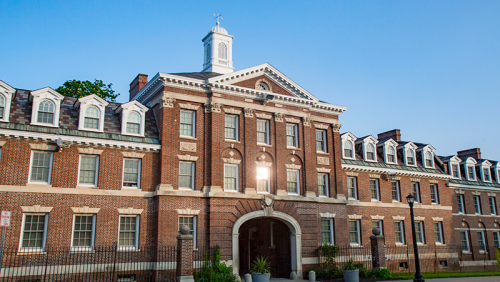
Gonzaga's 131-acre campus combines the old and new: College Hall, the original administration building, and DeSmet Residence Hall with the modern architectural structures of Foley Library, Hughes Life Sciences Building, Jundt Art Center and Museum, and the PACCAR Center for Applied Science. The campus is characterized by sprawling green lawns and majestic evergreen trees. Towering above the campus are the stately spires of St. Aloysius Church, the well-recognized landmark featured in the University logo.
Gonzaga encompasses five undergraduate schools: Arts and Sciences, Business Administration, Education, Engineering and Applied Science, and Professional Studies. The University offers the BA, BBA, BEd, BS, BSCE, BSCpE, BSCS, BSEE, BSEM, BSME, and BSN degrees.
Gonzaga offers several unique options for students. The Honors Program provides a rigorous liberal arts curriculum for intellectually curious students who thrive in a competitive academic environment. Business leaders mentor the Hogan Entrepreneurial Leadership Program students, and internships are an integral part of the program. The award-winning Gonzaga Alumni Mentor Program (GAMP) connects current students and recent graduates with alumni in their professional areas of interest. Students in the Comprehensive Leadership Program take a leadership certificate curriculum that may be combined with any major, and they participate in valuable, interactive leadership experiences. The Army ROTC unit prepares select women and men as leaders in service for their communities and their country. Gonzaga's nationally ranked debate team includes all skill levels. The Mock Trial Team competes nationally and involves students majoring in many different areas of study. Internships, research with faculty, and community service learning enhance class time while providing students first-hand experience.
School Says - Student Body
GU students enjoy a wide variety of activities on and off campus. The Gonzaga Student Body Association (GSBA) oversees over one hundred academic, social, and cultural clubs and provides the structure of student government. Some of the most popular clubs include the Outdoors Club, THIRST (a non-denominational worship group), GUTS (an improvisational comedy team), and the Hawaii Pacific Islanders Club. GSBA organizes service and conservation projects, dances, and countless other activities to channel and challenge the talents and passions of motivated men and women who seek to make a difference.
As the leading provider of service hours in the entire city of Spokane, Gonzaga University encourages students to volunteer their services at any of the area nonprofit organizations. University Ministry, the Gonzaga Student Body Association, Unity Multicultural Education Center and the Office of Intercultural Relations, and the Center for Community Action and Service Learning (CCASL) provide organized projects through which students become involved in the greater Spokane community.
Division I, West Coast Conference sports include baseball (men), basketball, crew, cross-country/track, golf, soccer, tennis, and volleyball (women). Approximately 85% of students participate in intramural and club sports such as ultimate frisbee and rugby. The Harry & Colleen Magnuson Theatre hosts main-stage plays (including musicals), dance recitals, GUTS, and numerous one-acts and student directed scenes. Gonzaga's musical groups include a nationally recognized University Choir, a Chorale, the GU Symphony, the Jazz Band, the Gregorian Schola, The Big Bing TheoryÃâ"an a cappella group, and numerous other ensembles. GU's students also host programs on Gonzaga's TV and radio stations. Additionally, many students participate in University Ministry events, such as retreats, the annual Pilgrimage hike, THIRST, Masses, Christian Life Communities, and interdenominational and/or interfaith services.
School Says - Academics
The core curriculum (a basic set of courses in thought and expression, philosophy, religious studies, mathematics, and English literature) is at the foundation of every student's academic experience at Gonzaga. In keeping with the Jesuit ethos of the University, all students share a framework of 31 credits: a trio block of thought and expression courses including English composition, critical thinking, and speech communication; three additional courses in philosophy; three religious studies courses; and one course each in math and English literature. Various schools in the University add courses that complement the core such as modern/classical language requirements, history and science classes, additional math courses, etc. Often, classes at Gonzaga require oral presentations or use of the written and discussion-based communication skills emphasized in the core curriculum.
School Says - Admissions
The University seeks diligent, inquisitive applicants with diverse backgrounds who will benefit from the rigorous Jesuit instruction at Gonzaga as well as enhance the University environment. A Common Application (www.commonapp.org) or the Universal College Application (www.universalcollegeapp.com) and the Gonzaga supplement, SAT I (Writing Section not used universally) or ACT scores (Writing Section not required), a teacher recommendation, a counselor report, an activities list or resume, and an essay are required. Transfer students and students with any college credit must submit official transcripts from all colleges. Transfer students must also complete a transfer student clearance report. International students must also submit official transcripts from all colleges attended. Additionally, international students must submit official results of their TOEFL examination. The Non-binding Early Action application deadline for freshmen is November 15th (postmarked). The main advantages of the Early Action Program are early communication of admission and potential scholarship notice (by January 15th). The Regular Decision application date is February 1 (postmarked). Students applying Regular Decision by this date will receive an admission decision by the beginning of April. After February 1, applications will be accepted only if space is available.
School Says - Campus Life
As the hub of the Inland Northwest, Spokane plays a vital role in shaping the University's character. While offering urban advantages such as museum exhibits, shopping, symphony, Broadway and ballet performances, Spokane still maintains an intimate, friendly, and community atmosphere. Used for running and cycling, part of the 37-mile Centennial Trail, runs through campus and to Coeur d' Alene, Idaho. Within a short distance of campus, students snow and water ski, hike, cycle, rock climb, swim, camp, and golf. With an average rainfall of only 16.7 inches per year, outdoor activities are easily accessible.
The 24 residence halls on campus, both single-sex and coed, house 40 to 360 students each. Freshmen and sophomores are required to live on campus. The ZagNet network provides students round-the-clock electronic access to email, Internet, campus intranet, and library holdings, all directly from residence hall rooms. Resident Directors and Assistants, along with a Resident Chaplain, provide a fun, secure, and nurturing environment.
School Says - Cost Aid
Tuition for the 2009-2010 academic year is $29,200; room and board is estimated at $7,976. Including tuition, room and board, books, fees, transportation, and living expenses, Gonzaga estimates $41,751 as the total cost of attendance for the 2009-2010 year.Over 95 percent of students receive financial aid. The average package for 2007-2008 was $22,643 awarded in the form of grants, scholarships, loans, and campus employment. A number of merit-based, merit/need-based, athletic, music, debate, and other program scholarships are awarded to students each year. Students should file the Free Application for Federal Student Aid (FAFSA) by the priority date of February 1. Gonzaga is committed to working with students and families to finance their investment in a quality education.
Students Say - Academics
Students tell us that Jesuit-run Gonzaga University is "one big family comprised of Catholics and non-Catholics alike" who "all work together in achieving success. We embrace the Jesuit traditions of service, spirituality, social justice, and leadership." The Jesuit influence is indeed pervasive. It can be seen in the effort to "educate the entire person" through a broad liberal arts curriculum, though Gonzaga requires four semesters of philosophy and three of religious studies. "They are classes that open your eyes to many harsh realities out in the world and ways that we can contribute with our careers to change [them]," one undergrad observes. It is also seen in the school's commitment to social service; "Almost everyone here is involved in some kind of community service, whether as a class requirement or just for fun," one student explains. "GU also requires a social justice class as part of the core curriculum [in the College of Arts and Sciences]." The school is "big enough to have good programs, small enough that you feel cared about." Academic standouts here include engineering, nursing, and business. The fine arts, on the other hand, "could use some more attention" and "need better facilities." The school also "has great support programs. There are endless offices where people can go to get help that include great counselors' offices and homework help." Those same services are "also very good about helping you figure out what you really want to do with your life."
Students Say - Campus Life
Gonzaga students "love to go to basketball games," even though "it takes a lot of time out of your week between waiting in line on Sundays to get tickets and waiting in line on game days to get seats. However, when you are in the stands among all those red Kennel Club T-shirts, it is totally worth it." Beyond the hardwood floor, GU's campus "is extremely active, which results in a lot of fun, active ways to entertain oneself," including "extremely popular" intramural and club sports and extracurricular clubs ("everyone is involved in a few"). While "The majority of people do go out and party on the weekends, and most parties take place at off campus houses in the Logan neighborhood surrounding campus," students may also choose from among "lots of things to do here that don't involve drinking. Every other week, the Gonzaga University Theater Sports (GUTS) club puts on an improv comedy show, which is hilarious without fail. There are also outdoor programs and trips, a myriad of clubs, and service-learning opportunities." Students also take "a very active role in the surrounding community (the Logan neighborhood, which is the poorest neighborhood in all of Spokane). Gonzaga puts on and sponsors a lot of after- school programs for the kids of the local elementary schools and junior highs." Hometown Spokane "has a lot to offer if you know where to look," including "concert venues, cafés, great food, movie theaters showing both mainstream and independent films, and shopping."
Students Say - Student Body
There is not a lot of diversity at GU, where "a majority of students are white, upper-middle-class." They "are active and generally good students, but they don't take school too seriously" and "like to go out." While they may not love learning for its own sake, they are "intelligent go-getters" who are "eager to grow and eager to explore the world." Most "are or have been involved in sports, either intramural or varsity level. Also, most students are involved with the communities around them, either through services like 'Campus Kitchen,' which serves food to those in the community, or 'Campus Kids' or 'SMILE,' which bring elementary to middle-school kids on campus as an after-school activity to play with and be mentored by the students on campus." Undergrads tend to be "at least moderately religious."