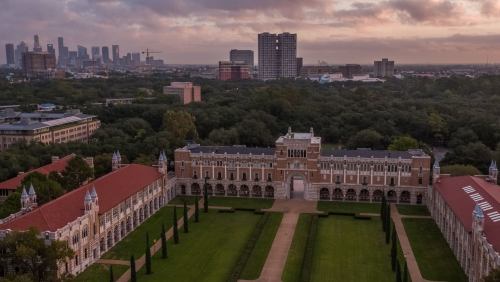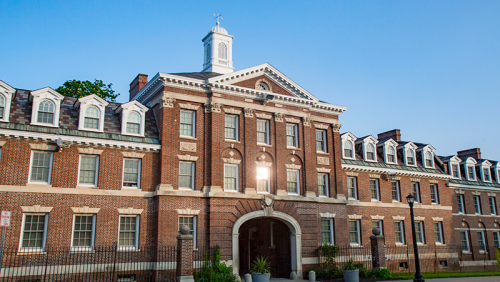
Princeton Review
Rochester Institute of Technology

Previous Photo
Next Photo

Contact Information

60 Lomb Memorial Drive
Rochester, NY 14623-5604
Phone: (585) 475-5502
Fax: (585) 475-7424
View Website
Rochester Institute of Technology Says...
RIT is one of the world's leading career-oriented, technological universities. At RIT, some of the world's most talented, ambitious, and creative students find a remarkable array of academic programs; diverse, talented and accessible faculty; an unusual emphasis on experiential learning; and a vibrant, connected community that is home to students from more than 100 countries. RIT's eight colleges offer more... Read More...

Statistics

Enrollment: 14224
Most Popular Majors: Information Technology,Mechanical Engineering,Photography,
Regular Application Deadline: 02/01
Student Faculty Ratio: 13:1

Scholarships & Financial Aid

Undergraduate Receiving Need-Based Financial Aid: 150
Average Freshman Total Need-Based Gift Aid: $16,500.00

Rankings & Lists

Least Beautiful Campus
School Says - General Information
RIT is one of the world's leading career-oriented, technological universities. At RIT, some of the world's most talented, ambitious, and creative students find a remarkable array of academic programs; diverse, talented and accessible faculty; an unusual emphasis on experiential learning; and a vibrant, connected community that is home to students from more than 100 countries. RIT's eight colleges offer more than 90 undergraduate programs in areas such as engineering, computing, information technology, engineering technology, business, hospitality, art, design, science, psychology, public policy, game design and development and biomedical sciences. Regardless of background or academic interest, students find that RIT offers a stimulating environment for intellectual and personal growth.

School Says - Student Body
Clubs and Organizations exist to bring students of similar interest together and provide them with opportunities to become effective leaders. These groups enhance the quality of student life by fostering social interaction, leadership development, school spirit and an affinity to RIT. Clubs and Organizations promote activities, diversity, service and learning outside of the classroom. Currently there are approximately 200 active clubs, 10 Major Student Organizations, and 29 Greek Organizations on campus.

School Says - Academics
Regardless of background or academic interest, students find that RIT offers an innovative and creative environment for intellectual and personal growth. RIT's eight colleges offer more than 90 undergraduate programs in areas such as engineering, computing, information technology, engineering technology, business, hospitality, art, design, science, psychology, public policy, game design and development and biomedical sciences. To complement their specialized field of study, students select from more than 90 minors available at RIT. Students can also complete a master's degree in five years through one of the university's accelerated BS/MS or BS/MBA programs. RIT was among the first universities in the world to offer cooperative education. Last year more than 3,600 co-op students alternated periods of study on campus with paid employment in nearly 2,000 firms across the United States and overseas. Today, experiential learning also includes internships, study abroad, and undergraduate research.

School Says - Admissions
RIT seeks a diverse and multicultural student body. Entering students come from a variety of geographic, social, cultural, economic, and ethnic backgrounds. Admission to RIT is competitive, but the admission process is a personal one. The university is interested in learning about students' interests, abilities, and goals in order to provide the best information and guidance as they select the college that is right for them. Students applying for freshman admission for the fall quarter (September) may apply through an Early Decision Plan or Regular Decision Plan. The Early Decision Plan is designed for students who consider RIT their first-choice college and wish to make an early commitment regarding admission. Early Decision requires that candidates file their applications and supporting documents by December 1 in order to receive admission notification by January 15. Freshmen who choose not to apply for Early Decision are considered under our Regular Decision Plan. Regular Decision applicants who have provided all required application materials by February 1 will receive admission notification by March 15. Applications received after February 1 will be reviewed on a space-available basis, with notification letters mailed four to six weeks after the application is complete. Students interested in being considered for merit-based (academic and extracurricular) scholarships or the RIT Honors program must apply by February 1. All applications for transfer admission are reviewed as they are received, and notification letters are mailed four to six weeks after the application is complete. Factors considered in our admission decisions include, but are not limited to, past high school and/or college performance (particularly in required academic subjects), admission test scores, competitiveness of high school or previous college, and academic program selected. Recommendations from those familiar with your academic performance and interviews with admissions counselors are often influential. Most students applying to RIT choose a specific academic program as part of the admission process. This is important because there are a variety of academic programs, and admission requirements may differ from one program to another. For example, a student applying for admission to our computer science program would present a strong academic record with particular strength in mathematics, while a student applying for a fine art or design major would need to show artistic talent through a required portfolio. For students who wish to explore their options before declaring a major, RIT offers the following undeclared options: University Studies (for students wishing to explore programs in two or more colleges); Undeclared Art & Design: Undeclared Business; Computing Exploration; Undeclared Crafts; Engineering Exploration; Undeclared Engineering Technology; Informatics Exploration; Liberal Arts Exploration; and General Science Exploration.

School Says - Campus Life
RIT's 1,300-acre campus is located in the suburbs, about six miles from downtown Rochester, NY. More than 6,800 diverse, creative, ambitious students live on campus in residence halls or apartments, and the self-contained, suburban location gives the campus a safe, residential atmosphere. RIT also maintains campuses in Croatia, Dubai, and Kosovo.

School Says - Cost Aid
For 2010-11, tuition and fees cost $30,282; room and board averaged $10,044; and books, transportation, and other expenses averaged $1,925.RIT's Office of Financial Aid and Scholarships assists students and their families in identifying sources of financial aid to help meet the cost of a quality education. Currently, more than 12,000 RIT undergraduate and graduate students receive over $243 million dollars in financial assistance from federal, state, and institutional resources, in the form of scholarships, grants, loans, and part-time employment.

Students Say - Academics
Uniting creativity, innovation, and applied knowledge, Rochester Institute of Technology is the place "where the technical left and artistic right brains collide." RIT offers a range of majors in technical fields-from game design to bioinformatics-as well as programs in art, engineering, and business. Across the board, there is an "emphasis on hands-on learning," and most majors require students to complete a cooperative work experience (basically, a paid internship), designed to "give you the opportunity to make connections in [an] industry within your field." On campus, undergraduates are encouraged to pursue research. Fortunately, "Funding is everywhere if a student takes the initiative to apply." The academic calendar at RIT is built around a "rigorous and fast-paced quarter system" that allows students to take more classes annually-but also keeps them burning the midnight oil. Not everyone is up to the challenge, and "The academic rigors of the school often force people to transfer or drop out." For those willing to put in the work, RIT offers all the tools for success: "All of the teachers I have had for problem-based classes (such as calculus and computer science) set up weekly office hours," and "Free tutoring is also widely available and excellent." In the classroom, "Professors are generally good, with the occasional whack-job or stellar teacher thrown in for good measure." Thanks to the "relatively small class sizes," teachers and students often develop personal relation- ships, and "even in the large lecture halls, [professors] try to get to know each student." Administrators get mixed reviews, but most students agree, "President Destler definitely shakes things up a bit (in a good way). He's all about the students and makes that very obvious."

Students Say - Campus Life
Thanks to RIT's demanding course work, "a lot of school life revolves around homework" and students are accustomed to "spending many nights in [the] lab working on an assignment." For fun, there are "huge campus events that happen once a year," and "[Division I] hockey is very popular" during the winter term. But, "For the most part, students don't really care about the clubs and organizations and simply do their own thing in their free time." In particular, students at RIT like to "play video games and drink"-though not necessarily in that order. RIT students also "go sledding in the winter, go to the movies," or make "late night diner runs." If you feel like taking a break from campus life, "There are many things to do on and off campus in the Rochester area. Museums and theaters are abundant, along with local festivals." However, not much lies within walking distance, so "a car is a necessity."

Students Say - Student Body
With an unusual assortment of undergraduate majors on offer, RIT attracts a "wide variety" of people and personalities, including, "art students, engineers, computer geeks, ROTC guys, deaf students, GLBTQ students, [and] foreign students." A unique addition to the student population, "There are also many deaf/hard of hearing students, since RIT is home to the National Technical Institute for the Deaf (NTID)." Socially, students are divided into two major categories: "Half of the students play video games all the time and the other half socialize, go to the gym, and party." No matter what camp they fall into, "there's 15,000 undergrads, so everyone has a nook somewhere" and most students "find people like them and make friends easily." Given the school's technical focus, it's no surprise that, "most students are self proclaimed computer nerds," and "even the 'cool kids' have secret passions for Star Trek." A fortunate perk of attending school here is that "At any time, someone within 100 feet of you can fix your computer for you." Unfortunately, to the chagrin of many students, "women are still underrepresented on campus," ringing in at about 33 percent of the undergraduate population.

Other Schools To Consider Top Programs

Quick Search

Find information on thousands of colleges and universities.

Think you have what it takes to be an entrepreneur?
Test your knowledge with our short quiz on entrepreneurship.

College Success Stories

Analyze This

Analyze This

Two ASU students prove that there is much more to analytics than page views. Billions more.
Dressed for Success

Dressed for Success

Blank Label founders Fan Bi and Danny Wong have made more than $350,000 in their first year.
The Bling King

The Bling King

Matt Lauzon's Gemvara puts the 'me' in e-commerce.
Simplified Sharing

Simplified Sharing

Three entrepreneurs on the same mission to facilitate college note-sharing join forces -- and 360,000 students follow.
It Passes the Mom Test

It Passes the Mom Test

A former law student develops an online business that lets anyone -- even his tech-challenged mother -- create a website.