Jon Taffer Likes to Yell. But His Franchise Strategy Is a Quiet Killer.
On TV, Jon Taffer rescues bars. But in real life, he also builds franchises. And he’s seen what works better than anyone.
This story appears in the September 2026 issue of Entrepreneur. Subscribe »
Jon Taffer knows what works in franchising. And he won’t yell at you about it.
Taffer is known for yelling. On his hit TV show, Bar Rescue, he’s spent 15 years screaming at failing bar and restaurant owners until they fix their businesses. But when he’s off camera, Taffer has a very different kind of solution for aspiring entrepreneurs: He says to open a franchise, where franchisees are handed the kind of playbook that independent business owners never get. That can make running a business much smoother.
Taffer has seen franchising work from every angle. As a franchisee, he once owned a Hooters location, as well as a Chinese restaurant franchise called Mark Pi’s. As a franchisor, he’s now growing his restaurant concept Taffer’s Tavern, which has three traditional establishments and one quick-service restaurant already open. And as a consultant, he’s helped Buffalo Wild Wings, TGI Fridays, Wolfgang Puck Express, and more.
“I find that entrepreneurs’ biggest flaws are typically bookkeeping, accounting systems, and controls,” Taffer says. “A great franchise fills those holes for an entrepreneur. It allows you to have systems that are tight, that’ll control your costs, control your structure, control your consistency, and still give you the freedom to be that connective person [with customers] that you love being as an entrepreneur.”
But before you take the leap, Taffer says there are a few things you need to consider. Not every brand will be right for you, and not every brand is primed for success. In this conversation, Taffer shares a game plan for picking the right franchise, marketing it strongly, and avoiding the kind of pitfalls that could land you on Bar Rescue.
Image Credit: Vivien Killilea Best
Why are you such a fan of franchising?
Franchising is risk mitigation. When I’m creating a new restaurant concept, for example, I need to close my eyes and picture it. But the most beautiful part of a franchise is: You can actually go sit in the business before you buy!
There’s no imagination necessary, because you can see how someone else is running that same business before you buy one yourself.
Yeah. You can see the finishes, you can taste the food, you can try the technology, whatever the franchise is. That allows you to really understand how it feels, how it adapts to your market, how it adapts to your personality.
In fact, I’m doing this right now, because I’m looking for a doggy daycare and boarding franchise. So I’m determining which franchise brand I want.
That’s an unexpected business for you to own! There are thousands of franchises out there in every conceivable category. How did you decide on doggy daycare?
It was personal. There was not a great place to board my dogs where I live. And this is a great way to start finding opportunities. When you travel in your community day to day, keep your eyes and ears open, and notice the interesting holes. You can say, “Boy, you know, my market really needs a blank.” So what kind of blank franchise opportunities are out there? And what are the benefits of each?
When you’re personally evaluating which franchise to buy, what things are you looking for?
A lot of people say, “Are the operations tight enough? Do they train the people well enough? Are the training systems good enough?” But I’ll give you a nontraditional answer: A great franchisor should have a great marketing and promotion department. If they don’t, I wouldn’t touch them with a 10-foot pole.
Of course, some brands have more resources than others. But that marketing muscle and sales orientation of a company is very, very critical. If the company is too operations-oriented and not marketing- and revenue-oriented, that would concern me.
Is that because, when you’re buying a franchise, you should also be able to benefit from that franchise’s existing reputation? Like, if the franchise isn’t getting its own name out there, then the thing you’re buying is less valuable?
Yes. And I’m of the belief that almost any franchise should be a slave to sales. Operations is a slave to sales: Everything about it should perpetuate sales, create frequency, create connectivity. The product should be built with a sales orientation. And the marketing, obviously, should be built with a sales orientation. If the company lacks that sales orientation, then revenue growth is going to be on your shoulders.
If someone’s thinking about buying a franchise, how do you suggest they inquire about this kind of thing?
The first thing is: Ask what their same-store sales comparables are. I don’t mean individual stores. I mean companywide. What are the sales compared to the same month last year? That’s an indicator right there.
Then say, “Tell me about your marketing department. How many people do you have? How active are they? What do the franchisees receive? Do we get quarterly promotions? I’d love to see the promotions. I’d love to see the last package that you sent to franchisees. Show me everything that you’re going to do for me to build my revenue.”
Show me how you’re going to build my revenue? You can just say that to a franchisor?Absolutely. And they’ll say, “Look, I can’t guarantee anything, of course, but I have seven people in my marketing department. You’re going to get promotions to choose from every quarter. Here’s an example of some of them.” They should have answers, and they should talk sales, not just operations.
What should a franchisee expect from the franchisor, and what shouldn’t they expect? Because of course, the franchisor isn’t actually making the franchisee money. The franchisee must run the business themselves.
What you said is very astute. It’s their business. They must get up in the morning and make sure it’s clean, that everything’s working. The franchise is just going to tell you what to do. But the franchisee is the one who’s got to do it.
So the issue then becomes: Are you the right person to do it? When we sell Taffer’s Tavern franchises, I like to go dark. I’ll tell the potential franchisee, “There are days you’re going to be there till 2 a.m. doing inventory. You’ll have some 12-hour days, man. Your dishwasher is gonna quit. And you’re gonna be running the dishwashing machine.”
Because you want to see how committed this person is?
There’s a brand risk any time a store closes, right? So you want to choose those people very carefully.
When you’re choosing franchisees for Taffer’s Tavern, what are you looking for?
Committed integrity. You know, Taffer’s Tavern is a tight restaurant operation. Our kitchen is tight. I don’t have to have an experienced restaurant operator, but I do like experienced customer service people. To me, the résumé isn’t as important as the personality. I want to see that they really care, and that they say to themselves, “I’m going there every day to make people smile. That’s important to me.
I wanna make people smile.” Then that’s my person.
What do you think smart franchises should be doing now in marketing?
It is noisy out there. So I think affiliating with other brands is very, very smart today. The most perfect franchise marketing that I’ve seen in the past few years — and you’ll smile when I say it — was the Doritos Locos Taco from Taco Bell. Taking a beloved product like Doritos, and bringing it into that taco? It was brilliant. Sales exploded for them.
As a restaurateur, I used to run spots with car dealerships. We’d say: “Come test-drive a Ford and you get a free lunch at Taffer’s Tavern.” That lunch would cost me $4, but they would run 60 spots a day saying, “Lunch at Taffer’s Tavern, lunch at Taffer’s Tavern.”
But the most important thing you can do is, in my view, have a five- to seven-word mission statement — and then pound it, pound it, pound it. Your messaging should always have these elements: This is why you want to come, and this is what you can expect. If you pound that messaging, it starts to break through the noise. But if every day your content is different, then your message is different, and that’s a big mistake. It never pounds through.
What’s that mission statement at Taffer’s Tavern?
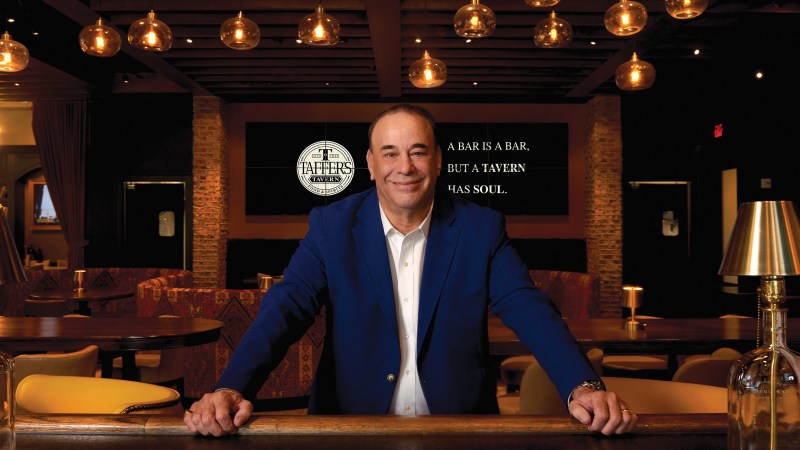
“A bar is a bar, but a tavern has soul.” It creates a perception. Now you’re saying to yourself, “Boy, I’m curious, what does he mean by that?” And there’s only one way you satisfy that curiosity, right?
The franchisor would do all this marketing, correct? Does the franchisee have a role in marketing too?
Typically, the store is responsible for what we call local store marketing, or LSM. And you, as the franchisee, are responsible for your local store marketing.
So as an experienced consultant, I’m going to tell you, “Jason, I want you to put all that money within about four or five blocks of your store. Own that neighborhood, ’cause the fact of the matter is, 80% of your business is going to come from four or five blocks away. It’s not going to come from the other side of town.”
I, as the franchisor, am not going to put flyers in the mailboxes of your neighborhood. But I’ll give you a lot of suggested local marketing programs and teach you how to do local store marketing. We do things like taking a couple of servers, and for 10 hours a week, they’ll be out in the marketplace. They might be just stopping into stores, developing promotional relationships. Sometimes we do food drops. You know, Hooters was famous for that. They’d send five Hooters girls over and do a wing drop with 300 wings in an office building.
That must have worked well.
It’s amazing what happens when you ask people to come to your business. Walking in and asking them to come to your business creates surprising results.
I like to give my employees business cards. And I like them to be proud of where they work. Because if they’re proud to work for Jon Taffer’s bar and they love our food, and they would invite their mother to Taffer’s Tavern for their birthday, then they are now ambassadors for my business, aren’t they?
What new things are you seeing in franchising today?
The restaurant space has smaller models. Taffer’s Tavern started as a 5,000- to 6,000-square-foot franchise, and is now 2,500 square feet. So the sales per square foot is, like, 40% higher, and the return is much greater. It’s easier to operate. Our Orlando restaurant doesn’t open for weekday lunch now; we open at 4 pm, which creates no second shift during the day.
I believe that any business that’s open seven days a week can probably do the same revenue six days a week. Just look at the business model and see for yourself. Where are those stress points? Where are those opportunities?
So it’s a question of: “How is consumer behavior shifting, and how can we take the most advantage of that?”
Yeah. And in today’s world of delivery, it’s amazing how many companies send me boxes with no promotional materials. In my restaurants, even when we mail checks out, there’s a promotional piece in that envelope, like a coupon.
That’s also a great opportunity for personalization. It matters.
When I was running my Hooters, I would have my servers write their name on a beverage napkin and put it in the middle of the table. “Hi, my name’s Kathy.” Their tips went up 8%. Because it created connectivity. Just like it personalizes the experience. I’m not a server, I’m Kathy.
And now you’ll remember her name, which means a customer feels more invested in her.
Yeah. The team loved tracking the tips. It was a great experiment together, and I bet a lot of them still do it to this day. Personalizing something and creating that connectivity — that’s how you create customers forever.
If someone’s been reading this, and is now inspired to go buy a franchise, what should their first step be?
Well, it costs nothing to do research. I would reach out to one of these franchise companies and ask them the questions that we talked about. Either you’ll start to feel warm and fuzzy about it, or maybe fears will grow. But you’ve got to stick your toe in the water.
It’s completely free to talk. They’re happy to spend time with you. And don’t feel guilty about it; they talk to many prospects that don’t buy. Just see how it feels to go through that process and to understand what they do. I’m going to guess that a good franchisor will make you feel comfortable with what they provide, what their support is, and help you mitigate that risk in your own mind.
Bring that process to life a little more. Let’s say someone calls Taffer’s Tavern to explore franchising. What happens?
We send you our FDD [Franchise Disclosure Document]. And then we talk to you two to three weeks later. We like to send our prospective franchisees to one of the stores in Georgia. We have you go spend the day in the store, spend time with the franchisee, ask him how he feels about it. I’m not in the room. We’re not monitoring anything. Go talk to the employees, see the customers, spend a whole day with the franchisee.
That’s a great thing for you to do as well, if you’re thinking about doing a franchise. Go to the restaurant first, even before you contact the franchise company. Talk to the owners. They’d love to see you be a franchisee too. Remember, every additional franchise puts more money in the marketing fund, so every franchisee wants to see more franchisees.
