XPANCEO Begins Ground Testing for AR Smart Contact Lens Ahead of Potential Space Trials The effort is being carried out in collaboration with the Mohammed Bin Rashid Space Centre (MBRSC).
You're reading Entrepreneur Middle East, an international franchise of Entrepreneur Media.

XPANCEO has initiated a multi-stage testing program for its augmented reality (AR) smart contact lens, marking a significant step toward developing the first wearable smart lens intended for use in space. The effort is being carried out in collaboration with the Mohammed Bin Rashid Space Centre (MBRSC).
The program includes laboratory validation, ground-based simulations, and, pending results, potential in-orbit testing. The prototypes feature AR image display capabilities and built-in biomedical sensors designed to monitor indicators such as intraocular pressure, glucose, vitamin levels, and lactate. In orbit, the lens is expected to integrate with space suit systems to receive power, transmit visual data, and collect health metrics, while displaying information directly in an astronaut's field of view.
XPANCEO and MBRSC will jointly determine the technical and operational requirements for the device before any spaceflight. Ground tests at MBRSC will replicate mission conditions—including low humidity, elevated oxygen levels, and enclosed environments—to assess performance and safety. The program will also include parabolic flights that simulate microgravity, along with lab studies involving biocompatibility assessments and supervised in-eye evaluations.
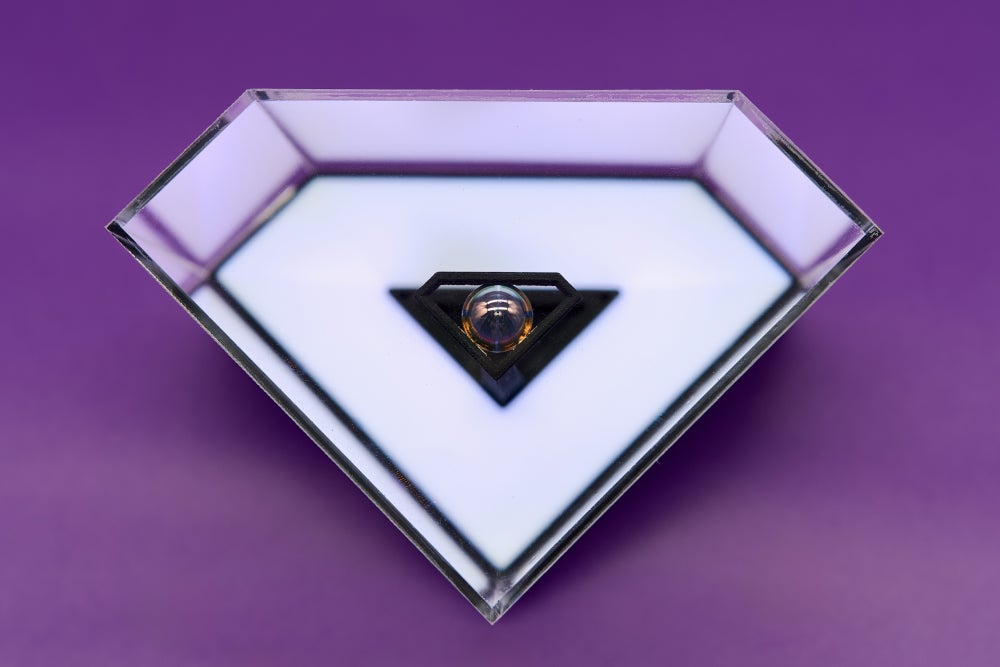
If parabolic and ground tests confirm the lens's reliability under space-like conditions, the partners plan to advance the technology for consideration in future in-orbit validation missions.
"A smart contact lens is not just a tool — it's the next generation of computing, and space is the ultimate testing ground," said XPANCEO Founder Roman Axelrod. "This mission brings us closer to a future where humans interact with information seamlessly, without screens or devices in their hands — something essential not only for life on Earth, but for missions to the Moon and Mars."
Dr. Valentyn Volkov, XPANCEO co-founder and CTO, added, "In space today, astronauts still receive voice instructions like 'take the third wire from the left,' or use tablets they control with their noses because of their bulky gloves. Our lens changes that: it puts critical data directly in front of their eyes with AR features, improving accuracy, speed, and safety. Combined with real-time health monitoring, it addresses real challenges, like vision issues that affect over 70% of astronauts on long missions, while laying the foundation for a new era of computing."
In parallel, XPANCEO will analyze how its advanced materials—including quasi-2D metals and Van der Waals heterostructures—perform in microgravity and radiation. These ultra-thin, semi-transparent materials are essential to enabling compact, high-performance systems inside a contact lens, and may hold potential for other space technologies such as solar sails and next-generation communication systems.
By advancing smart contact lenses through space-readiness testing, XPANCEO aims to demonstrate their potential for astronaut safety and operational efficiency, while laying the groundwork for wider applications on Earth.