
Tools as Teammates: How AI Agents Are Reshaping Digital Workspaces The first wave of workplace AI was simply prompt and response. You asked a question, the AI responds.
Opinions expressed by Entrepreneur contributors are their own.
You're reading Entrepreneur India, an international franchise of Entrepreneur Media.

Remote workspaces without a physical address are the new norm now. We use Slack for comms, Notion for knowledge, Google Workspace for collabs, Linear for projects, time trackers for accountability and these workflows exist entirely in software.
So how is a workspace different from an office? It's a digital system. Offices have become just an arm of the larger workspace ecosystem.
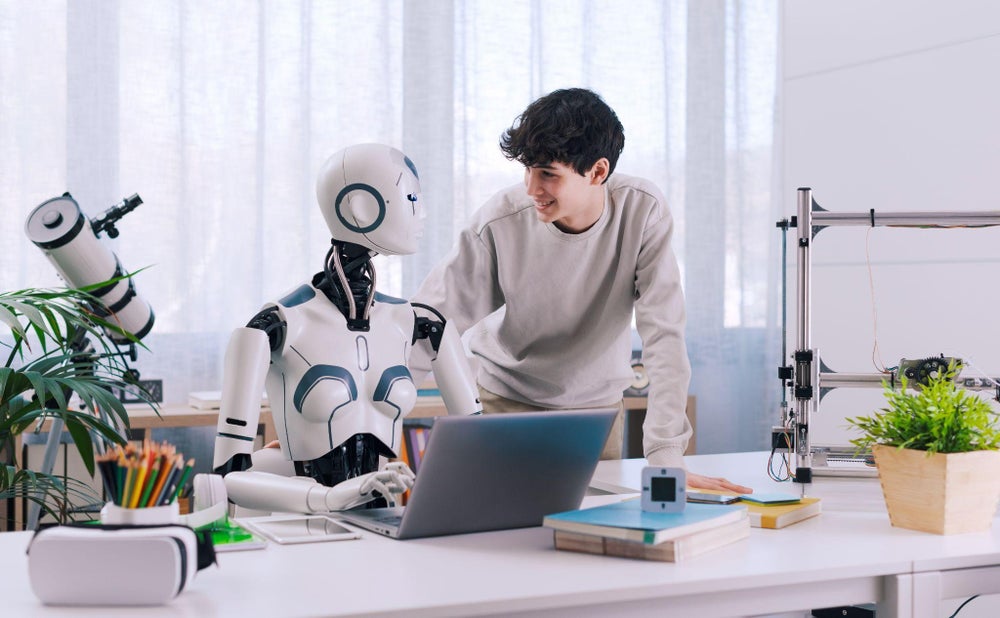
Now non-human AI agents have entered the chat.
They help real employees. They respond, initiate, and act just like humans.
How tools became our teammates
The first wave of workplace AI was simply prompt and response. You asked a question, the AI responds.
Now, AI agents can join Slack, Microsoft Teams, internal chats and be part of the conversation.
They also initiate and act first.
Gartner predicts that 40% of enterprise applications will include integrated task-specific AI agents by the end of 2026, up from less than 5% in 2025. IDC projects 1.3 billion AI agents in enterprise environments by 2028.
Slack declared itself an "agentic operating system" in late 2025, opening its conversational data to agents built by Anthropic, Google, and Perplexity.
Microsoft's Facilitator agent in Teams takes meeting notes, tracks decisions, nudges quieter participants, and converts discussions into assigned tasks — all without being asked.
An Agent in SharePoint organizes files, applies tags, and stitches together related content across channels in the background.
The workspace is now a shared environment where humans and agents coexist.
WebWork, a time tracking and workforce management platform developed its first AI capabilities in 2024, launched conversational queries and productivity insights in early 2025, and added automated behavioral analysis and performance categorization by mid-year.
By early 2026, WebWork's capabilities became agentic — the AI agent creates tasks, generates summaries, and sends proactive alerts without being asked.
WebWork AI integrates directly into the communication layer — Slack, Microsoft Teams, or WebWork's own Team Chat, where managers message their team and employees already work.
It surfaces performance insights before anyone tasks. It flags burnout risk before the manager notices. It answers workforce questions in plain language without the need for opening a single report.
Where it gets interesting
The big platform players are building agents that work across any industry, team, or use case.
Traditionally, understanding how a team is performing means pulling reports, cross-referencing timesheets, checking project boards, and hoping the data tells a coherent story. A manager might spend their Monday morning piecing together what happened last week before they can plan the next one.
Meanwhile, WebWork introduced an AI agent that crosses the line from assistant to agent.
It lives directly inside the workspace and analyzes activity patterns, app usage, and project progress. Then it surfaces who's overloaded, who has capacity, where a project is falling behind schedule, or whether attendance patterns suggest someone is burning out.
The agent speaks and acts first — flagging an irregularity, sending a workload alert, or generating a summary before the standup starts. It even handles reminding a channel about an upcoming holiday or sending a birthday message.
WebWork AI lives where the team already works—in daily conversation, contributing insights like a sharp operations-lead would, except it never sleeps, never forgets, and never needs to be caught up.
What this means for managers
When an AI agent handles daily check-ins, time reviews, workload distribution, status updates — the manager can focus on strategy, team development, resource allocation, and creative leaps.
Gartner says by 2026, 20% of organizations will use AI to flatten their organizational structures, eliminating more than half of current middle management positions. Whether that number lands or not, the direction is clear. The manager who spends their day compiling reports and chasing updates is being replaced by a manager who designs systems rather than polices them.
Vahagn Sargsyan, WebWork's founder and author of Builder's Time, has framed time as a system to be designed rather than a metric to be tracked. His research found that many talented developers spend only about 30% of their time actually building, while the rest disappears into systemic inefficiencies.
This is the philosophy that shapes how WebWork's AI operates: it interprets patterns and acts on them, rather than simply counting hours.
The managers who will thrive in this new environment are the ones who learn to design systems rather than micromanage outputs — who treat AI agents as team members with specific strengths and clear boundaries, not as surveillance tools or magic solutions.
The new normal and the hard questions
If an AI agent flags an employee as at risk of burnout, who is responsible for acting on that? When 15% of daily work decisions are made by agents — as Gartner projects by 2028 — what does accountability look like? Gartner also predicts that by 2028, 40% of large enterprises will deploy AI to measure employee mood and behaviors.
If your company runs on a digital workspace, expect it to feel different soon. While the tools remain the same, the occupants have changed. Your team and their AI agents now share the same space, the same channels, and the same daily rhythm.
The question is whether you'll design for the reality of people and AI agents working together— or simply let it happen on its own.


