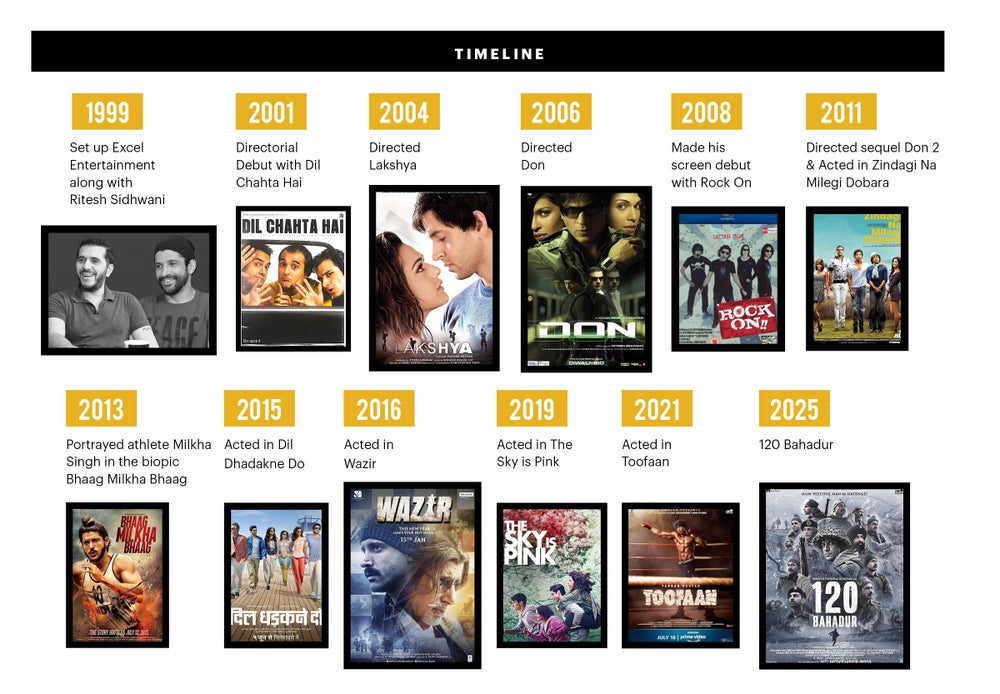
The Maverick Mind: Farhan Akhtar From redefining friendship in Dil Chahta Hai to embodying grit in Bhaag Milkha Bhaag and purpose in Lakshya, Farhan Akhtar thrives by pairing creativity with discipline and unwavering clarity.
This story appears in the October 2025 issue of Entrepreneur India. Subscribe »
You're reading Entrepreneur India, an international franchise of Entrepreneur Media.

Actor–director–producer–musician Farhan Akhtar has spent nearly 25 years shape-shifting across Indian entertainment. His playbook for staying relevant is surprisingly simple: protect your voice, bet on discipline over passion, and build teams that share the mission.
Meeting Farhan Akhtar is meeting a man with a mission. A disciplined, focused soul, who knows what he is looking for. I realized not just after meeting him but after witnessing his movies, he's a director's actor while also being a director who knows what to get out of his actors.
A Bhaag Milkha Bhaag or a Dil Chahta Hai might be two movies for two different sets of audiences but made while keeping the right set of audience in mind. A man of purpose, his clarity of thought is what amazes you while talking to him. You might be enthused by his simplicity or overwhelmed by his body of work, his clarity of thought and his multi hyphenate personality is what leaves a charm.
At 51, Farhan lives by fitness as his mantra and entertainment as his power whether through acting, directing or singing. Being born in a family which is rooted in films, the love for cinema came naturally to him. "I knew this was the world I wanted to belong to," says the actor, director, writer, producer and singer. He knew success has to be repeated every time for the audience to keep applauding you. For him, creativity without discipline is useless.
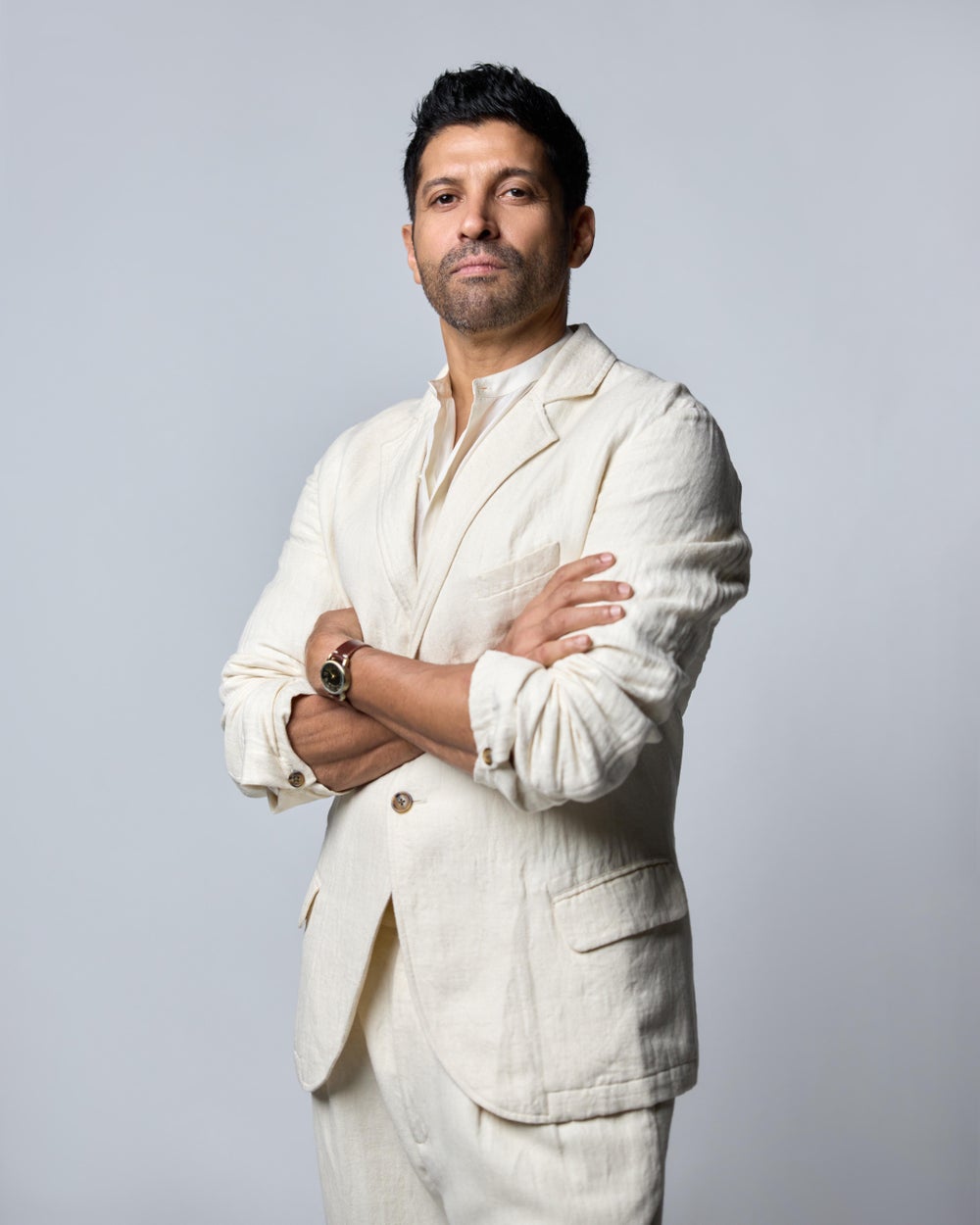 His experience outside films drives his creativity the most, its these everyday experiences of traveling, reading, listening to music, spending time with family and friends opens up a new world. The support I can give in so many lives drives the change. To be challenged as producers and storytellers is good for the business, says Akhtar, the man who has stayed relevant in cinema for the last 24 years.
The Nutgraf
Farhan Akhtar's career looks like a highlight reel of contradictions: performer and producer, mainstream draw and creative risk-taker. The common thread, he says, is ruthless discipline and an allergy to imitation. "Creativity and passion without discipline is useless," he tells me. "It's the one who digs in deep and does the work, every day, who has the edge." That mindset powers everything—from how he chooses stories at Excel Entertainment to how he manages the art–commerce tension in a business where no one can truly predict the box office.
The Multi-Hyphenate, Without the Hype
Ask Akhtar to pick a favorite role and he pushes back. "Oh God, that's very difficult," he laughs. "I enjoy engaging with people through music and through film… performing music live feels the most liberating of all." The point isn't to rank the hats he wears; it's to stay connected to audiences across formats, whether on stage or on screen.
 Inherited Values, Self-Chosen Standards
Raised in a family steeped in cinema and the arts, Akhtar says the lesson that stuck was gratitude—and guardianship of one's voice. "Remind yourself what it is about the work that you loved enough to get into it… and remain true to the voice you have as a creator." With choice comes responsibility: "It's a blessed place to be in; it can't be taken for granted."
Akhtar refuses to live inside a film-industry bubble. He reads widely, travels, and talks to people outside his world. Reading, he says, is a superpower for makers: "If you and I read the same book, we'll have two completely different visuals… what more can a creative person ask for than to be challenged to use their mind all the time?"
Feeding the Creative Engine
For Akhtar, alignment precedes execution. "The first task is to work with people who believe in the project as much as you do—who see more than a job." After that, clarity becomes a leadership duty: "You have to have answers for every question that comes your way. That's primarily the job." His long partnership at Excel runs on mutual trust and positive influence across life, not just filmmaking.
 Art vs. Commerce—Managing the Product–Market Fit of Stories
"There's no perfect balance," Akhtar says of creativity and commercial pressure. "Filmmaking is a risky prospect." The producer's job is to preserve the storyteller's voice while minimizing risk "through system, method, and sometimes jugaad." Pre-sales can hedge, but theatrical performance is the ultimate variable—and impossible to predict. His rule of thumb: "If I have to fail or succeed, I'd rather it be on something I believed in than be a bad copy of someone else."
The Lakshya Lesson—Redefining ROI
Shooting Lakshya in Ladakh for five months was a crucible: weather, logistics, low connectivity. The bigger lesson came years later at the Indian Military Academy, when a majority of cadets credited the film with nudging them toward service. "It gave me a whole new perspective on success," Akhtar says. "Not everything meaningful shows up in box-office numbers."