
India-EU FTA Bets On AI, Quantum, and Advanced Semiconductors Touted as the 'Mother of all Deals', India-EU Free Trade Agreement also deepens technological cooperation, including joint initiatives, and investment in critical emerging technologies.
By Kul Bhushan
Opinions expressed by Entrepreneur contributors are their own.
You're reading Entrepreneur India, an international franchise of Entrepreneur Media.

'Mother of all deals.' India and the European Union (EU) have entered into a free trade agreement (FTA) after years of negotiations at the 16th India-EU summit. The trade agreement is indeed historic in many ways - first the it brings an unprecedented market access as India and the EU both are huge economies and second that it comes at a time of geopolitical uncertainty. The agreement brings the two markets much closer through tariff liberalisation, market access, and also sets a strong foundation for technological cooperation.
Before we hold forth, let's go through some key things about the India-EU FTA.
- The EU is India's one of the largest trading partners, with bilateral trade in goods and services growing steadily over the years.
In 2024–25, India's bilateral trade in goods with the EU stood at INR 11.5 Lakh Crore (USD 136.54 billion) with exports worth INR 6.4 Lakh Crore (USD 75.85 billion) and imports amounting to INR 5.1 Lakh Crore (USD 60.68 billion).
India-EU trade in services reached INR 7.2 Lakh Crore (USD 83.10 billion) in 2024.
- India and the EU are 4th and 2nd largest economies, comprising 25% of Global GDP and account for one third of global trade. Integration of the two large diverse and complementary economies will create unprecedented trade and investment opportunities.
- India has gained preferential access to the European markets across 97% of tariff lines, covering 99.5% of trade value, while India is offering 92.1% of its tariff lines which covers 97.5% of the EU exports
You can learn more about these partnerships in depth here.
Experts believe that the deal could be extremely beneficial for the Indian economy.
"The India–EU FTA arrives at a pivotal moment marked by global trade fragmentation, rising protectionism, US–India trade frictions, and elevated geopolitical uncertainty. The agreement could serve as an effective counter-cyclical buffer by deepening India's integration into global value chains, expanding market access, and supporting supply-chain diversification. With the EU accounting for ~17% of India's goods exports, we estimate that closer bilateral alignment could lift India's exports to the EU by ~USD 50 billion by 2031," Trideep Bhattacharya President and CIO Equities Edelweiss MF said.
Technology In Focus
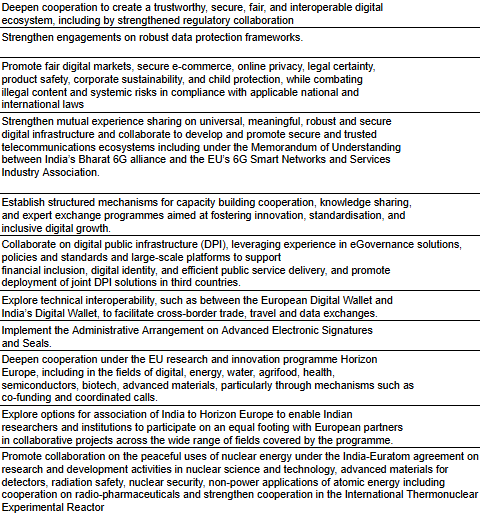
As mentioned above, the FTA sets a strong foundation for technological cooperation in several key areas. In what may be seen as an attempt to shed dependence on China, the agreement focuses on collaboration along semiconductor value chains, research partnerships in emerging tech sectors, and areas like data governance and artificial intelligence.
Initiatives like the Trade and Technology Council (TTC) will serve as a central platform for cooperation between India and the EU on critical and emerging technologies, digital governance, green technologies, and resilient supply chains.
Having said that, as per the FTA the two sides have agreed to promote collaborative research focused on artificial intelligence (AI), quantum, advanced semiconductors, clean tech and biotech.
There will be new India-EU Innovation Hubs which aims to provide support for dialogue, knowledge exchange, and joint projects in critical emerging technologies, by bringing together policymakers, industry leaders, startups, investors, as well as civil society experts to identify shared priorities and catalyse innovation.
The two sides will work on advancing promising technologies from early-stage collaboration to promote industrial deployment and accelerate private-sector engagement. For new and old entrepreneurs, the India-EU startup partnership in collaboration with the European Innovation Council will see several segments, Start-up India, and Member States, to push for cross-border investment, co-creation, and deep-tech scale-ups between European and Indian SMEs, incubators and start-ups.
There is also an agreement on cooperation on research and development, reciprocal talent exchanges, and technological development of advanced semiconductors, focusing on design and prototyping for AI applications, leveraging inter alia Indian design strengths and EU research infrastructures. The two sides will work on AI domains, including large language models, multilingual natural language processing datasets, AI training datasets, and AI solutions for public goods such as healthcare, agriculture, and climate action. The AI cooperation will also focus on building sustainable, human-centric AI, including by strengthening collaboration between the European AI Office and India's National AI Mission and India AI Safety Institute to expand AI safety, testing, and evaluation.
Here are some other highlights from the FTA:
"...The agreement fosters deeper EU-India ties in technology, innovation, and digital areas (building on the India-EU Trade and Technology Council). This could lead to more EU investment in India's IT ecosystem, joint ventures, R&D in AI, semiconductors, cleantech, and startups. Indian IT companies could benefit from technology transfer, cocreation, and expanded partnerships…," said Nasscom in a statement on the India-EU FTA.
"By boosting bilateral trade and economic ties, the deal supports job creation, MSME growth in tech, and overall confidence for investors in India's services sector. The FTA includes dedicated SME chapters with contact points and digital platforms. Given the geopolitical challenges, the FTA diversifies markets for Indian IT exporters, providing a hedge against global trade uncertainties. It strengthens India's position in global value chains for digital services," it added.
Speaking to Entrepreneur India, senior geopolitical analyst at the Future Shift Labs, Sunanda R. Marak, said that the successful conclusion of the India-EU Free Trade Agreement after nearly two decades of long-drawn negotiation represents a structural realignment of not only economic but strategic interests as well. The agreement emerges at a cusp of heightened Trump-induced systemic uncertainty, scepticism towards globalisation and weaponisation of the supply chain.
From India's vantage point, the agreement's preferential access to the EU's high-income market strengthens India's manufacturing and services competitiveness and eases technology inflows. It aligns with domestic industrial policies, export-led growth, and integration into the global value chain. For the EU, the FTA directly complements its de-risking and diversification strategy, primarily in response to an increasing trade deficit with China and Trump's unilateral approach, she said.
"Therefore, enhanced market access to demographically large, developing India reduces European overexposure to single-country risks while opening opportunities for EU firms. Thus, this FTA offers a win-win situation for both economies and truly justifies its description as the "Mother of all Deals," she added.


