
SaaSpocalypse: Anthropic's New Plugins Send IT Stocks In A Tizzy But is the Panic Overblown? Anthropic's new Claude Cowork plugins have caused a 'SaaSpocalypse' panic among IT and SaaS firms but experts say the fear may be premature.
By Kul Bhushan
Opinions expressed by Entrepreneur contributors are their own.
You're reading Entrepreneur India, an international franchise of Entrepreneur Media.

'SaaSpocalypse'! That is how Anthropic's new plugins for Claude Cowork are being deemed by conventional IT and SaaS firms. The substantial loss in market capitalization, reportedly totaling USD 285 billion, further fuels the panic. This impact was seen globally and in India, affecting numerous companies, including Infosys, Tata Consultancy Services, HCLTech, Tech Mahindra, and Wipro.
Ever since AI firms started getting traction in the enterprise space, it was widely speculated that these firms, with more enhanced capabilities, would at some point train their guns at conventional SaaS firms. In simpler words, AI firms are trying to offer everything under the sun that typically has been bread and butter for SaaS firms. And India, which is a massive SaaS hub, is likely to be impacted.
What did Anthropic actually launch?
Anthropic offers Claude, essentially a suite of conversational large language models (LLMs) and a chatbot, which can perform several tasks such as reasoning, analysis, coding, and content generation. Late last month, Anthropic introduced 11 new plugins which enables Claude to become more tailored for specific teams or organisations.
Essentially, the beefed up version can now be deployed towards "any use case, but they're especially powerful for tailoring Claude to specific job functions like sales, legal, and financial analysis," according to Anthropic.
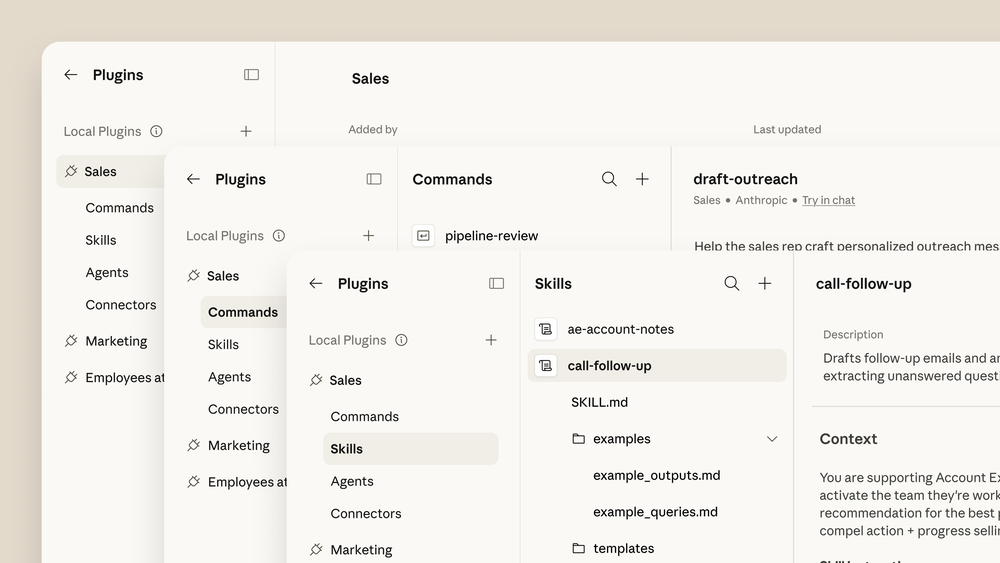
Image courtesy: Anthropic
"As your team builds and shares plugins, Claude becomes a cross-functional expert. The rich context you share gets baked into every relevant interaction, so leaders and admins can spend less time enforcing processes and more time improving them," it further explains on its website.
AI vs SaaS
Soon after the roll-out of these plugins, a panic set in among the conventional software service providers.
"The fear with AI is that there's more competition, more pricing pressure, and that their competitive moats have gotten shallower, meaning they could be easier to replace with AI," Thomas Shipp, head of equity research at LPL Financial is quoted as saying by Bloomberg.
"The range of outcomes for their growth has gotten wider, which means it's harder to assign fair valuations or see what looks cheap."
The report also noted the global impact of the availability of improved AI tools from Anthropic as well as Google.
Fear too soon?
Are the calls for an apocalyptic-like situation for software companies too premature? Here's what Nasscom has said in its latest statement:
AI models and tools continue to drive exponential innovation and rapid adoption. The recently released Claude Cowork tool aims to automate work across functions such as legal, sales, marketing, and data analysis.
However, concerns that such tools will significantly disrupt or eliminate the technology services sector where India has a strong global presence are misplaced. Indian technology services companies work closely with global enterprises that operate complex technology environments, with interconnected systems and fragmented data.
Creating real business value from AI requires careful coordination, with humans in the loop who understand business context, industry knowledge, and enterprise workflows.
AI is unlikely to be adopted as a simple "out-of-the-box" solution in large enterprises.
Technology services companies have already accelerated their data and AI capabilities by investing in platforms, building partnerships with AI companies and hyperscalers, upskilling talent, and leveraging mergers and acquisitions. With AI, new opportunities are emerging in areas such as legacy modernization, AI-ready data foundations, and the use of intelligent agents across business and enterprise functions.
As enterprise AI adoption moves from experimentation to large-scale deployment, technology services companies will play a critical role in enabling this transition. Their deep understanding of enterprise systems and processes positions them well to orchestrate evolving technology stacks, build customized solutions aligned to business workflows, and drive measurable returns on AI investments.
AI adoption will follow different paths across different types of enterprises, and the technology services sector is actively reinventing itself to stay ahead of these changes.
ALSO READ: AI vs SaaS: Potential Impact of Freemium Model
Interestingly, Cognizant CEO Ravi Kumar too came out to dispel panic around the new AI developments.
"A tool or a technology would be plugged into an enterprise landscape, and magically, there will be output coming out of it. If that's the case, why hasn't that value drifted into enterprises over the last three years (since OpenAI launched ChatGPT). The reality is that the value is actually still sitting with infrastructure and not drifting to enterprises," Moneycontrol quotes Kumar as saying.
According to 3Cubed founder and CEO Shammik Gupta, Claude Cowork is a powerful tool. It makes research, analysis and drafting simpler. But work in a company is more than drafting and summaries. It is the process (deciding what to do), coordinating and influencing (people), and owning the outcome (governance). Work remains intact. It gets faster, leaner, and priced on outcomes instead of hours. Work in an organisation will continue to be people, process and technology wrapped in governance. Technology taking over and surpassing any of these, is hype.
"It is mostly hype at the moment. Real disruption will take time. AI can kill junior grunt work like analysis, reports, slideware. But, it cannot take up accountability, integration, risk ownership, change management. Claude doesn't sign MSA's," he told Entrepreneur India.
Ajay Setia, Founder and CEO, Invincible Ocean tells Entrepreneur India that in the near term, companies like Infosys and TCS are not facing an existential threat from tools like Claude Cowork. They continue to have long-standing client relationships, large delivery teams, and enterprise-scale responsibilities that cannot be replaced end-to-end by AI today.
"Over the longer term, however, the impact will be meaningful. As enterprises use AI to complete certain tasks more efficiently, there will likely be pressure on traditional pricing and margin structures, particularly those built on time-and-effort billing. There will also be a gradual shift in skill requirements. Teams will spend less time on repetitive coding or standard analysis, and more time on managing AI systems, validating outputs, ensuring compliance, and addressing complex problems that require human judgment.
At the same time, this transition creates new opportunities," Setia said.
"Large IT firms can increasingly position themselves as AI integration and governance partners, helping enterprises deploy AI responsibly, securely, and at scale.Overall, this is not an extinction event for IT services, but a transition in how value is delivered," he added.
Having said that, even as AI enhancement may not be an immediate threat to SaaS firms and software companies in general, experts advise that firms must shift from people leverage to outcome leverage.
As explained in one of our previous deep dives on AI vs SaaS, AI in all likelihood will reshape the conventional SaaS model or see some sort of a hybrid model.


