
The Lessons Between Life and Leadership: Rob Salter's The Action Gap
You're reading Entrepreneur United Kingdom, an international franchise of Entrepreneur Media.

Purpose can often stem from the most challenging moments of life. When Rob Salter, founder of Saltant Ltd and author of the latest book The Action Gap, woke up in a hospital room, he could barely recognise his own body. A month had passed since he went to bed thinking he had food poisoning. "When I woke up, I was in an ICU bed, unable to walk, speak, or even feed myself," he recalls. A subarachnoid brain haemorrhage had nearly taken his life, a condition with a 75% fatality rate. Many survivors, he later learned, live with paralysis or severe disability.
"I woke up looking at the ceiling, confused, terrified, and utterly dependent on others," he recalls. "It was like starting life all over again, but with nothing familiar to hold onto."
 Source: Rob Salter
Salter's path to writing The Action Gap began long before his brush with death. As a business coach, he notes spending years working with leaders and CEOs who devoured books, seminars, and videos, yet failed to translate insight into meaningful action. "I realised many highly educated leaders had all this knowledge, but it wasn't changing anything in their businesses, or their lives," he says. "They knew the lessons but weren't acting on them. That gap, that space between insight and execution, was exactly what my book set out to address."
According to Salter, The Action Gap was intended as a concise, practical guide with 12 essential principles business leaders could implement immediately. Salter deliberately kept it short. He says, "I didn't want to create a book called The Action Gap, and then keep a three-week duration to get through the book. The point is to minimise the gap between learning and doing."
Salter's recovery, as he says, was painstaking, where months of physiotherapy, relearning basic motor skills, and rebuilding confidence followed. Yet he found that the principles he had spent years teaching to CEOs, resilience, decisiveness, and focus, were equally essential in his personal struggle.
But, he notes, the brain haemorrhage transformed the book entirely. Confined to bed, tubes, and constant care, Salter found himself reflecting not just on business but on survival. He shares, "Even in the hospital, I was asking myself: can these lessons help me recover? Can they help me rebuild my life?" He tested every chapter against his own ordeal, exploring what truly matters when even the simplest actions, walking, eating, talking, require monumental effort.
"I had to apply the very lessons I had written about, in the most extreme way possible," he says. "That gave me a profound perspective that fundamentally changed how I told the story in the book." It encouraged him to draft chapters that intertwined business principles with real-life recovery lessons.
One chapter, Good from Bad, examines finding opportunity in adversity, a mindset Salter cultivated during his rehabilitation. "When unfortunate things happen, you can't change the past," he says. "You can only respond, starting with asking yourself, 'What can I do about it?' That mindset saved me."
Furthermore, Salter notes another chapter titled Nothing Is Something, highlighting the paradox of inaction. "Deciding not to act is still a decision," Salter notes. "The book is indeed aimed at encouraging people to get up and do something, even if that something is the choice to do nothing."
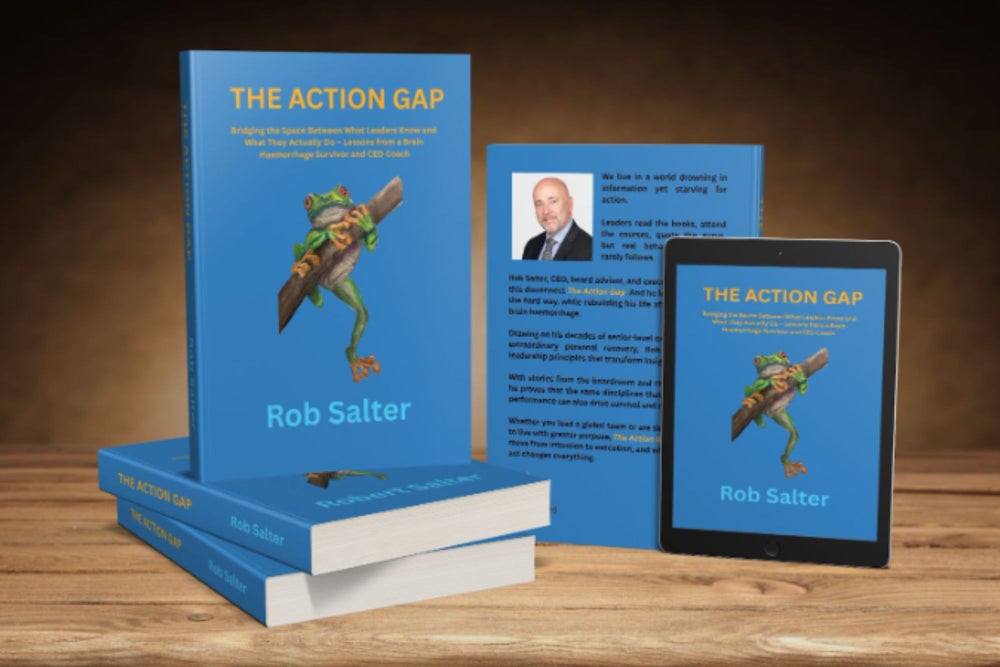
Salter emphasises that even the book's cover tells a story. A frog clinging to a branch represents a vision Salter had during a coma dream, a tiny creature assuring him he would survive. "It felt like a message to hold on," he explains. "My friend drew the frog as soon as she heard the story, and I knew at that moment that it would become the emblem for the book, a symbol of perseverance through the impossible."
With the book released less than a month ago, Rob Salter hopes readers can perceive The Action Gap as a call to action in life itself. From a near-death experience in a hospital bed to guiding leaders through the nuances of execution, the book is a way of turning survival into insight and insight into action. As he says, "If people and leaders take even one lesson from the book and act on it, that is already a meaningful impact."


