
Building New Tables The Aurora Tech Award drives capital, connections, and credibility for female entrepreneurs
Opinions expressed by Entrepreneur contributors are their own.
You're reading Entrepreneur United Kingdom, an international franchise of Entrepreneur Media.

When Isabella Ghassemi-Smith, Head of the Aurora Tech Award - an annual award built to back the 'boldest' female tech founders in emerging markets - reflects on her journey into female entrepreneurship, she frames it not as a career pivot, but as a reckoning. "The story started well before Aurora," she tells me. Her path began in London's venture start-up scene in 2019, moving from working within a company to evaluating opportunities as an investor. It was there, amid pipeline reviews and pitch decks, that she first confronted the stark reality of the gender gap in venture funding.

"Exceptional women were building incredible companies," she says, "but very few made it through to investment." This realisation sparked a question that would define her next steps: if she was to stay in this industry, what did she want to achieve? The answer, she discovered, was to help build infrastructure for women founders - though the blueprint for what that looked like took time to crystallise. By the time she encountered Aurora, a global award that identifies and elevates standout female tech founders across emerging markets, Ghassemi-Smith recognised both the scale of the problem and the extraordinary opportunity. The Award operates on a principle she articulates simply: if the table isn't built for you, build a new table. In practical terms, that meant backing women founders from emerging markets, often overlooked by traditional investors. They are building companies in fintech, medtech, edtech, agritech and other sectors, impacting society in a positive way.
Beyond the real-world problems these startups are tackling, they are also delivering commercially compelling results. Women-led companies, Ghassemi-Smith notes, often deliver 63% higher ROI than their male counterparts, according to research by the Boston Consulting Group. For her, this was not merely an argument for equity, but an arithmetic one: supporting women founders is not just right; it is financially compelling.
The structural gaps
Despite the obvious talent and market potential, women founders still face structural barriers in securing funding. Globally, women receive just over 2% of venture capital. In Africa, over 75% of all capital goes to male-led start-ups, with mixed-gender teams receiving around 10%. Yet, Africa has the highest proportion of female entrepreneurs worldwide, with over a quarter of businesses founded by women. The conclusion is stark: pipeline is not the problem; systemic bias and structural barriers are.
"One of the key issues is that women experience the world differently to men," Ghassemi-Smith explains. "They build solutions to problems they know deeply, which are often overlooked by male investors." These include innovations in healthcare for menopause or endometriosis, or fintech solutions tailored to underserved communities. Yet, despite the market potential, male-dominated investor boards often struggle to evaluate these opportunities through an informed lens.
Gender bias compounds the challenge. In India, for instance, a strong ecosystem for female founders exists, but structural prejudice persists. Women are asked, "How will you defend against risk?" whereas men are asked, "How big can this become?" Even highly profitable ventures can falter in attracting institutional capital. This leads to a "series A cliff" in emerging and frontier markets: women founders struggle to secure their first significant institutional check, despite strong early-stage traction. Once that hurdle is overcome, female-led businesses often thrive, demonstrating sustainability and resilience far exceeding male counterparts.
Changing investor behaviour
If there were one thing investors could change tomorrow to improve access to capital for women, Ghassemi-Smith argues, it would be this: evaluate women on potential, not past performance. "Women are often judged on proof, men on promise," she says. Shifting this lens would unlock immense untapped opportunity, particularly in sectors where women are already delivering market-leading solutions.
Expanding who is considered investable is equally vital. Many women founders are simultaneously raising funds and raising children - a factor that can translate into remarkable efficiency and decision-making clarity. Yet, traditional investor assumptions frequently misinterpret these circumstances as risk factors, rather than assets. Networking also plays a critical role. Warm introductions and historical patterns dominate venture decision-making, which disadvantages women operating outside traditional networks. In emerging markets, this barrier is pronounced: "I can pitch anywhere. I just can't get the introduction," one founder remarked.
Technical talent presents another structural challenge. With lower average funding, female founders often struggle to attract software engineers or technical co-founders. Even mentorship, when offered without context, can be insufficient. Founders from emerging and frontier markets need experts who understand the nuances of building businesses in Pakistan, Nigeria, India, or Colombia, not Silicon Valley templates.
The Aurora approach
Aurora was originally launched in 2021 by inDrive – a fairness-driven mobility and daily services platform, which scaled from an underdog startup in a remote corner of the globe to become the world's second-most downloaded app in ride-hailing. The award addresses the structural gaps, aiming to level the playing field for women founders through a tripartite model: capital, connections, and community.
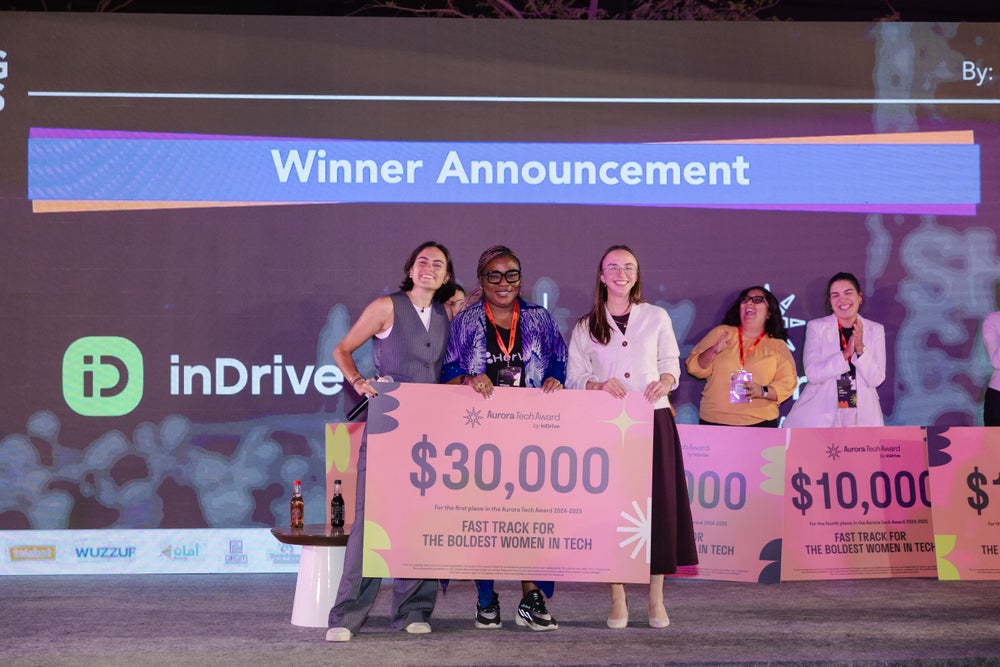
Capital: Winners receive up to $50,000 in non-dilutive funding. This year, the prize money is $50,000 for first place, $30,000 for second place, and $20,000 for third place. More importantly, Aurora serves as a de-risking mechanism for downstream investors, leveraging a rigorous, data-driven selection process, and builds confidence in female founders. Over 3,400 applications poured in from 127 countries this year - a 68% increase from the previous year - illustrating both the scale and quality of the emerging talent pool.
Connections: Aurora creates curated networks of regional experts and industry leaders. "If a founder needs a technical expert in Egypt or access to retailers in Colombia, we connect them," says Ghassemi-Smith. This builds pathways to market expansion and operational support that are otherwise closed to many women founders.
Community and Credibility: Visibility matters. Aurora is a social-first brand, boasting nearly 20,000 followers across platforms. The top 100 founders are showcased in global and regional media, gaining not only recognition but tangible business opportunities. One past winner, Shreya Prakash of Flexibees, credits Aurora with driving international referrals that catalysed geographic expansion. "Winning showed us we were globally competitive," she said, "and added credibility to every pitch."
Who stands out
At Aurora, the focus is rarely on the product alone. Instead, attention falls on the founder - their vision, their determination, and the problem they are determined to solve. What catches the judges' eye is not just market traction, but the capacity to create something from almost nothing, to build against the odds. Mercedes Bidart, the founder of Quipu, embodies this spirit. Born in Argentina and building her venture in Colombia, Bidart has taken on the challenge of extending financial inclusion to communities overlooked by traditional credit systems. She has scaled Quipu to touch more than 22,000 entrepreneurs, demonstrating that socially meaningful work and commercial success are not mutually exclusive - they can, in fact, flourish together.
Looking ahead
Aurora is not static. Its ambitions include expanding capital access through potential future funds, leveraging InDrive's wide-reaching network to connect founders with strategic opportunities, and bridging gaps between investors and female founders globally. Ghassemi-Smith envisions a system where the pipeline of women founders are treated not as an afterthought, but as a major untapped asset class. "Our message is clear: if the table isn't built for you, build a new table," she says. But the vision extends beyond women alone. True transformation, she argues, comes from collaboration across gendered and geographic boundaries, marrying capital with talent and visibility.
Aurora is creating a new ecosystem, one where structural barriers are addressed with purpose-built solutions, and where women can build, scale, and thrive without apology. In doing so, it is rewriting the rules of venture capital and demonstrating the immense potential of a long-overlooked segment of global entrepreneurship.
For women in emerging markets, the message is no longer conditional: with the right support, expertise, and visibility, they can compete on a global stage - and win. Ghassemi-Smith concludes with hope "We are at the beginning of an incredible decade of momentum when it comes to female entrepreneurship, and the solutions that women will have access to, because the pain points that we feel have been solved by someone who understands them. "
The Aurora Tech Award will announce the Top 100 on December 8, the Top 30 semifinalists on January 14, and the Top 10 finalists on February 16, followed by a mentorship program from February 23 to March 13, with the award ceremony taking place in the Spring of 2026.


