Measuring How Traders Decide: Sanghita Dey and the Case for Behavioral Data
A score nobody acts on is a report card, and advice with no measurement behind it is a newsletter.

Retail trading in emerging markets has never been easier to enter. In Brazil, for example, more than half of new equity investors arrived with 200 reais or less — about $40 — and nearly a quarter with 40 reais or less. Fractional entry, mobile execution and zero-commission structures have removed several barriers that once stood between a first-time participant and a live position.
What happens after they arrive is well documented and rarely discussed. Among Brazilian day traders who persisted past 300 sessions, 97% lost money and 1.1% earned more than the minimum wage.
Across 15 years of complete Taiwanese exchange records, fewer than 1% were predictably profitable after costs. And research tracking nine years of individual investor records found that much of what resembles learning-by-trading is attrition rather than improvement — the surviving population performs better largely because the weakest participants stop trading.
That last finding is the one Sanghita Dey keeps returning to. If experience by itself does not teach, then time in the market may not be a route to competence, and the industry’s implicit answer — that people will work it out.
Her argument is that this is a measurement failure before it is anything else. Trading systems record what a trader did and what it earned. They do not record how the decision was made — which means the single variable separating a skilled participant from an unskilled one may not be captured effectively.
Dey is the founder and CEO of Solus Finance, with more than 15 years across technology, financial services, artificial intelligence, and product innovation. She is a Forbes Business Council member and was named to Forbes 40 Under 40 Tech Leaders, Argentina, in 2025. Her work has converged on a single proposition: that how a trader decides is measurable, and that measuring it changes what a platform is able to do for them.
The data category that doesn’t exist yet
Dey set out the architecture publicly in 2026, writing for the Forbes Business Council. Finance, she argued, has been built on top successive categories of measurable data — market data, then credit data, then transaction data. Behavioral decision data constitutes the next such category, and it is the only one of the four that institutions struggle to capture. She built five measurable dimensions: risk posture, decision quality, capital management under pressure, execution discipline, and skill progression.
What distinguished the proposal was that she stated it as a set of falsifiable conditions rather than as claims. A trader behavioral score gives traders visibility into their own decision patterns — the kind of data that can support better strategy and more deliberate decisions over time.
The instrument
The behavioral model built at Solus Finance observes a trader across varying market conditions and scores them on four operating dimensions — risk behavior, decision quality, volatility response and discipline. It does not attempt to predict market direction. It evaluates the quality of a decision already made, scoring each trade against behavioral benchmarks: leverage used relative to leverage available, position size relative to account risk, and consistency of execution over time.
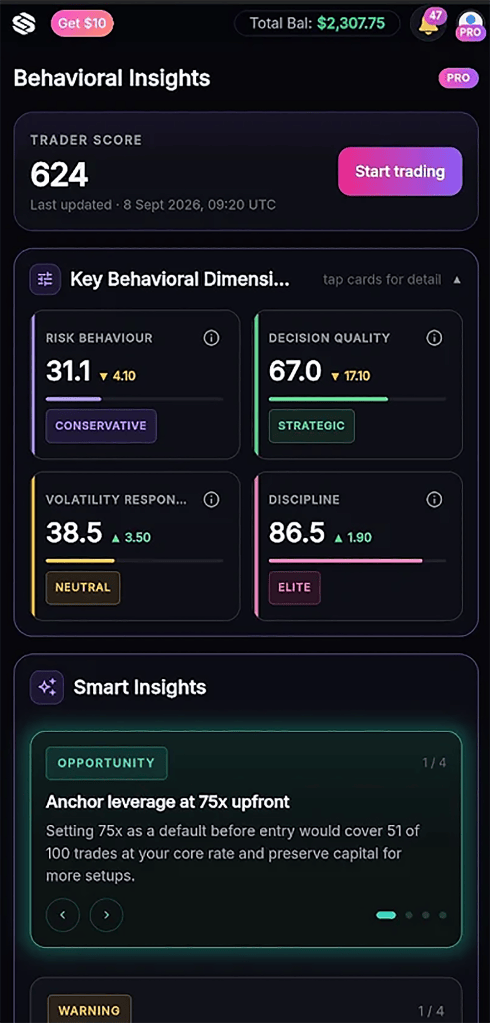
Solus 4-Dimension Behavioral Insights
Image Credit: Solus Finance
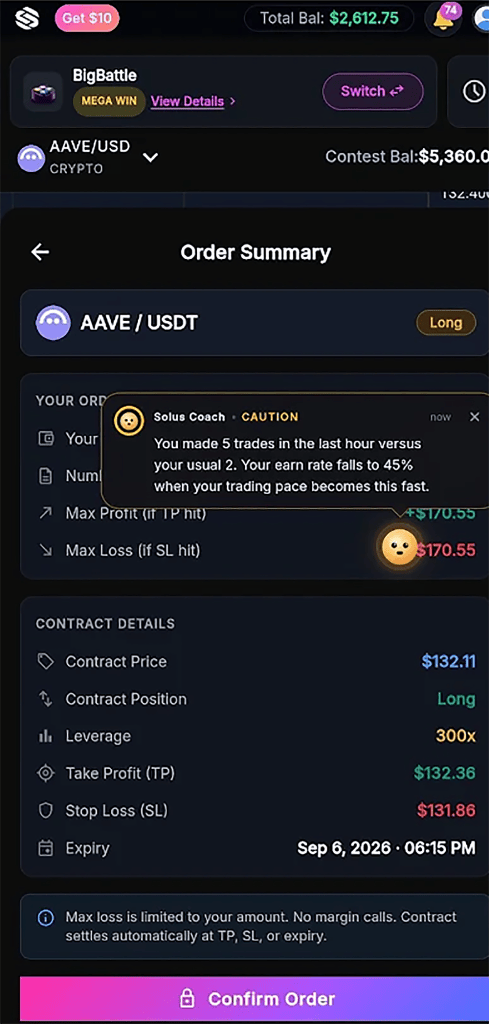
Solus AI Coach Example
Image Credit: Solus Finance
Solus says the model was trained on a substantial internal trade history and validated on a separate, more recent set it hadn’t been trained on. — a later period, under different market conditions, that the model had never seen. On that held-out data, Solus reports that traders scoring in the bottom band on discipline showed a substantially higher rate of full-position losses than those in the top band — a gap past P&L alone did not predict. It also reports that low volatility-response scores tracked meaningfully larger swings in trade-to-trade P&L
The score and the coach are not two features. They are halves of one mechanism, and Dey is direct about why neither survives on its own: a score nobody acts on is a report card, and advice with no measurement behind it is a newsletter.
The diagnosis comes first, she says. The dashboard returns a composite trader score alongside the four dimensions, each carrying a band rather than a bare figure — risk behavior marked conservative, discipline marked elite — and each opening into three parts: what is happening, what it means, and what to try. A trader whose entries cluster inside the same short window is told that frequency is crowding out judgement, and that the trades placed in a rush are usually the ones they would not have taken with more room. The instruction that follows is specific enough to act on that afternoon: after closing a trade, wait before opening the next.
The coach carries that diagnosis to the point where it can change something. The same World Bank evidence base that finds financial education broadly effective also finds that programs built on compulsory participation produce effects statistically indistinguishable from zero, while interventions delivered at the moment of an actual financial decision produce significant behavioral effects. Solus puts the coach on the trade ticket, firing before the next position is opened. Seven trades in an hour, twice what you usually do, one reads. Stepping back for a moment is a strategy too. Another, triggered when a higher leverage tier is selected shortly after a loss, notes that similar patterns carry a 73% loss rate across the platform.
Then the loop closes. Each dimension carries direction as well as value — rising or falling since the last reading — so a trader can see whether the correction they made last week held. The coach intervenes at the decision, the decision changes the behavior, and the behavior moves the score that produced the intervention. That is precisely what the attrition research says is missing: not more information, but a signal that responds to what the trader actually did.
Two things separate this from a generic alert. The benchmark is frequently the trader’s own history rather than a universal rule — “twice what you usually do” is computed against that individual’s baseline. And the platform-level figure exists only because the behavioral data has been collected in aggregate, which is Dey’s thesis running on itself: the data category she argued for is what makes the coaching possible.
Both halves are deliberately restrained. The coach describes itself as silent when the trader is steady, and each pattern fires once and then rests — a concession to the fact that an ignored warning is worse than none. The dashboard discloses its own uncertainty: where a finding rests on too few closed trades to carry weight, the card says so rather than presenting the number as settled. That is an unusual choice in a category built on confident-sounding analytics, and a consistent one from a founder who published the conditions under which her own model should be rejected.
Market prediction, by contrast, is a crowded field where sustained edges are rare, largely because most models compete on data that’s widely available to begin with. Behavioral measurement can draw on data that exchanges do not publish and brokers do not typically retain — the sequence and structure of a decision rather than its outcome.
The signal traders end up reading
The signal traders currently receive may be incomplete or misleading. A recent Brazilian study found traders assess their own ability by the proportion of days finishing in profit, a measure the disposition effect systematically inflates: 54% observed against 48% unbiased. Participants are not being deceived by anyone. They’re reading a real number that tends to run in the wrong direction — and because it looks perfectly ordinary, it can take longer to notice than something that’s simply false.
Replacing that number is the point of the whole apparatus. Solus pairs structured competition in live market conditions — which manufactures the repeatable decision moment the research identifies — with bounded downside, so the cost of a lesson remains capped, and with a behavioral reading in place of the profit figure traders may misread.
The limits she names
Dey has been direct about the limits of artificial intelligence here, which is notable given that her own product depends on it. A 2026 study of large language model financial advice found that among users receiving it, those with lower financial literacy ended up with materially lower projected wealth than more sophisticated users — output quality tracking the sophistication of the question. Her conclusion is that AI does not automatically close a capability gap and can widen it, and that a coaching system built for first-time traders has to compensate for a trader’s starting position rather than assume it away. It is the reason her coach is driven by measured behavior rather than by what a trader thinks to ask.
She attaches a second warning to her own analogy. If behavioral scoring becomes infrastructure the way credit scoring did, any such score must remain contestable and auditable, or it becomes a mechanism of exclusion rather than of access.
Final thoughts
The retail trading boom across emerging markets has produced enormous account growth but still 90% traders lose money. What it has not produced is a record of why. Platforms publish volumes and account numbers; far fewer publish what happened to the people behind them, and how those people decided.
Dey’s contribution has been to argue that the industry cannot fix what it has never measured — and then to do the three things that claim obliges. Build the measurement. Wire it to an intervention at the one moment it can still change the outcome. Publish, in advance, the conditions under which the whole thing should be thrown out.
Whether behavioral scoring becomes infrastructure the way credit scoring did remains an open question.
What seems increasingly clear is that the variable is no longer beyond measurement.
Investing involves risk and your investment may lose value. Past performance gives no indication of future results. These statements do not constitute and cannot replace investment advice.
Entrepreneur Media was not involved in the creation of this content.