How the YRI Fellowship Is Showing Students That AI Can Open New Doors to Scientific Research, If They Learn to Use It Wisely
Through the Young Researchers Institute Fellowship, students are learning how AI can expand access to scientific research, accelerate experimentation, and support discovery while developing the critical thinking and judgment needed to use it responsibly.
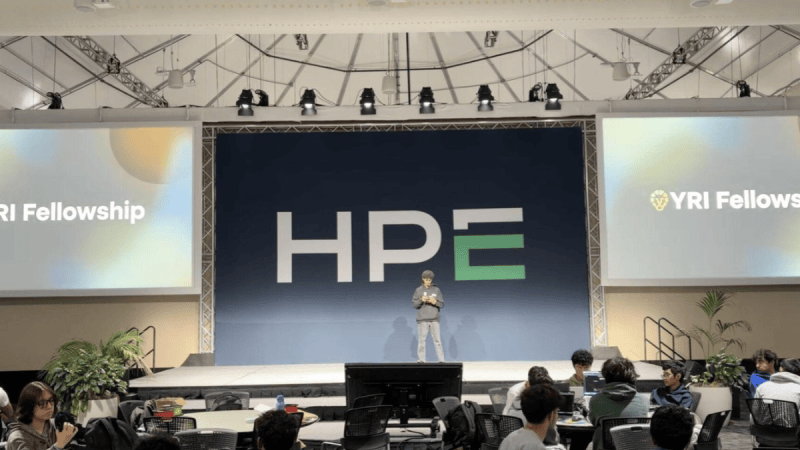
Artificial intelligence has become one of the most debated technologies in education and research, with concerns ranging from hallucinated information and inaccurate citations to overreliance on chatbots and questions of academic integrity. On the other hand, AI is also influencing how scientific research is conducted by helping researchers search literature, analyze data, write code, and speed up complex workflows.
For aspiring science, technology, engineering, and mathematics (STEM) students, this presents both a challenge and an opportunity. Rather than viewing AI as a shortcut, many researchers see it as a tool that can strengthen scientific work when used responsibly. Among them is Ishan Jain, a former researcher and the founder of the Young Researchers Institute (YRI), an organization that mentors and guides high school students to publish their own research.
“I think students should get involved with AI,” he says. “The more comfortable they become using it now, the better prepared they’ll be as it becomes more integrated into research and society.”
AI can remove barriers, not scientific thinking
A common misconception is that AI replaces human intelligence in research. In reality, it changes how that intelligence is used. Tasks such as coding, analyzing datasets, testing computational models, and reviewing scientific literature can now be completed much faster, allowing researchers to focus on higher-level problem-solving.
Ishan says he has witnessed young researchers in the YRI Fellowship who integrate AI into their workflow can test multiple hypotheses simultaneously. Instead of writing one algorithm to solve a problem and hoping it works, a student can now prompt an AI to generate 20 variations of an algorithm in a matter of days. Exploring a wider range of possibilities may help improve accuracy and provide additional insights, depending on the task and approach.
However, he also stresses that AI should support technical execution, not scientific judgment. Real-world data, transparent methodology, and human interpretation remain essential to producing research that is credible, reliable, and scientifically meaningful.
Democratizing access to the laboratory
One potential benefit of AI is its ability to broaden access to research tools. For decades, conducting high-level STEM research required access to a physical laboratory, expensive equipment, and proximity to major universities. This naturally shut out large numbers of ambitious yet underprivileged students from remote areas or developing nations.
Digital tools now support many aspects of laboratory work. With just an internet connection, advanced computational AI software, and the right guidance and supervision from mentors living anywhere in the world, even a student living on the opposite end of the Earth can run complex healthcare simulations or analyze deep biological datasets that were previously locked behind institutional walls.
Scientific publishing is changing, too
One of the more unexpected areas where AI may prove valuable is peer review. Traditionally, manuscripts submitted to journals are evaluated by subject experts—a process that can take weeks or even months—while AI often provides more detailed feedback in far less time.
Jain believes AI could eventually play a larger supporting role by helping reviewers identify methodological issues, inconsistencies, or overlooked weaknesses more quickly. At the same time, human oversight remains essential for scientific judgment and ethics.
How AI may reshape the researcher’s role
One criticism often directed at AI is that it will reduce the need for critical thinking. If software can write code, summarize papers, compare algorithms, and analyze results, what role is left for the researcher?
Jain believes the answer lies in redefining that role rather than resisting the technology.
“The human isn’t going away; their role is shifting,” he says. “Researchers will become better orchestrators and managers of these AI systems instead of doing every individual task themselves.”
Rather than replacing researchers, AI changes where their expertise is needed, he says. Someone still has to decide which scientific questions matter, design meaningful experiments, determine whether conclusions are valid, and understand the broader implications of the findings. AI can process information at remarkable speed, but deciding which problems are worth solving remains a distinctly human responsibility.
For business leaders, one practical takeaway is to identify repetitive, time-consuming tasks where AI can support employees without replacing human judgment. Starting with a small workflow—such as research, data analysis, or drafting—and requiring employees to review and verify AI-generated output can help teams gain efficiency while maintaining accountability.
Considering the risks
None of this means the concerns surrounding AI should be dismissed. Large language models can hallucinate facts, generate inaccurate references, and tempt students to accept answers without verification. Students who copy AI-generated text without verification risk introducing errors into their work while also undermining their own learning. Universities around the world continue to debate appropriate policies on AI-assisted writing, authorship, and disclosure as the technology evolves.
Students need to know one important truth about research. It is not about finding quick answers; it is about asking the right questions. Jain agrees that students must avoid treating AI as an unquestionable authority, but use it critically. “When AI gives you an answer, don’t stop there,” he urges. “Ask it to evaluate its own reasoning. Ask for alternative approaches. Ask it to go deeper.” After all, every scientific conclusion should withstand scrutiny, and AI-generated information should be no exception.
Empowering the next generation
Curiosity, critical thinking, creativity, and sound judgment remain valuable as researchers incorporate AI into their work. As AI becomes more accessible, alongside access to suitable tools, asking clear questions and interpreting evidence responsibly can support successful research.
When used thoughtfully and ethically, AI can make research more accessible while empowering the next generation of scientists to tackle increasingly complex problems.
Entrepreneur Media was not involved in the creation of this content.