Why AI Commerce Could Be Won at the Moment of Decision
As conversational AI spreads through retail, the next competitive advantage may come from proprietary data that helps customers make better decisions.
The race to build AI shopping agents is accelerating.
Many technology companies, e-commerce platforms, and retailers have begun investing heavily in AI agents that can help consumers discover products, compare options, and complete purchases. McKinsey estimates that agentic commerce could orchestrate as much as $1 trillion in U.S. B2C retail revenue by 2030, with the global opportunity potentially reaching $3 trillion to $5 trillion.
Conversational AI is becoming increasingly capable and accessible as foundation models improve. Product summaries and recommendations, as well as natural-language searches, are likely to become expected features rather than sustainable competitive advantages.
For entrepreneurs, that raises a more interesting question: If everyone has access to powerful AI, where will the competitive advantage come from?
A good part of the answer may be specialized intelligence that helps AI make better decisions.
Fashion’s $2 trillion decision problem
Apparel and footwear represent a global market of roughly $2 trillion. Yet despite decades of e-commerce innovation, one deceptively simple question continues to drive hesitation, abandoned carts, and costly returns: Will this fit?
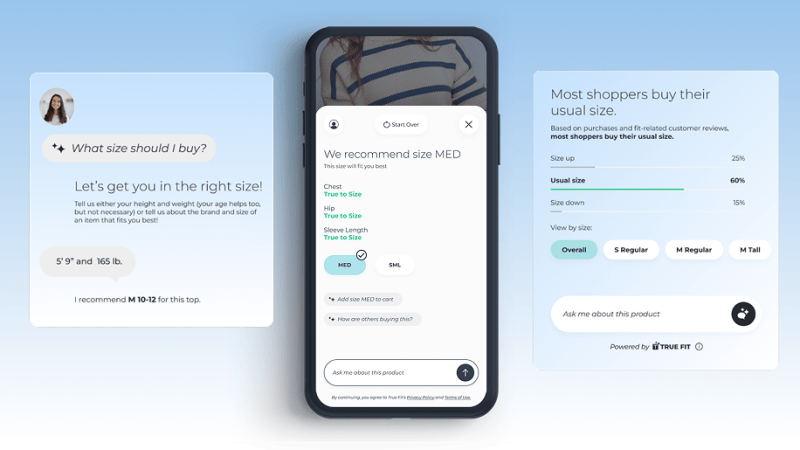
True Fit recently analyzed millions of real shopper interactions with retailers’ AI agents and found that more than 70% of shopper questions involved fit or sizing.
Shoppers aren’t simply asking an agent to find a sweater. They’re asking:
- Whether to go with a medium or a large
- How this brand’s fit compares with one they already wear
- Whether to size up to leave room for a layer underneath
These aren’t search questions. They’re decision questions.
E-commerce has become good at helping people discover products, and AI will make discovery even easier. But a sale often isn’t lost because the shopper couldn’t find something they liked. It’s lost because they couldn’t decide with enough confidence to buy it.
From conversation to decision intelligence
Large language models can interpret product descriptions, summarize reviews and respond naturally to complex questions.
Shoppers rarely buy because an AI conversation sounds intelligent. They buy when they like the product and feel confident it’s the right one.
A conversational agent might tell a shopper that a dress has a slim silhouette. A decision-capable agent needs to determine what that means for a particular shopper, in a particular size, from a particular brand, based on the shopper’s body, preferences and previous purchase outcomes.
That requires more than language. It requires specialized data.
Every industry has some version of this. Healthcare depends on diagnostic intelligence. Financial services rely on risk intelligence. Cybersecurity requires threat intelligence. True Fit believes fashion requires fit intelligence.
This points toward one of the most important competitive dynamics of the AI economy: As access to foundation models becomes increasingly democratized, proprietary vertical data may become more valuable, not less.
AI can read a size chart, product description, or customer review. What it doesn’t inherently know is what happened after millions of similar decisions.
Which size did the shopper buy? Did they keep it or return it? How did that outcome compare with purchases from other brands? How does a particular garment actually fit relative to similar products?
That outcome history can turn information into decision intelligence.
Why outcome data may become an AI moat
Scot Wingo, CEO of ReFiBuy, agentic commerce thought leader, and host of the Retailgentic podcast, wrote that “in this era, one of the remaining competitive moats is a proprietary data set.” The strongest sets, he writes, are “painstakingly gathered over years if not decades,” grow through “data network effects” and are “impossible to recreate with AI.” True Fit, he writes, is “in the enviable position of having a data-set that fits this pattern.”
True Fit offers one example. According to the company, nearly two decades of e-commerce activity have created a data set representing more than $600 billion in transactions from more than 100 million shoppers across 60 million active products and more than 91,000 apparel and footwear brands.
The interesting part isn’t simply the scale. It’s what the data represents.
Most digital data tells businesses what consumers searched, viewed, clicked, or said. Outcome data can reveal what they actually purchased, kept and returned.
That distinction becomes more important as AI moves closer to making decisions on behalf of consumers.
As True Fit co-founder and CEO Jessica Murphy puts it: “AI doesn’t create trust by knowing more. It creates trust by helping people make better decisions. The real advantage comes from connecting intelligence to outcomes—understanding not just what a shopper might like, but what will actually work for them.”
A weak chatbot response is inconvenient. A bad purchasing recommendation can mean a return, a dent in trust, and a shopper who hesitates before delegating the next decision to an agent.
The standard therefore needs to move beyond having lots of data, or even well-structured data, to decision-grade data: information grounded in real outcomes, continuously updated and reliable enough to influence an actual transaction.
For entrepreneurs in almost any industry, there’s a useful question here: What does a business know from real-world outcomes that a general-purpose AI model doesn’t?
That may ultimately be more defensible than the AI interface itself.
Visualization is powerful. But it isn’t the decision.
Generative AI is quickly changing how shoppers picture products before buying. Virtual try-on can help a shopper see themselves wearing a jacket or dress, addressing another longstanding e-commerce question: How might this look?
That is progress. But visualization and decision intelligence solve different problems.
Seeing a photorealistic image of themselves in a jacket doesn’t necessarily tell shoppers whether to order a medium or large, whether the shoulders will feel tight, or whether the cut will fit the way they prefer.
A recent partnership between Glance and True Fit, announced in September, illustrates where this could be heading. The article mentions that Glance combines conversational shopping with generative virtual try-on, while True Fit adds personalized fit and sizing intelligence grounded in purchase and return outcomes.
Put those capabilities together and AI can begin addressing three distinct stages of a purchase:
- Discovery: Does the shopper like it?
- Visualization: How might it look on the shopper?
- Decision: Will it fit the way the shopper wants, and what should they buy?
The progression matters because creating desire isn’t the same as creating confidence.
A compelling AI-generated image may increase purchase intent. But the business outcome ultimately depends on whether the consumer completes the purchase, and whether that purchase stays purchased.
Specialized intelligence can go wherever the shopper goes
There’s another implication for entrepreneurs building in AI: a business doesn’t necessarily have to own the entire customer experience to own something valuable within it.
AI commerce will likely involve an ecosystem of specialized capabilities for discovery, recommendations, payments, customer service, logistics and other functions.
Specialized intelligence can work the same way.
A retailer could build its own shopping agent but access outside fit intelligence when a shopper asks a sizing question. Emerging infrastructure such as Model Context Protocol, or MCP, makes this increasingly possible.
The shopper doesn’t need to know which system supplied the answer. What matters is whether the primary agent can tap the right intelligence at the moment a decision has to be made.
That creates an interesting opportunity for businesses with proprietary expertise or data. Instead of trying to build another general-purpose AI destination, they can turn what they uniquely know into intelligence that other AI systems can access.
The moment of decision
For the past several years, much of the AI industry has focused on making machines better at conversation. The next phase is likely to be about making them better at decisions.
As foundation models level the playing field for language and interaction, businesses should be asking what proprietary intelligence they can contribute on top of them.
In fashion, one answer is fit. In another industry, it might be risk, compatibility, performance, quality, pricing, or another form of domain-specific expertise.
The specific data will vary, but the underlying question is the same: What does a company know that general AI doesn’t, and can that knowledge be turned into intelligence that helps customers make a better decision?
Because the next great AI opportunity isn’t simply helping people find what they want. It’s giving them the confidence to decide.
Entrepreneur Media was not involved in the creation of this content.