How Prescription Eyewear Available to Busy Executives is Changing
Advanced manufacturing and AI are changing the way eyewear companies innovate to correct your vision.
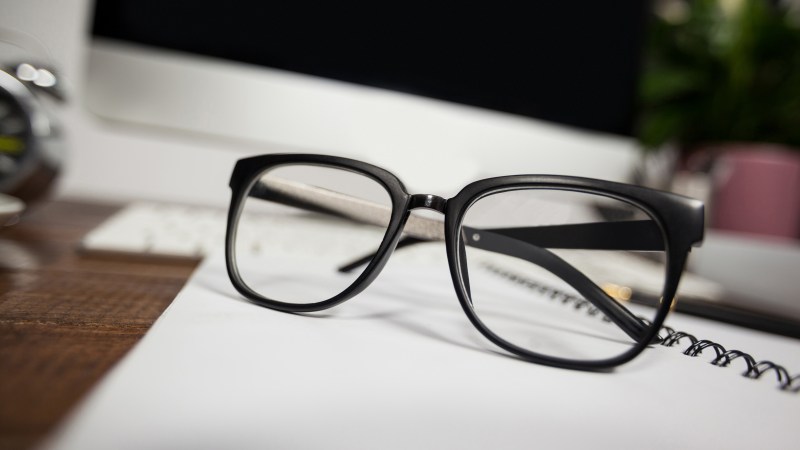
A busy professional unexpectedly finds that they have to replace their glasses while traveling or between one work week and the next. Because time is money and convenience matters, they seek out an online retailer, such as GlassesUSA, and after trying on a pair of frames virtually, they enter their prescription and place a quick order.
Thanks to the ease of online retail, this can be done quickly and with little thought. However, when you have time to plan ahead and really ponder your eyewear options, modern lens-crafting and artificial intelligence (AI)-assisted technology have expanded the options available.
Today’s spectacles are simply not your grandfather’s eyeglasses, and they aren’t even your eyeglasses from a few years ago. Here is a quick look at just a few examples of the premium eyewear tech that is becoming more available to busy executives who care about their vision but want eyewear rather than laser surgery.
Digitally surfaced lenses
Two of the ways that eyewear has changed over the past decade are more advanced lens manufacturing and a greater attention to personalization. This has made it possible to create and continuously improve digitally surfaced lenses. Rather than craft a few simple curves, modern CNC-controlled machines can sculpt thousands of tiny points on the lens, customizing each lens to your exact prescription, the shape and size of the frame you selected, and the vertex distance (in other words, the distance between your lens and your physical eyes). This also makes it possible to fine-tune a pantoscopic tilt, allowing the bottom of the lens to be angled inward closer to your cheeks, so that you can look straight through the lens when gazing ahead or down. Digitally surfaced lenses can also take your pupillary distance and even your eye rotation into account, so the glasses are tailored to your vision and face rather than a more general specification.
The results are both aesthetic (thinner lenses) and functional (sharper periphery vision and less distortion outside the middle of the lens).
AI-Optimized Progressive Lenses
Besides recent improvements in 3D-modeled, digitally surfaced lenses, advances in AI over the past couple of years have enabled premium manufacturers to harness machine learning to optimize progressive lenses. Progressive lenses, unlike traditional bifocals and multi-focals, adjust your prescription naturally depending on the angle at which you are looking through the lens.
For example, looking at the lower part of the lens, you get clearer near vision. Looking through the upper part of the lens, you get clearer far vision. And you don’t have to deal with a visible line cutting across your sight where the prescription shifts; instead, the prescription adjusts gradually along the curve of the lens. It is probably no wonder that progressive lenses are such a fast-growing and global market.
However, most progressive lenses available on the market require some compromises, especially to peripheral vision. A “swim” effect and peripheral blur can make progressives difficult for some wearers, especially those prone to dizziness or migraines.
That’s where AI-powered optimization is starting to make a difference with some newer, high-end progressive lenses. By drawing on vast databases of wearer data, AI models can analyze wearer preferences and behavior to predict eye-movement patterns at various distances.
This puts big data to use in creating progressive lenses that have less peripheral blur, wider reading zones, and smoother transitions when you look up from your book or down from the road to your dashboard. This new tech tends to be pricey but highly personalized.
Personalized binocular lenses
One exciting development for those whose vision is starkly different from one eye to the other is optimized binocular lenses. These lenses not only consider each eye separately but are also designed to account for how your two eyes work together.
Instead of applying a single prescription to both lenses, binocular prescriptions take additional measurements. The design has to take into account which eye is dominant, how and where your left and right vision converge, your reading posture, your preferred working distance (for example, how far from your laptop’s screen you prefer to sit), the position of your head while reading or working, and the orientation of your frames.
By designing with all of this in mind, you can get lenses that improve stereoscopic vision and depth perception while making it possible to read comfortably for longer stretches at a time.
Looking ahead
Human beings have been designing corrective eyewear since the thirteenth century, but modern technology is making it possible for eyewear to evolve at a rate your ancestors could not have imagined.
With improved manufacturing and further development of machine learning models, the market may see more biometric customization in the years ahead, personalizing lenses to your facial anatomy, your specific eye movements, and your habits. Premium manufacturers in several countries are even in a race to bring dynamic focusing lenses to the market.
Those are lenses that use liquid crystals or transparent fluids and electrical charges to change a lens’ focus in real-time. These “electronic” eyeglasses are still in research and development, but they point to some intriguing options for the future.
One thing at least is certain: vision difficulties no longer have to interfere with a busy executive lifestyle, and there may be a future scenario in which your prescription eyewear is as technologically advanced, personalized, and seamless a part of your work and life as your tablet or smartphone.
This article is for informational purposes only and does not substitute for professional medical advice. If you are seeking medical advice, diagnosis or treatment, please consult a medical professional or healthcare provider.
Entrepreneur Media was not involved in the creation of this content.