The High School Researcher and Entrepreneur Who is Using AI to Rethink Rural Healthcare
Aviraj Soin is exploring how physician-supervised AI could help underserved rural communities.
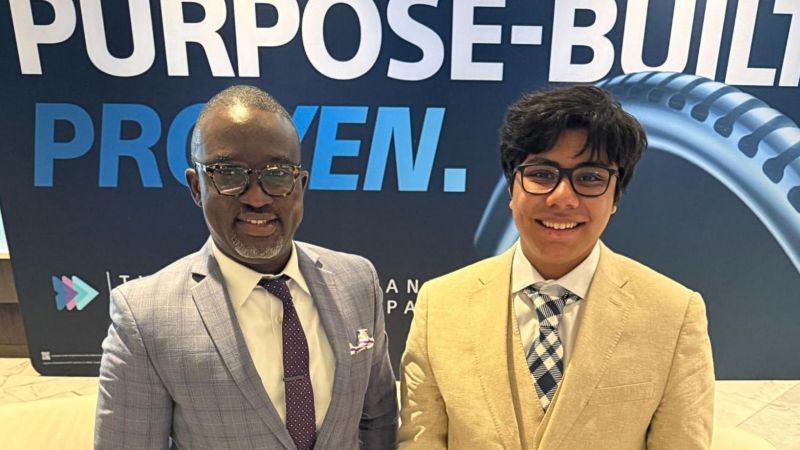
High school student and researcher Aviraj Soin is focused on a central question: why should the zip code where a patient lives determine their access to medical expertise and knowledge? As a young person from Yellow Springs, Ohio, Soin understands that rural patients may have limited access to specialists, advanced imagining, and major academic medical centers.
“Patients in rural America should not receive a lower standard of clinical insight simply because they live far from an academic medical center. My goal is to study whether AI can help bring some of that expertise closer to the clinicians who care for them,” Soin says.
When specialists are not located in a patient’s area, diagnosis and treatment of complex conditions may be difficult. Soin plans to bridge this gap in care with an artificial intelligence (AI) model to assist them.
Starting with a problem close to home
Growing up in a small Ohio community gave Soin insight into the issues surrounding healthcare and access to medical knowledge in underserved areas. It wasn’t an abstract problem, but something that the people in his area lived with every day.
Already interested in the overlap of technology and medicine, he wanted to find a solution to unequal access to specialized medicine. To narrow his research, he decided to concentrate on spinal pain. Rural patients often don’t have access to spine or pain specialists in the area, making diagnosis difficult, especially because symptoms can overlap with other conditions.
“This project is not about replacing rural doctors with technology. It is about giving rural doctors another tool and helping them access information that might otherwise be concentrated at large academic institutions,” Soin explains.
Building a model around clinical support
Soin built an AI program to determine whether a computer could help doctors with diagnosing a patient with back and spine pain. The AI sorts through a patient’s records and reviews many different pieces of information.
Soin reports that in its trial run, the AI model looked at the data of 250 patients and reviewed the severity of the pain, location, duration, physical limitations, and previous treatments such as physical therapy, injections, and surgery. The model also looked at other details in their medical history, searching for patterns that are attached to four spinal conditions.
The program’s purpose is not to replace the doctor, but serve as an organizational assistant or second set of analytical eyes. A doctor can review the AI program’s report and determine if the patient may need additional testing or a specialist.
The future of Soin’s AI platform
Soin has proposed a two-part research program in collaboration with Dr. Charles Odonkor, Co-Director of Clinical Research in the Department of Orthopaedics & Rehabilitation at Yale School of Medicine, and Dr. José Rodriguez of the Geisel School of Medicine at Dartmouth. The collaboration builds on their shared work examining how artificial intelligence could help extend specialty expertise to rural and underserved communities.
Soin, Odonkor, and Rodriguez recently co-authored the peer-reviewed article, “Artificial Intelligence for Clinical Decision Support in Rural Spine Care: A Narrative Review,” published in the journal Healthcare. The review emphasizes that AI may strengthen clinical decision support in rural settings, but that models require rigorous validation, explainability, physician oversight, and real-world testing before widespread clinical implementation.
“Yale represents the level of clinical and research excellence we want to learn from. The Dartmouth phase is important because rural-health disparities are not limited to spinal pain. If the framework proves useful, we want to determine whether it can be adapted to cardiac care and other specialties while preserving physician oversight,” said Aviraj Soin.
Odonkor notes that, “Aviraj’s work is compelling because it begins with a real healthcare-access problem. The next step is to determine scientifically whether the model can generalize, remain interpretable and provide meaningful assistance without introducing new risks.”
“Rural-health innovation must be practical. A system is only valuable when it works within the actual workflow of community clinicians and improves care without creating unnecessary complexity,” Rodriguez says.
For Soin, the work is ultimately driven by a straightforward principle: a patient’s ZIP code should not determine the quality of clinical assessment they can access. His next phase of research will focus on determining whether AI can responsibly help narrow that gap—first through rigorous validation in spine care and, if successful, by exploring whether the same framework can be adapted to other areas of medicine.
This article is for informational purposes only and does not substitute for professional medical advice. If you are seeking medical advice, diagnosis or treatment, please consult a medical professional or healthcare provider.
Entrepreneur Media was not involved in the creation of this content.