They Turned Parking Lots Into a Cultural Movement
Lessons from Rayson Esquejo and Lauren Delgado-Hodgins, the founders of Filled Market.
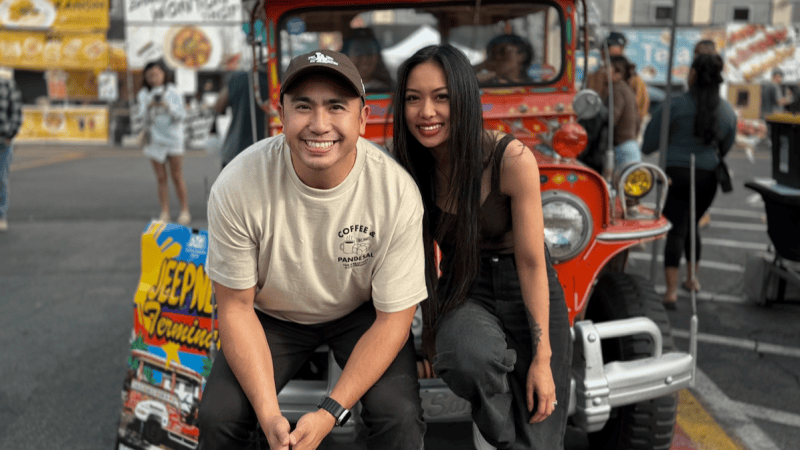
Two friends set out to throw a party for their culture. Nearly a decade later, what they built has become a home for Filipino-American small businesses, creatives, and entrepreneurs.
It’s also a lesson in finding an audience, adapting when the world changes, and building something bigger than yourself.
Twenty-five thousand reasons to keep going
In 2017, Rayson Esquejo and Lauren Delgado-Hodgins wanted to create a celebration of Filipino American culture in Los Angeles.
They had no venue of their own, no investors, and no guarantee anyone would come. According to the founders, they rented a parking lot at Eagle Rock Plaza, recruited food vendors, enlisted family and friends, and spread the word about their first festival, Eat. Play. Move., through social media.
They hoped for 3,000 to 5,000 people. An estimated 25,000 showed up.
The crowd confirmed something the two friends had long believed: Filipino-American culture deserved a bigger stage, and a new generation was hungry for a place to connect with its heritage.
But a crowd was only the beginning. Over the next nine years, their work would take them from festivals to pandemic-era car hops, from the Manila District, and finally to Filled Market and the nonprofit USAPAN. Along the way, they took on real financial risk, reinvented their model more than once and learned to lean on a growing circle of entrepreneurs, collaborators, and community leaders.
Their journey offers several lessons about building a business around a mission. And letting that mission grow beyond the people who started it.
Make your niche accessible without losing what makes it special
As American-born Filipinos, Esquejo and Delgado-Hodgins knew what it meant to grow up between cultures. They saw Filipino-American identity becoming more diverse, especially among younger generations and mixed-heritage families. They also saw an opportunity to introduce Filipino culture to people who had never experienced it.
The challenge was creating one experience that welcomed both audiences. Their answer was food.
Instead of asking visitors to understand Filipino culture before they arrived, the founders gave them a delicious way to discover it. Someone new to Filipino cuisine might start with an ube cronut and leave curious about adobo, lumpia, or halo-halo. The festival gave Filipino Americans a place to celebrate their culture while introducing it to people who were less familiar with it.
“We realized early on that if we wanted Filipino culture to reach a wider audience, we couldn’t just market it to people who were already familiar with it,” Esquejo says. “We had to create an experience that made people curious enough to show up, comfortable enough to participate and excited enough to share it with someone else. The goal was never to make Filipino culture less Filipino. It was to make it more accessible to everyone.”
Success, however, brought a hard truth. A crowd of 25,000 generated buzz, but it did not guarantee an event they could afford to repeat.
“People see 25,000 attendees and assume that means financial success, but there’s a huge difference between drawing a crowd and running a sustainable event,” Delgado-Hodgins says. “We were taking on financial risks without knowing whether anyone would show up. Every decision, from the venue to the vendors to how much we could afford to spend, was a calculated gamble. We learned quickly that success wasn’t just about how many people attended. It was about whether we could create something sustainable enough to do again.”
The founders said they changed their approach for the next festival, moving to a block party in the downtown Arts District, introducing an admission fee and planning for a more manageable crowd. Growing an audience and building a sustainable operation, they had learned, were two different challenges.
The lesson: Make your niche approachable without compromising its identity. But don’t mistake popularity for profitability. Sustainable growth requires understanding the costs and risks behind the attention.
When the world stopes, protect the mission—not the business model
By early 2020, Esquejo and Delgado-Hodgins had a recognizable festival concept and a loyal following. Then COVID-19 brought large gatherings to a halt.
Restaurants closed. Events were canceled. Many of the small food businesses the founders had championed lost their main sources of income almost overnight.
The founders faced a choice: wait it out, or find another way to show up for the entrepreneurs who had trusted them. They chose to show up.
Delgado-Hodgins said she was able to secure access to an office building on East 7th Street in downtown Los Angeles through her network. The building had a commercial kitchen and an adjoining parking lot. She proposed using the space for small, socially distanced drive-up events.
Together, the founders built a series of car hops where customers could order from participating vendors without the crowds of a traditional festival. Instead of thousands of people gathering once a year, smaller groups could support local businesses again and again.
The format had changed completely. The mission had not: bring people together through Filipino culture and create opportunities for entrepreneurs.
As restrictions evolved, the parking lot grew into a recurring outdoor marketplace with more than a dozen vendors. According to the founders, they named the location the Manila District, honoring the history of Filipino Americans in downtown Los Angeles, near the area once known as Little Manila.
The temporary arrangement also gave vendors new opportunities. They introduced new products, built loyal customers and gained visibility without first investing in permanent storefronts. The founders said some participating vendors eventually opened brick-and-mortar locations of their own.
The vendors played an important part in making those events work. In the most uncertain season many of them had ever faced, those vendors trusted two founders with an unproven idea in a downtown parking lot. That trust is something Esquejo and Delgado-Hodgins have never taken for granted.
The founders hadn’t just found a substitute for their canceled festivals. They had discovered a new way to fulfill their original purpose.
The lesson: A business model is a tool, not a mission. When circumstances change, look at the resources and relationships already around you. The best next step may look nothing like the original plan.
Build a brand that’s rooted in culture and guided by shared values
Out of those pandemic years, Esquejo and Delgado-Hodgins developed Filled Market—the concept, the name, and the philosophy behind it—drawing directly on everything Eat. Play. Move., the car hops, and the Manila District had taught them.
From the start, they faced a defining question: Could a Filipino-American marketplace welcome businesses from other backgrounds while remaining grounded in the community it was created to celebrate?
Their answer was yes—with Filipino leadership and culture at its center.
Filled Market would be Filipino-led, but not Filipino-only. Its name, drawn from “Filipino-Led,” expressed that distinction: an invitation to participate in a Filipino-centered space, not a departure from its roots.
Participation meant more than adding a Filipino ingredient or aesthetic. The connecting thread was a genuine commitment to celebrating Filipino flavors, traditions and cultural influences while honoring where they came from.
Ninong’s, a Los Angeles based dessert brand, offered one example with its ube pancakes: a meeting of American traditions and an ingredient beloved in Filipino desserts. Other entrepreneurs brought Filipino-inspired food, desserts and merchandise, each adding their own perspective within a Filipino-led setting.
The founders wanted to welcome different cultural influences while keeping Filipino identity at the center. Their approach also created opportunity: Filled Market became a place for emerging entrepreneurs to test products, meet customers and build relationships with fellow small-business owners.
That approach also took shape in Historic Filipinotown, where USAPAN once turned a parking lot there into a gathering place for food, culture and small businesses, bringing more than 9,000 people to the neighborhood known as HiFi. It was another way to create a bigger stage for Filipino culture while connecting people to a neighborhood rooted in its history.
Delgado-Hodgins sees that balance as the heart of what Filled Market stands for. “Filled Market was never about building walls around our culture,” Delgado-Hodgins explains. “It was about building a table. One where Filipinos sit at the head, tell our own stories and invite others to share in them with respect. When our community leads, everyone who joins us becomes part of something meaningful.”
The lesson: Strong brands are clear about their roots, their values and the responsibilities that come with participation. Thoughtful collaboration can broaden a brand’s reach while honoring the people and culture that give it meaning.
Build something bigger than yourself—and empower others to carry it forward
Nearly a decade after their first festival, Esquejo and Delgado-Hodgins still pursue this work alongside demanding careers. Esquejo identifies himself as a founding partner and president of Harvey Industries International, a company specializing in woodworking machinery and precision tools.
As their events grew, Esquejo and Delgado-Hodgins found they needed more people to help manage the work.
From the very first parking lot, their events depended on far more than two people. Esquejo’s wife, Delgado-Hodgins’ family and their friends staffed booths and managed operations. Joey Ngoy and the TFN Media publicity team contributed community connections and communications expertise. Over the years, coordinators, artists, content creators, social media managers, influencers and advocates have all lent a hand.
But the founders are clear about who deserves the deepest thanks: the vendors. Their work is central to Filled Market’s events. They wake before dawn to prep, haul tents and coolers across the city, and invest their own time, money, recipes and family stories into every event. Every customer who discovers a new favorite dish, and every line that wraps around a booth, exists because a vendor was willing to bet on themselves and on this community.
As the work grew, the founders created the nonprofit USAPAN to give their mission a lasting home. After establishing Filled Market, they invited a board to support its day-to-day operations. According to Filled Market, its leadership includes Chef Ralph Degala, a master chef and chief financial officer; Di Barbadillo, who handles vendor relations; and Manilynn Disuanco, who serves as brand manager. The board helps manage the work the founders and vendors built, so the mission can continue beyond any single event.
Strategic partnerships have mattered just as much. As Filled Market outgrew its original setting, producing larger events independently would have required more staffing and infrastructure. The founders credit Darwin Manahan of Punch & Co. with introducing them to Smorgasburg LA. The partnership allowed Filled Market to use Smorgasburg’s event infrastructure while continuing to focus on its cultural programming, vendors and community relationships.
October 2026 marked Filled Market’s fourth consecutive year partnering with Smorgasburg LA. “One of the most important things we’ve learned is that you don’t have to own every part of the experience to make an impact,” Delgado-Hodgins says. “Every opportunity came with a decision about where to invest our limited resources. We had to ask ourselves whether growing bigger actually helped our mission or just created more financial responsibility. Partnering with established organizations allowed us to focus on what we do best: bringing people together, supporting small businesses and creatives, and creating meaningful cultural experiences.”
For Esquejo and Delgado-Hodgins, bringing more people into the work has allowed Filled Market to continue growing while giving vendors and community partners a larger role in its future.
The lesson: Sustainable leadership means knowing when to delegate, collaborate and share ownership. The strongest organizations are built by people who empower others to contribute, not by founders who insist on doing everything themselves. And it means never forgetting who made the work possible in the first place.
The mission stays the same
In a 2017 interview, Esquejo described what he hoped that first festival might become: “We want to turn it into a movement, turn it into something that the city can embrace,” he said.
Nearly a decade later, that vision has taken forms neither founder could have imagined.
A parking lot festival. Car hops in a downtown lot. The Manila District. Filled Market. Each chapter brought new challenges, new opportunities and new people who helped shape what came next. Yet the purpose connecting them never changed: bringing people together, celebrating Filipino culture and creating opportunities for others to thrive.
“What we’re building has never been about one event or one name. It’s about creating a place where our community sees itself reflected, where small businesses have room to grow, and where the next generation can take what we started further than we ever imagined,” Delgado-Hodgins says.
The venues may change. The format may evolve. But the measure of success will stay the same: not how many people walk through the gates, but how many find a sense of belonging, a chance to grow and a role in carrying the mission forward.
And for Esquejo and Delgado-Hodgins, the purpose remains clear: Filled Market is not the final destination. It is the latest chapter of a vision two friends began in a rented parking lot. And one whose future will be written by the entrepreneurs, community leaders, creatives, and partners who make it their own—while staying true to the founders’ original mission: bringing people together, celebrating Filipino culture and creating opportunities for everyone to be part of it.
Entrepreneur Media was not involved in the creation of this content.