Exploring the Future of AI and the ‘Next Economy’
Entrepreneur and Boston University Questrom School of Business teamed up for a thought-provoking one-day event for business owners, innovators, academics, and more.
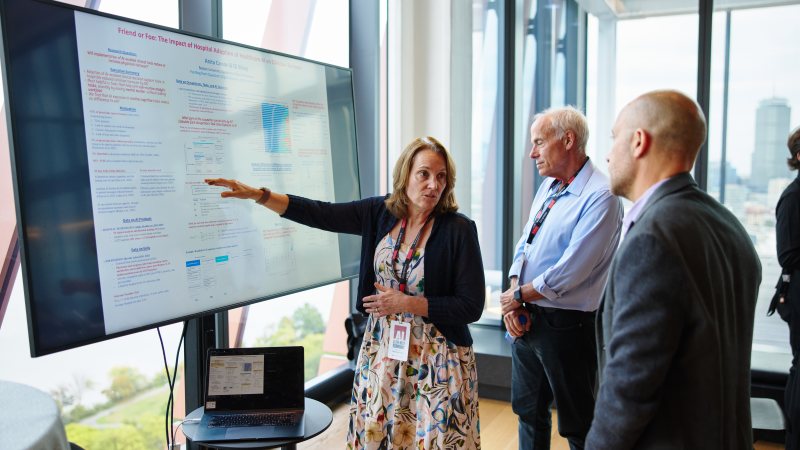
Whether you’ve embraced it or are ignoring it, artificial intelligence (AI) is changing the ways we work, live, and interact. In business specifically, AI and AI-powered tools are reshaping markets, enterprise strategy, organizational design, work, and—perhaps most importantly—human judgment. Changes are coming fast, and the way entrepreneurs, executives, and their teams do business will be transformed over the coming years.
This was the focus of Exploring AI and the Next Economy, a recent event presented by Boston University Questrom School of Business and Entrepreneur. Combining executive insight, live problem-solving, working breakout sessions, research translation, demonstrations, and relationship-building, the one-day event was held at Boston University. It attracted executives, entrepreneurs, innovation leaders, alumni, and organizational decision makers from around the Boston area.
Keynotes highlighted the important details between experimentation and transformation, with one taking a deep dive into a case study featuring specific challenges a real-world business owner faces, with solutions offered by a Questrom faculty expert. Other themes explored by speakers and attendees included:
The global AI economy. How regulation, infrastructure, talent, data, and market structure are reshaping competition across countries and industries.
The AI-enabled enterprise. How organizations move from pilots and isolated tools to redesigned workflows, operating models, and measurable value.
Human-AI relationships. How leaders structure collaboration, judgement, accountability, trust, skills, and organizational change.
Getting leaders up-to-speed now—not later
In a breakout session called Leading an AI-Confident Workforce, Michel Anteby, Professor of Management & Organizations at Boston University Questrom School of Business, explained how leaders build confidence, fluency, trust, and accountability while addressing concerns about job redesign, accuracy, privacy, fairness, and professional identity.
“AI is not about the future; it’s happening right now. Entrepreneurs already leverage AI in lots of impressive and creative ways,” Anteby says. He argues that using AI tools—such as properly trained and prompted social agents—can help owners refocus on their expertise and “core love” of their business.
“Increasingly, AI agents will become part of firms’ proprietary human capital,” he explains. “People will want to join specific businesses to be supported by their unique AI capabilities. In the same way that we spoke about ‘talent wars,’ we will see ‘social agent wars’ where IP-protected social agents will be supporting employees’ work and the winning enterprises will be the ones deploying the best internal ‘AI capital.’”
The tools continue evolving, and so must user skillsets
H. Sami Karaca, Clinical Assistant Professor in Markets, Public Policy, & Law at Questrom, is a firm believer that businesses need to catch up when it comes to how they’re using AI. The tools have dramatically changed, he says, but much of the conventional wisdom about prompting has not.
Karaca led a breakout session called Everything You Learned About Prompting is Wrong. And he means it.
“Two years ago, the value was in the wording: magic phrases, role-play, the perfect one-shot prompt,” Karaca explains. “Today, the value is in the context. The tools ask questions now, so the skill is explaining the work the way you’d brief a new hire, then checking what comes back.”
Karaca says human skills will be critical for businesses to successfully push the needle in the coming years. Paul R. Carlile, Sr. Associate Dean of Research & Innovation, and the Peter and Deborah Wexler Professor of Management and Information Systems at Questrom, agrees. He co-presented a live case study during the keynote, Experimentation to Transformation: Framing the Challenge.
“As AI makes it increasingly tempting to offload thinking, this moment requires us to reclaim what is distinctly human: not just solving problems but framing better ones,” he says. “Not just using powerful tools but exercising the judgment to determine where they can have the greatest impact.”
Click here to learn more about Boston University Questrom School of Business and the ways it is preparing the next generation of business leaders for the future of AI.