These Friends Used a ‘Nerve-Wracking’ Strategy to Start a Business Selling a Home Essential — And It’s Surpassing $100M in Revenue
Adam Bedford and John Fanelly put one foot in front of the other to bring their business to life.
Key Takeaways
- Bedford and Fanelly launched their home-health essentials brand Sans in 2020.
- The duo started with an air purifier but have since expanded the product line.
- Sans is a nine-figure company with employees on five continents and plans for ongoing growth.
During the pandemic, Adam Bedford and John Fanelly were in the same “Covid bubble” in Southern California, which gave them plenty of time to talk. And the friends began noticing how much attention people were paying to air quality, which led to a business idea.
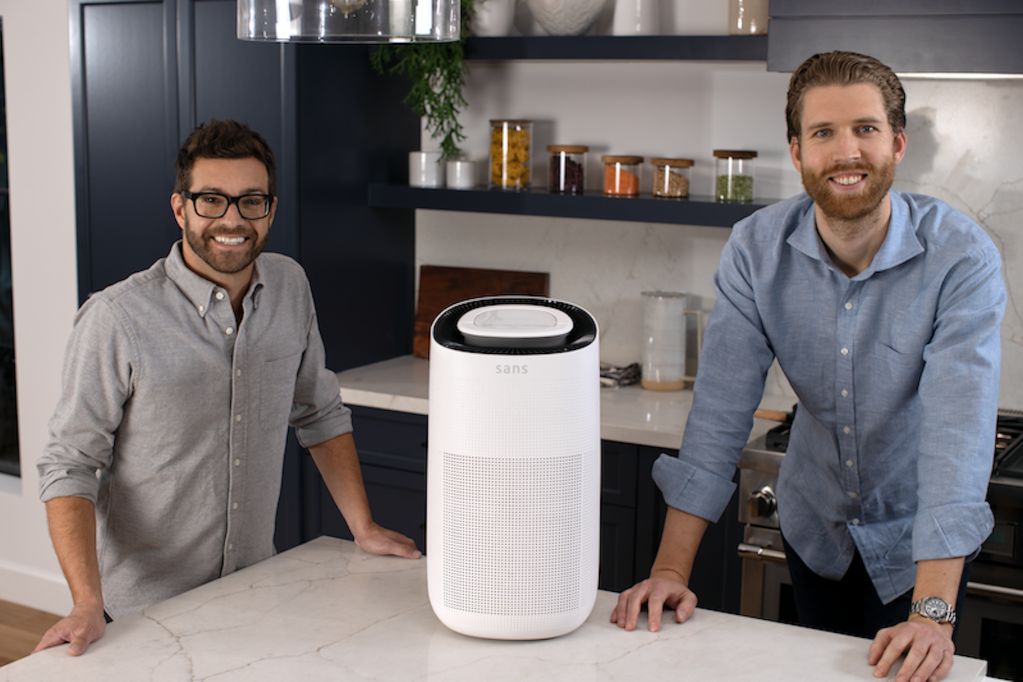
In 2020, Bedford and Fanelly self-funded and launched Los Angeles-based brand Sans, which focused on selling an air purifier with medical-grade filtration and a modern, quiet design.
Their product’s HEPA (high-efficiency particular air)-grade purification technology traps up to 99.97% of particles, with one pound of active carbon to catch chemicals such as formaldehyde, and has an internal UV-C light for pathogen protection. Not all air purifiers on the market offer the three-layer system.
Additionally, at 25 decibels, the Sans air purifier is quieter than many household fans and other common appliances.
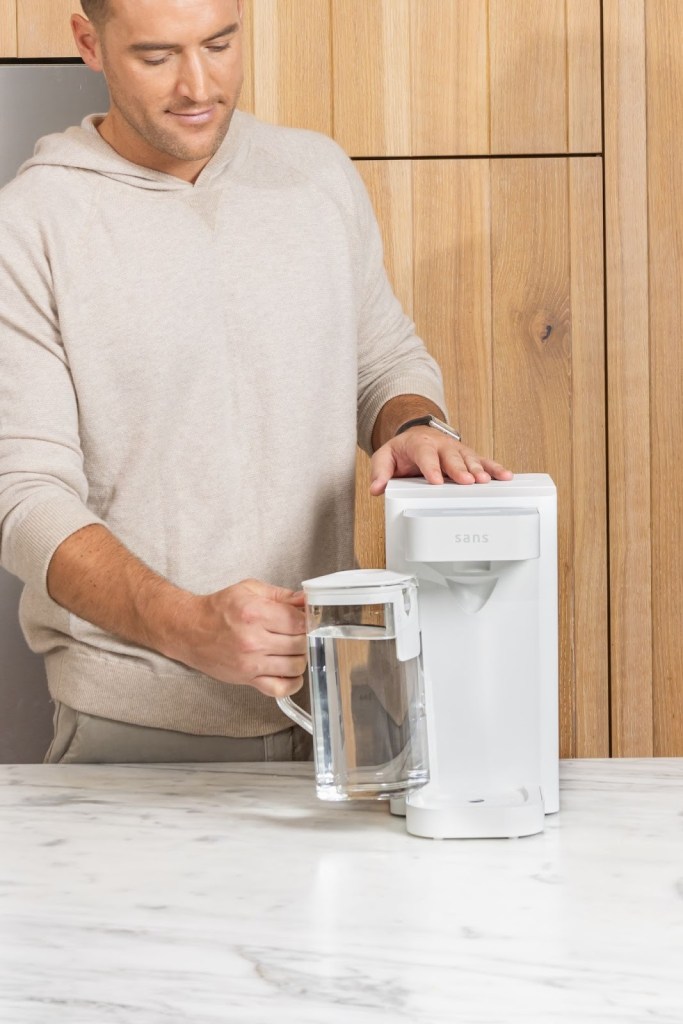
However, from the beginning, the co-founders envisioned Sans as a comprehensive home-health essentials brand with the ability to address a variety of issues. Today, the company’s product line also includes a water purifier and self-cleaning water bottle.
Starting a business without a pitch deck or outside investment
Neither Bedford nor Fanelly had experience selling direct-to-consumer (DTC) products. Bedford had founded a business-to-business software company in the education technology sector. Fanelly’s background was in the home-goods space, manufacturing and selling products offline. Those complementary skillsets helped the co-founders and co-CEOs enter uncharted DTC territory.
At the time, putting a pitch deck together and raising money felt like it would slow them down during an “urgent moment.” Since they’d both built successful businesses in the past and had the capital to start, they got to work developing a standout product and figuring out how to bring it to market. Although bootstrapping the business was “really nerve-wracking,” it ensured the co-founders kept a close eye on every penny invested into the brand.
Self-funding also motivated Bedford and Fanelly to extend the amount of time before Sans’s first hire. The co-founders were the company’s only full-time employees for four years.
“Somewhere along the way after telling yourself, We’ll just get to the next milestone and then we’ll see whether we want to raise some money, or We’ll just get to the next milestone and then it’ll be easier to raise money, you cross enough of those milestones where you look back and say, We don’t need to raise any money,’” Bedford says.

The business’s unit economics worked from the start, which was key, the co-founders note.
Sans gained a foothold in a growing market, and its product didn’t require a significant bet on lifetime value the way one with a subscription-based model would. In other words, the co-founders wouldn’t have to wait months to turn a profit, all the while risking their own capital.
Now, Sans is a nine-figure company, on track to exceed $100 million in revenue in 2026 — and the co-founders still haven’t taken outside funding.
Naturally, Bedford and Fanelly learned several important lessons along the way.
1. Gather customer feedback to establish an emotional connection
Like a lot of air purifier companies in the market at the time, Sans initially leaned on product features and hard statistics to win over customers.
But the co-founders wanted Sans to stand apart from competitors. So, they took a step back to figure out what other concerns, in addition to air quality, people had about their home’s health.
With that knowledge, they went back to the drawing board to craft a more compelling ad campaign. The original campaign, rolled out at the start of the pandemic, focused on the science, filtration technology, particle size and virus-level removal. The new one highlighted the everyday problems the product could solve: dust, odors, pet dander and allergies.
“We were able to really strike an emotional cord with people,” Fanelly recalls, “and our sales started taking off, which was great, but then that meant we didn’t have enough product.”
2. Get granular when it comes to forecasting product demand
Both new to ecommerce, when Sans’s orders spiked and inventory depleted, Bedford and Fanelly had to figure out how to get a product manufactured overseas and shipped from their Los Angeles warehouse to customers as quickly as possible.
The co-founders called their freight forwarder, a company that ships and receives goods on behalf of other companies, with a request to airship product so they could keep up with fulfillment. The shipment dimensions — “basically a 20-foot container” — and cubic volume were so significant that the freight forwarder first thought it was a joke.
“That was a lot of money,” Fanelly says. “I’m not going to say wasted. But that we’d spent to make sure that we were able to meet the demand of the market.”
The co-founders learned they had to refine their demand forecasting methods. They also realized that with the right messaging, those customers they’d built a relationship with might give them some leeway when it came to shipping times.
3. Go in with a multi-category mindset — and understand what that requires
Building a company with the goal of an ambitious and varied product line isn’t without its challenges. Notably, when Sans wants to sell a new product in a different category, as it did with its water-purification products, it almost necessitates starting from scratch, the co-founders say.
“ Effectively what you’re doing every time you launch a new category is you are launching a new business,” Bedford explains. “There’s a reason why a lot of the brands in the space, and a lot of brands in DTC in general, are super verticalized.”
A DTC supplement brand, for example, doesn’t have to reinvent the wheel completely to introduce other supplements to its line, Bedford says.
The time to start is when you literally can’t imagine doing anything else.
Now, as the co-founders continue to establish trust with customers across categories and reflect on a year of milestones — 15 full-time employees on five continents, the biggest revenue days and months to date, and a U.K. launch — they stand firm in their early decision to self-fund and put one foot in front of the other.
“The time to start is when you literally can’t imagine doing anything else,” Bedford says. “There is a pre and post moment. You have a job. You’re thinking about this on the side. You can get on with your day and not be obsessed over this, even though it lingers. The tipping point is when you absolutely cannot do anything else other than think about the thing that you want to go and start. That’s the moment you have to do it.”
Sign up for the Money Makers newsletter to get weekly, expert-backed tips to help you earn more money — from real people who founded and scaled successful businesses. Get it in your inbox.
Key Takeaways
- Bedford and Fanelly launched their home-health essentials brand Sans in 2020.
- The duo started with an air purifier but have since expanded the product line.
- Sans is a nine-figure company with employees on five continents and plans for ongoing growth.
During the pandemic, Adam Bedford and John Fanelly were in the same “Covid bubble” in Southern California, which gave them plenty of time to talk. And the friends began noticing how much attention people were paying to air quality, which led to a business idea.
In 2020, Bedford and Fanelly self-funded and launched Los Angeles-based brand Sans, which focused on selling an air purifier with medical-grade filtration and a modern, quiet design.
Their product’s HEPA (high-efficiency particular air)-grade purification technology traps up to 99.97% of particles, with one pound of active carbon to catch chemicals such as formaldehyde, and has an internal UV-C light for pathogen protection. Not all air purifiers on the market offer the three-layer system.