The Next Generation of Sports Stars Is Being Built Outside the Big Leagues — And Off The Field
College athletes are becoming the next big sports influencers, using NIL deals and brand partnerships to break into fashion and luxury.
Opinions expressed by Entrepreneur contributors are their own.
Key Takeaways
- Athletes in overlooked college sports have deeply engaged local followings that brands have historically undervalued.
- Canopy Talent and The Society Management are partnering to give fashion, beauty and luxury brands direct access to these collegiate athletes.
- Athletes now own their audiences and distribution, which makes them long-term brand partners rather than one-off endorsement deals.u003cbru003e
The line between fashion, sport and entertainment has never been more blurred. Award-winning actors are now just as well known for their podcasts, TikTok stars are releasing Grammy-nominated albums and NBA players are modeling for underwear companies. You could argue that this dilutes the value of fame, but another perspective is that it creates new value propositions that simply weren’t available before.
Jack Liechtung, founder of athlete management and brand partnerships agency Canopy Talent, believes the latter.
“Our thesis has always been: these athletes that we work with on a day-to-day basis are far more than just the sport they play,” Liechtung tells Entrepreneur. “Historically, people have looked to them as the bottom line of a balance sheet. So if their sport doesn’t make enough money, they’re kind of useless. I think that’s a terrible way to look at it.”
Chris Gay, president of top modeling firm The Society Management, which represents Kendall Jenner and Adriana Lima, sees a similar opportunity.
“What’s incredibly interesting from a collegiate and fashion standpoint is these kids have a really engaged following,” Gay tells Entrepreneur. “They don’t have to win the championship or play the biggest revenue sports. There’s a whole community of people deeply invested in the kid who is playing volleyball, the kid who’s playing water polo and so forth.”
Working primarily with collegiate athletes in overlooked sports like gymnastics, swimming, softball, and volleyball, Liechtung has seen firsthand just how wide the gap can be between their perceived brand value and their actual influence. “They have immense value and influence within their respective communities, and they’ve been speaking to their audiences about the brands and products they love and use outside of competition,” Liechtung says.
That shared philosophy has brought the two companies together, establishing a first-of-its-kind partnership that gives the world’s leading fashion, beauty, and luxury brands access to the next generation of collegiate athletes.
The stars beyond the scoreboard
For Liechtung, the partnership is a natural evolution of what he always envisioned for Canopy. The company was initially conceived in collaboration with another modeling agency around an idea similar to what Canopy is now doing with Society. But because that agency wasn’t based in the U.S., the partnership ultimately didn’t work. Still, Liechtung knew he was onto something.
“A modeling agency with brand partnerships and the prestige that far precedes our own existence is something that we wanted from the outset,” he says.
So Liechtung reached out to Gay on LinkedIn. “I had spoken with other modeling agencies, management companies, so I kind of knew what would hit, but I also knew that they were working with some pro NBA players, and I kind of tied in to that,” Liechtung shares.
“I also spoke a bit of his language. I worked at WME back in the day prior to going to law school, and spent summers working at fashion houses and with fashion designers.”
The two hopped on a couple of calls, then went months without speaking before Gay circled back. When they finally met in person, they quickly realized just how closely their visions aligned.
“I think this idea that these athletes are not bound strictly by the wins and losses in their sport was something that he really wanted to get behind,” Liechtung says. “But my co-founder and I saw this kind of intersection and overlap between sport and fashion from the outset. It just seemed super clear to us.”
Someone like Livvy Dunne is an example of the potential this type of partnership can unlock, but Liechtung points to someone like skier Eileen Gu as a North Star for the project, noting the disconnect between her earnings from skiing and the scale of her fame.
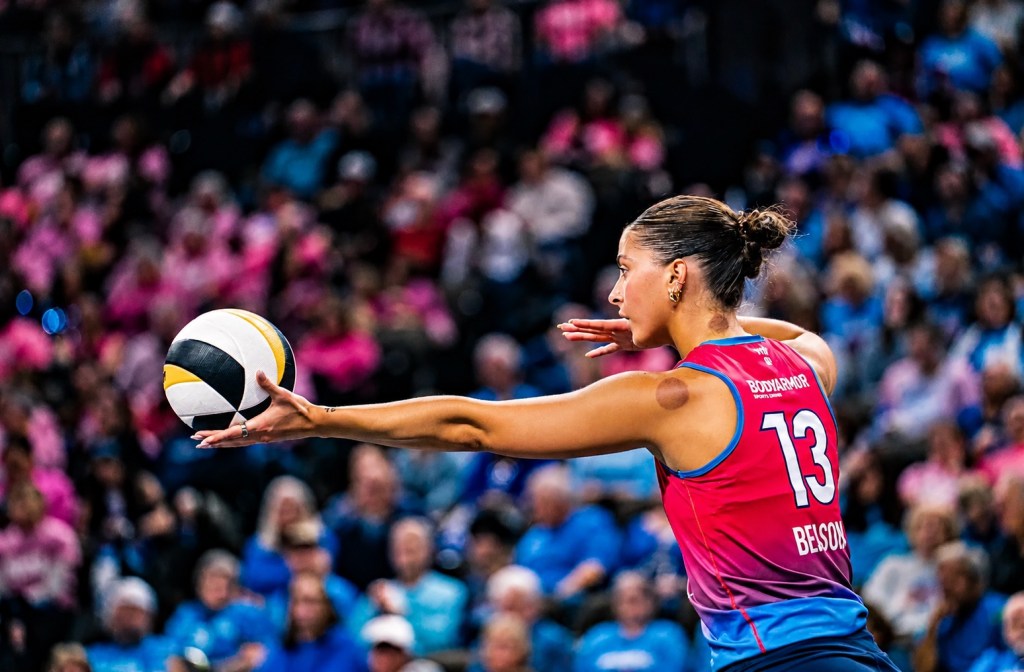
He recalls a conversation at an event where one of his athlete creators, Major League Volleyball player Merritt Beason, a former Nebraska star, came up.
“Someone overheard me talking about her, and they said, ‘Merritt Beason in Omaha is bigger than Patrick Mahomes,’” Liechtung recalls.
“These athletes are rock stars in their communities, and sometimes far beyond, and the people that follow them are deeply invested.” He notes that, on his roster, athlete creators’ engagement rates are roughly six times higher than those of standard influencers. “It’s really wild how sticky these athletes are,” Lietchung adds.
The audience is the asset
From Gay’s perspective, having a partner well-versed in the nuts and bolts of the complex NIL landscape was essential. But just as important was finding someone who shared Society’s vision.
“We really just felt a certain kinship together when we started sort of discussing this deal,” Gay says. “I felt Jack was the perfect person and his company was the perfect company to go forward with it.”
Gay isn’t entirely new to the athletic world. In another lifetime, he actually wanted to become a sports agent.
“I was in school in Boston, and literally went to work at a tiny little modeling agency that represented some of the Red Sox players. And, like, legitimately, we were doing fashion shows for department stores,” he says, laughing.
Still, the experience gave him an early education in the modeling business and eventually led him to start his own company. Along the way, he continued to work with athletes, including Angel Reese, whom he represented while she was at LSU.
At this point, Gay sees athletes and models as “extraordinarily similar,” in that both build their own fan bases independent of the team or agency they work for.
“It’s more than just a passing deal that they’re doing, you know, with Gucci or with Nike,” Gay says. “This is their community. They’re bringing that to the table. There’s no intermediary.”
In the past, he explains, a brand deal with a company like Nike meant the brand handled the media buy, distribution, and much of the connection with the audience. Today, that dynamic has changed.
“The piece of content is often created by the athlete, model or entertainer, and then distributed out on their own platforms,” Gay says.
This largely informs his and Lietchung’s strategy when approaching clients.
“The goal is never these one-off deals,” Lietchung explains. “I think an athlete could kind of source their own one-off deals. We’re trying to work with athletes that already have some sort of platform, a voice. We amplify that. We work with them to really sharpen that focus. It could be anything from faith to fashion to comedy, and we work with them to expand on that.”
Liechtung’s background in corporate and entertainment law comes in handy when navigating the complex rules and regulations surrounding NIL — a term he actually hates.
“I actually don’t call it NIL,” Liechtung says. “I think to the brand, they’ve kind of written it off historically as something that’s just far too complicated and messy.”
Instead, Liechtung and his team focus on educating brands about the value these athletes can bring at both the collegiate and professional levels.
“You don’t need to partner with LeBron James to make an impact, to drive consumer spend, to get eyeballs.”
Expanding the playing field
Under the deal, Canopy will serve as Society Management’s exclusive on-campus partner, providing the access and compliance tools needed to operate within the collegiate environment. Canopy understands the NIL deal submission process and has relationships with schools that can help streamline communication and expedite approvals.
Liechtung believes that infrastructure will become increasingly important as universities look to build an athletic presence beyond football and basketball. The opportunity, he argues, comes down to the fundamentally different incentives facing athletes in less commercialized sports.
“Unlike the basketball and football players that have not been very incentivized to create content and kind of go get out of competition because they’re looking ahead at a pro contract, that was not the case for these other athletes,” Liechtung says. “Frankly, I did not want to be beholden to the ACL of an offensive lineman.”
As Gay sees it, the possibilities are endless.
“I think it’s incredibly dynamic because I think the needs of the brands that we work with are going to be very different than maybe some of the needs of the current type of brands that are engaging a collegiate athlete,” he says. “We’re going to be revealing a really different type of quality of content that’s going to be very different than the type of stuff that you might currently see.”
Key Takeaways
- Athletes in overlooked college sports have deeply engaged local followings that brands have historically undervalued.
- Canopy Talent and The Society Management are partnering to give fashion, beauty and luxury brands direct access to these collegiate athletes.
- Athletes now own their audiences and distribution, which makes them long-term brand partners rather than one-off endorsement deals.u003cbru003e
The line between fashion, sport and entertainment has never been more blurred. Award-winning actors are now just as well known for their podcasts, TikTok stars are releasing Grammy-nominated albums and NBA players are modeling for underwear companies. You could argue that this dilutes the value of fame, but another perspective is that it creates new value propositions that simply weren’t available before.
Jack Liechtung, founder of athlete management and brand partnerships agency Canopy Talent, believes the latter.
“Our thesis has always been: these athletes that we work with on a day-to-day basis are far more than just the sport they play,” Liechtung tells Entrepreneur. “Historically, people have looked to them as the bottom line of a balance sheet. So if their sport doesn’t make enough money, they’re kind of useless. I think that’s a terrible way to look at it.”