This 27-Year-Old Left Wall Street to Create a Product That ‘Gives People Time Back.’ It Hit $10,000 in Sales in 36 Hours.
Maria Cabral Menezes worked as a trader before deciding to risk it all and start her own business.
Key Takeaways
- Maria Cabral Menezes, 27, worked in finance at Citadel and JPMorgan before deciding to create a “dry shampoo for clothes.”
- The product arose out of necessity: Menezes frequently found herself with clothes she wore once that were too clean to wash but not fresh enough to wear with confidence.
- The Reset Spray, which retails for $29, hit $10,000 in sales less than 36 hours after its debut in early August.
Maria Cabral Menezes, 27, never set out to be an entrepreneur — let alone one behind a product that achieved $10,000 in sales in less than 36 hours.
Menezes moved to the U.S. from Brazil to study at the University of Pennsylvania, where she majored in behavioral economics, retailing and international development. After graduating in 2021, she joined JPMorgan Chase as a global equities trader, then moved to Citadel as a trader after a year.
“I came to the U.S. to go down the most typical finance path ever,” Menezes tells Entrepreneur in a new interview. “I was not meant to be an entrepreneur, at least I didn’t think I was.”
As a trader, Menezes encountered a pain point. When she traveled for conferences, she would try to rewear the same blazer two or three days in a row and not feel very confident that it was clean enough. She would also go to the gym in the morning and travel around for the rest of the day with sweaty clothes stuffed into a duffel bag.
Then there was the chair. Menezes would tell her friends about the chair she had at home, piled up with clothes she had worn once. The clothes were too clean to wash, but not fresh enough to rewear and feel confident. She would end up paying to dry clean them.
“I remember thinking, I wish there was something like a dry shampoo, but for your clothes,” Menezes says. “A spray that allows you to re-wear an item between washes so that you’re not constantly over-washing your clothes or over dry cleaning, which is not good for the actual clothing itself if you lightly wore it.”

Creating a new product
Menezes started researching the market. She found that laundry companies mostly focused on detergent. They didn’t consider the 99% of the time when clothes were nowhere near the washing machine.
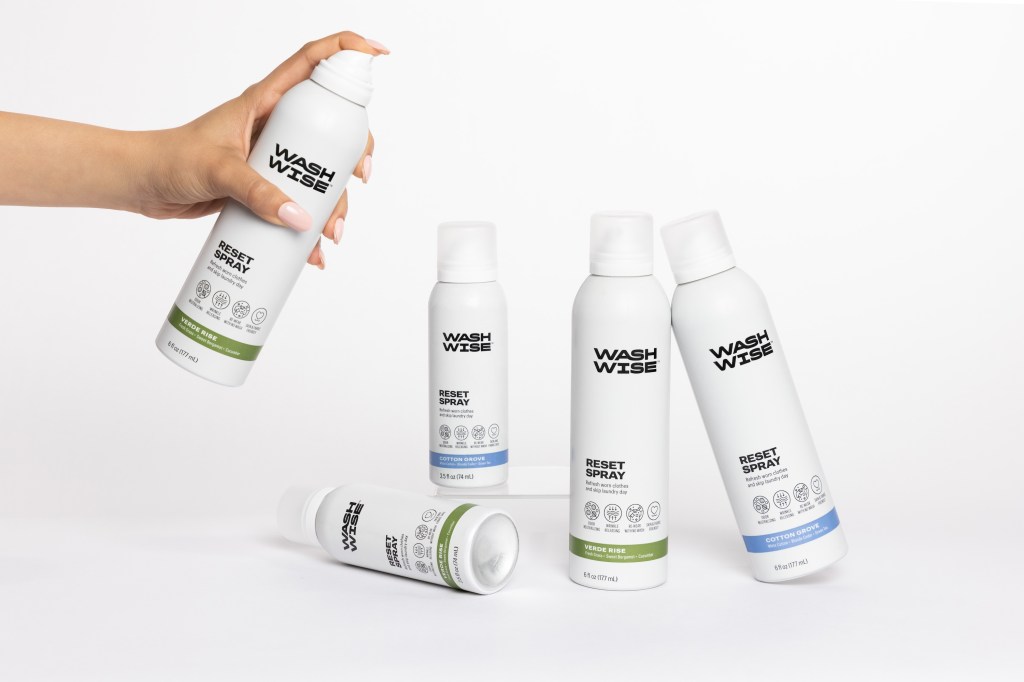
That was the inspiration for Menezes’ brand, WashWise, and its hero product, the Reset Spray. The $29 product markets itself as “dry clean in a bottle” and a “dry shampoo for clothes.” It reduces wrinkles in fabric, cleanses and neutralizes odors in a way that is skin- and fabric-safe. The spray comes in two fragrances and two sizes, including a travel option. Menezes launched the product last month.
“My goal is that when you take any piece of clothing out, you’re going to think, Is this dirty? Is this clean?” Menezes says. “And if it’s in between, we’re WashWising it.”
Though the Reset Spray was built with sustainability in mind, WashWise positions it more as a time-saving product. It’s selling convenience to consumers who travel, work out, wear synthetic fabrics or simply do not want to run a load of laundry after every light wear.
“We’re basically giving people time back,” she says.
Menezes believes that framing helps the product reach multiple audiences. The phrase “dry shampoo for clothes” may immediately register with women who already use dry shampoo, she says, but the use cases extend beyond that customer.
“It’s not just the woman who understands ‘dry shampoo for clothes,’” she says. “It’s also the Wall Street bro who sometimes has wrinkles in between meetings, or the college kid who is messy and doesn’t do laundry as much as they should.”
Menezes says the brand’s consumer research found that one bottle of product could replace up to $300 in dry-cleaning costs, six hours of laundry time and 110 gallons of water, although those results will depend on an individual consumer’s habits.
How she developed the spray
Menezes started developing the product by first examining what a washing machine does for clothes so that she could copy it in a spray format. She was still working at Citadel last year when she came into contact with a chemist via LinkedIn.
“I bounced the idea off of her, and we started really at home, putting all of these formulations together in my living room,” Menezes says. “Eventually we came up with a formulation we felt so confident about that we were ready to go speak to contract manufacturers.”
Menezes estimates the internal process involved 10 to 15 iterations. The eventual manufacturer made two minor reformulations, focused more on product preservation and scale than on the formula’s core function.
“By the time we went to them, we already had something that was proven in our own house,” she says.
The full path from meeting the chemist to the first production run took more than a year. It was not a straightforward process. Menezes initially explored a separate idea: a water-soluble bag for sweaty workout clothes that would dissolve in the wash and contain odor-neutralizing agents.
Then she identified an obvious flaw.
“When something is sweaty, it’s going to melt the bag before it ever gets to your home,” she says. “It was just such an oversight.”
She tabled that product, though Menezes says WashWise may eventually introduce another solution for handling especially sweaty clothing until it can be washed.
A finance mindset, applied to consumer products
The spray also presented a complex formulation challenge. Many ingredients used for odor neutralization can interfere with fragrance, Menezes says, while other components can work against wrinkle reduction or cleansing performance.
“The hardest part was finding ways in which we were learning enough about these ingredients to find innovative ingredients that work symbiotically,” she says.
Menezes left Citadel once she believed the product had legs and could be manufactured. She had worked on WashWise briefly alongside her full-time job but says the intensity of a finance career made a true side hustle unrealistic.
“The moment I hit all those checks and knew this was feasible, that’s when I decided to leave,” she says. She has worked on WashWise full-time since June of last year.
Before raising outside funding, Menezes says she invested between $50,000 and $70,000 of her own savings. WashWise raised $1.2 million from investors including Hims & Hers co-founder Jack Abraham, Oats Overnight founder Brian Tate, Sense founder Alex Jankowsky and FJ Labs in August.
Menezes has not paid herself in more than a year, choosing instead to invest resources in hiring and customer acquisition.
“I see the value of every dollar I’m putting in,” she says. “I would rather put every dollar into something that has a huge multiplier effect.”
Her finance background has shaped how she operates the company. Menezes says her primary takeaway from Citadel is insisting on process: questioning why each task is done, if it can be improved and how it could function at a much larger scale.
“In order to survive in a place like Citadel, your process needs to be bulletproof,” she says. “There’s no, ‘We do this just because we do this.’”
The difference between startup life and finance
The move from public-market investing to private-company building forced Menezes to get comfortable with uncertainty. In finance, she could measure results quickly and precisely. Market performance follows an investment decision. Startup choices, including hiring decisions, brand strategy and long-term partnerships, are less easy to evaluate.
“It’s taught me to be a lot more intuitive,” she says. “There’s less quantitative stuff to grasp onto.”
For Menezes, disciplined process and intuition are not opposites. She says that thoroughly examining routine decisions makes her better prepared when an unexpected decision requires speed and judgment.
“The moment something comes at me out of the blue and I have to make a fast decision, I feel like I’m the best prepared version of myself to make that decision,” she says. “I feel very confident in trusting myself.”
Building demand before checkout opened
WashWise’s launch in early August was more than a year in the making, but its early sales surge rested heavily on audience-building in the months before launch.
Rather than waiting to reveal a polished product, Menezes documented the company’s development across TikTok and Instagram. She posted packaging options, new boxes, formulation updates and questions for prospective customers. Her audience was relatively small, about 3,000 followers on Instagram and roughly 600 on TikTok at the time of this interview. However, followers were highly engaged.
“Anytime we wanted advice, we always went on social media to ask for it,” she says.
That approach gave early followers a sense of ownership. By the time WashWise launched, the product did not arrive as a surprise.
“If you’ve been a friend of mine and you’ve followed along, you probably know just as much of WashWise as myself, because I really tried to share it all,” Menezes says.
She also created a TikTok series called “Deglamorizing Founder Life,” in which she candidly discusses setbacks and difficult days. The posts gave her a way to build a founder-led brand without turning entrepreneurship into a polished highlight reel.
“Actually building is really hard,” she says. “So that’s one thing I’ve been doing. Whenever I have a rough day, and building is tough, I share that because I think it’s important too.”
A strategy that worked
That transparency ran against some conventional public-relations advice. Menezes says members of her PR team worried that building too visibly would remove an element of surprise from the eventual launch. She saw it differently.
“I’m like, no, I want people to see the journey because it means that once we turn the orders on, there’s a lot of demand already there,” she says.
The strategy appears to have worked. Menezes says WashWise built “a really, really big list of people who were ready to purchase” before launch.
More importantly, customers already understood the vocabulary. The company used phrases like “chair robe,” a reference to that chair full of once-worn clothes, and “dry shampoo for clothes” repeatedly enough that they became shorthand for the problem WashWise was trying to solve.
“We really owned words that hadn’t been out there as part of this new habit we’re trying to create,” she says.
The Reset Spray hit $10,000 in sales in less than two days after launching August 10. Menezes says that her goal is to make WashWise a household name and change people’s habits with the Reset Spray and other products she’s currently developing.
“Let’s do it once; let’s do it really well,” she says. “Let’s have all our marketing and all our focus on this one product, and then let’s do it again and keep repeating it.”
She added that the approach was similar to what Dyson does: Think outside the box, develop one product, really nail it, then move on.
“We’re giving it the time it needs to establish ourselves as innovators in the laundry space before going for the next one,” she says.
Key Takeaways
- Maria Cabral Menezes, 27, worked in finance at Citadel and JPMorgan before deciding to create a “dry shampoo for clothes.”
- The product arose out of necessity: Menezes frequently found herself with clothes she wore once that were too clean to wash but not fresh enough to wear with confidence.
- The Reset Spray, which retails for $29, hit $10,000 in sales less than 36 hours after its debut in early August.
Maria Cabral Menezes, 27, never set out to be an entrepreneur — let alone one behind a product that achieved $10,000 in sales in less than 36 hours.
Menezes moved to the U.S. from Brazil to study at the University of Pennsylvania, where she majored in behavioral economics, retailing and international development. After graduating in 2021, she joined JPMorgan Chase as a global equities trader, then moved to Citadel as a trader after a year.
“I came to the U.S. to go down the most typical finance path ever,” Menezes tells Entrepreneur in a new interview. “I was not meant to be an entrepreneur, at least I didn’t think I was.”