When Trends Turned Against My Brand, We Pulled Off an ‘Unheard Of’ Pivot
To save my clothing company, Tibi, I did something experts said was impossible.
This story appears in the May 2026 issue of Entrepreneur. Subscribe »
I stood in front of my senior team and took a deep breath. I knew what I was about to say would be controversial.
“We’re going to make a big change,” I told them.
We’d spent the past 10 years building a fashion brand called Tibi, and it did $50 million a year in business. But now, I wanted to change everything about our products.
“No focus groups. No directives from merchandising,” I said. “Our designs, our product, are going to align with who we are as individuals.”
I looked around the conference room.
“I’m out,” said my head of technical design, an industry veteran who came with an outrageously high headhunter fee. He’d been at too many fashion companies that had decided to reposition themselves. He said it would never work without a name change and a massive investment. “Ditto for me,” said our head of production and buying.
That was OK, I thought. Not everyone had the stomach for what we were about to embark on. But I believed it was necessary. The future of the company was at stake.
Here was the problem: We started the company in 1997 and became known for brightly colored printed dresses. People loved these prints, and it propelled our success. By 2010, Tibi was headquartered in New York City, and our dresses were sold in hundreds of stores around the world.
But then sales started to slide. Retail buyers were coming to appointments and rejecting our designs. “Our customer is not into prints anymore,” they said. “You are our printed resource; we will be back to buy you when the trends change.”
Truth be told, I understood why customers had lost interest, because I didn’t connect with the printed dresses anymore, either. Neither did my head of design, Traci Bui-Amar.
So why had we continued making these clothes long past when we stopped liking them? Because we’d been stuck in a feedback loop — the same feedback loop that kills many companies by narrowing their vision and limiting their innovation.
Here’s what it looked like in our case: For years, retail buyers told us that bright prints were what customers wanted — so we kept designing them. But we weren’t talking directly to our consumer. All our insights were coming through an interpreter: either the department store or one of the many showroom agents I’d hired to handle a burgeoning business in the UK and Europe. And those stores and agents were working through another interpreter: their selling data. But data is a funny thing. It can tell you what’s selling, but it can’t tell you about the opportunities you’re missing. Which means that sales data often just encourages you to keep doing the thing you’re already doing.
In other words: We made patterned dresses. Our retail partners sold those dresses and told us to make more of them. But we were blind to what else consumers would like. And after many years of making patterned dresses, the product started to feel formulaic — like they were created based on sales data, not on what real-world people were actually telling us, and certainly not on what actually inspired us. Which meant that, by the time trends changed and consumers wanted something else, we were stuck in a corner. Retailers saw us purely as makers of patterned dresses. We had little else to offer. To save the company, we needed to take a risk, and do something drastically different.
Even if we didn’t have the data to back it up.

Image Credit: Nicolás Ortega
To explain how prints came to define us in the first place, we have to rewind to 1997. I was living in Hong Kong, where I’d moved for my husband’s new job. I had recently quit my corporate job at American Express. I wasn’t educated as a designer, but I had an entrepreneurial spirit, a unique visual sensibility, and I could draw. In Asia, I had access to luxury fabrics, highly skilled sewers and patternmakers, and lots of entrepreneurial-minded individuals.
I got into a fashion trade show in New York, where an influential buyer spotted two silk slip skirts I had designed in bold prints. “This! This!” she said. She hadn’t seen “this” before. I had access to the best silk fabrics, so why wouldn’t I create little throw-on skirts in a forty-momme — a rich, heavy silk crepe normally reserved for luxury designer eveningwear? She said if I came back to next year’s show with a broader range in this bias silk skirt concept, she’d be “all in.”
So that’s what I did. I took inspiration from $10 vintage silk scarves, and twisted their sad, tired colors into something unsettling and garish enough to feel wholly new. A year later, I returned to the trade show, and everyone wanted my skirts. The tacky prints, balanced out by luxury fabric, in a minimal but well-made design, at an inoffensive price point? This was truly new at the time. We wrote orders for over $100,000 in skirts that first day.
At the time, all of this was thrilling. The idea that I had done something new and audacious validated that I was onto something. But I had never intended to build a brand solely around these prints. They were a moment in time for me, an element that worked in my style when the mood struck.
I evolved. I grew up. My tastes became more varied and sophisticated. Clothing is a deeply personal form of self-expression. As a founder, I eventually felt I was leading a double life — still selling these colorful patterns while becoming someone else on the inside. But what was I to do? My company had become the “lively, printed, bold, colorful brand,” and that success felt impossible to escape. How do you walk away from what’s working?
You could see and feel the tension in everything we designed. When someone describes an incredible meal, they often conjure up images of the love the chef puts into each dish: passion you can literally taste. With our clothing, not only could you not feel the love, but if you looked closely, you could sense the disdain. We thought if we added clean lines and a sense of modernity that it would be more palatable — to us. The “us” that was never going to be embracing it, no matter the contortions we took to add a sharp element to a chiffon printed dress.
When sales took a turn for the worse, our dangerous position crystallized. Buyers at department stores can only interpret future likelihood based on the past. Follow that logic and your product is likely to stay static, which means you’ll never be able to grow with your customer. Why? Because customers aren’t static; they evolve. If you don’t move with them, then you’re left scrambling to expose yourself to a wider net of customers to replenish those who have moved on, as one eventually does from varied trends. This was us. Our customers looked nothing like the original ones we had attracted when I first started my line. And I had no idea who this new customer was.
We invested in a consultant who told us that our brand was intrinsically rooted in our prints and color; it was the only tool we had to differentiate ourselves from others. We needed to keep doing what we were doing, just do it better. Better prices, better margins, more product range, more advertising. Just be better and it would work out, they told us.
No. No. No. This didn’t feel right, even when the data and their impressive consultant-speak about “brand alignment” and “consumer triangulation” said it was so. When things are fundamentally wrong, the answer cannot be to convince ourselves that what we see in front of us is not so, and to proceed the same way only better, stronger, somehow.
I needed to get to the essence of what we were about.
The thing we were told, again and again, was that our prints defined our brand. It was what made Tibi recognizable. So, first and foremost, I needed to know if that was even true.
I bought two large posterboards. On one board, I pasted images of models wearing brands that were quite minimalist in nature, all black. On the other board, I included pictures of models wearing designs from brands renowned for their prints, from Missoni and Pucci to more contemporary brands like DVF, Milly, Trina Turk, and Tracy Reese.
I set them up on easels, armed our employees with Sharpies and Post-its, and asked them to identify each cluster by designer. At the board with individuals dressed in all black, as seemingly nondescript as you could get, everyone scribbled and tagged away. Margiela here. Demeulemeester, yep, stick. Prada, Rick Owens, Jil Sander — no hesitation, stick, stick, stick. Even the contemporary brands received correct Post-its — Alexander Wang, Rag & Bone, stick, stick.
But the board populated with distinctive colorful prints, brands that were so obviously tethered to what we thought were clear monikers? This is where heated debate ensued. “I think it’s Pucci — err, maybe. Is it Lilly Pulitzer? No, that group is Trina Turk — wait, no, I think it’s DVF? Hey, is this Tibi over here? Or is it Milly? Did we make this dress? This must be Missoni, but it also reminds me of Tracy Reese.” The stickies were all over the place, and nearly all of them were wrong.
We just debunked something we, and the industry, had always taken as fact. Yes, it’s indisputable that the quicker and more visually on point you can represent yourself to the customer, the better the branding. But color and type of print aren’t the definition of visual branding. There has to be something more that allows you to see the creative hand, a throughline of connective tissue.
Sunk-cost fallacy happens when you focus so hard on the amount of investment that can’t be recovered that you’re forced to pursue a strategy that yields no growth. And a company without growth eventually dies. We were focusing so hard on protecting our investment in the Tibi brand that we hadn’t recognized the simple fact that we didn’t have a brand.
We had built a company that could produce things well; we understood fit and consistency, we had excellent factory relationships, and we’d built an infrastructure for shipping and accounting. We had the bones, but we had no meat. The data we had been using to guide us had been collected from the individuals who had already spent money on our product rather than the ones that we wanted to spend money on the brand.
But between me and Traci, our head of design, we did have two individuals who shared the same creative headspace.
We had to start somewhere, and the assumption was that if we loved it and wanted it, then others would too. It was the logical place to begin. The strategy: Build it and they would come, and when they came, we’d figure out the commonalities of who showed up.
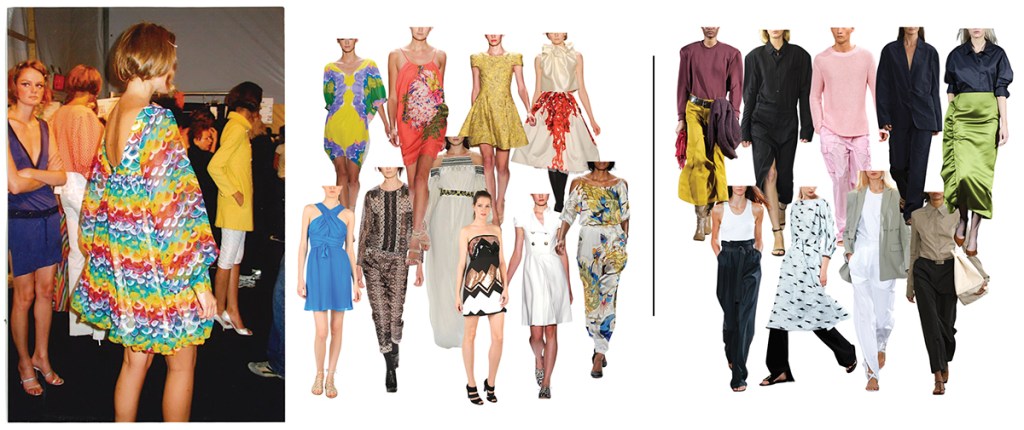
(Left) Early print designs; (Middle) Years of identity struggle; (Right) Current Tibi: chill, classic, modern.
Image Credit: Courtesy of Tibi
Of course, this was easier said than done. A branding pivot like this was unheard of in our industry — as many of my executives made abundantly clear, just before quitting.
We knew we didn’t have time for a slow change; things needed to happen with speed and visual clarity. Top-line sales looked healthy, but the bottom-line profits were razor-thin — and because of the time horizon fashion works on, you can easily find yourself in quicksand this way.
For an industry that should, in theory, thrive on the creative rhythms of individuals, its economics suggest almost the opposite. A calendar snapshot looks like this: While you’re collecting on a recent season’s receivables (resort), you’ve just shipped and billed customers for the new season (spring), hoping to be paid quickly on product you paid for in full to the factories months before it even arrived at your warehouse. You’ve also now paid for materials and invested in producing the following season’s collection (fall), and you’re designing, marketing, and taking orders for the season after that (next year’s resort), which matches the current month you’re in, only a full year out.
We had to build another revenue stream that would buy some time to make the bold move required to reposition Tibi. We needed, in a word, cash.
I gathered the team for another curveball announcement.
“I think we should create another brand,” I declared. “One that can generate enough sales to hold us over till the new Tibi can live on its own.”
Before anyone could react, I passed out an outline of how I’d come to this conclusion, starting with some truths:
- We do not have an identifiable brand. Without that, we are a commodity. Commodities compete on price and distribution; we are equipped for neither.
- Prints and color do not make a brand.
- We have a solid business infrastructure. So solid, in fact, that it has been an impediment to garnering outside investment. Outside investors work on banking low-hanging fruit: their ability to immediately identify production, collection, and distribution inefficiencies and apply best practices to reap savings and earn themselves a return. At Tibi, there is no cleanup to be had, just the glaring problem of the brand itself. And that fruit is high up in the proverbial tree.
After the truths, I shared some reasonable assumptions:
- If we start with a new design positioning for Tibi, we’ll likely lose the bulk of our existing stores, as they will no longer be a good fit for the brand. We also won’t have a long-enough financial runway to convince the right stores that we’re now the right brand for them. This will create an unsustainable financial drain.
- Without financial stability, we’re likely to cave under the pressure of lost sales, and we’ll have wasted time and resources confusing our brand even further.
- Therefore, we have to move forward with this new course; we have no other choice. At the same time, we’ll have to find a way to build the financial resources to do it.
A highly spirited debate ensued. Laying out some first principles kept us focused; facts are facts. Any course of action that contradicted what we knew to be factual could not be considered. And through that debate, through discourse — lots of it — we picked out our pivot.
We decided to create a new brand label, called 4.Collective, designed to generate revenue over a short period, ideally two to three years. The new brand would be used to support our business as we pivoted Tibi’s girly, printed, colorful positioning to a more minimal and classic young designer collection. All our best-selling dresses and our treasure trove of prints would be the 4.Collective product offering. No new development. This was critical if we were going to execute this seamlessly and with maximum net profit.
I calculated that 4.Collective could reach sales of at least $5 million in the first year, and that we could do it with one salesperson and a small rented showroom space. The gross margin would be around 70%, which could nearly be referred to as a net margin because we had very little additional selling, general, and administrative expenses.
Over a decade of experience and team depth at Tibi ensured that we could address the typical impediments to launching a successful new brand head-on — namely fit, quality, brand consistency, and a Rolodex of stores (or lack thereof). An upstart will often be one thing the first season, only to become something completely different the next. I was able to mentally dissociate from this brand and keep it focused in its one-dimensionality, the very thing I rebelled against for Tibi. Plus, from experience, we knew that department stores were historically hungry for dress brands. If you were a brand starting out, it was the easiest area in which to get “picked up,” and at the same time, it was the deadliest. Once you were in their claws, you could not switch to another department. In industry parlance, this area was brand death if you aimed to be taken seriously as a designer.
But that was OK. We didn’t care about the brand’s long-term survival; it would be there to throw off cash — get in, get out. 4.Collective had no ego.
We rented a small studio in the heart of the Garment District, and hired a salesperson with a background in selling dresses to department stores. With a promise to sworn confidence, we told stores that Tibi was behind the brand. This quelled any of the typical concerns a store has with bringing on a new label. They trusted us — and if we were going to start fast, that trust was critical. We limited the collection to 15 styles, priced them to compete in the contemporary dress market, and we were off and running.
The first year of 4.Collective drove about $5 million in sales, as hoped. That’s what we needed to support Tibi through its transition.
It doesn’t escape me that all those industry expert advisers I asked weren’t wrong about what an industry playbook looks like. We more or less followed it with 4.C, to a successful end — or at least, the end that we’d planned for it.
Meanwhile, at Tibi, we got to work designing clothes we wanted to wear.
We took our old positioning and flipped it on its head, pivoting toward its opposites — subtle, minimal color, more masculine, little to no print — which gave us the vocabulary to describe the brand aesthetics we wanted to see. By placing our own tastes at the center of our designs, we had a visual that we were creatively happy with (most of the time). It didn’t take long before our passion for what we were making translated to sales.
It took a few years of dogged persistence to make it happen, but the funds generated from 4.Collective allowed us to make the pivot independently, without outside investors. By 2019, we were inching toward $70 million. Every day, we could check the numbers and dial in with our showrooms all over the world — China, London, Paris. Are Net-a-Porter’s numbers up? Check. Solange Knowles, Diane Kruger, and Gwyneth Paltrow had been photographed in our designs, check. We were no longer a girly contemporary brand, check.
We did runway shows of creative designs I was so proud of: the Japanese-inspired spring collection of 2015, the sharply tailored suits we introduced in the fall of 2017, and the colors of fall 2018 set to a soundtrack featuring a haunting violin rendition of Eminem and Rihanna’s “Love the Way You Lie.” The spring 2020 collection we showed in the fall of 2019 had some of my favorite pieces we’d ever created.
Then the pandemic happened. Everything came crashing to a halt. We all went home.
I never imagined that when everything stopped — the fashion weeks, the buyer appointments, the campaign shoots — that is when I would truly come to understand our customers. From my couch.
Before 2020, I was somewhat of a social media virgin. I had always been — and read this word with sarcasm — “encouraged” by our marketing team not to do anything directly in front of a camera. I was a businessperson, a mom, past 40. I wasn’t an “official” designer, but I could draw and illustrate, and I didn’t have any particular angst that could define me. In other words, I was your basic fashion PR nightmare. But in that spring of 2020, I found myself stripped of a marketing team to police me; it was the first department we knew we had to cut.
So I started experimenting with Instagram Stories. I began sharing styling information and the creative process. And then I started to share more, go deeper. I began explaining the choices we were making for our business, without bravado. And when I did, the DMs came fast and furious. People wanted to know more, or they felt compelled to explain where and why their views differed. So we talked, and we talked, and we talked. Sometimes the conversations made me pause and rethink my views, but more often, they made me think about how to be clearer in expressing my views.
This world opening up in my DMs was giving me data on our customers. Yes, I was gaining in-depth knowledge of what people — our people — wanted to feel when they slipped on a silk dress or a cashmere sweater.
But more importantly, these dialogues were making me smarter about the way I think. They were helping me to better understand what I myself am drawn to, and why.
For so long, I was siloed from our customers — guided blindly by sales, unable to see where they were going. It almost killed Tibi. Ultimately, I saved the company by designing the clothes I genuinely wanted to wear, and to see, in the world. Now, these conversations with customers were helping me sharpen my point of view, crystallizing my vision. It was the feedback loop I had been looking for all along.
Adapted from ALMOST RECKLESS: A Creative and Pragmatic Approach to Taking Risks by Amy Smilovic, published on March 3, 2026 by Portfolio, an imprint of Penguin Publishing Group, a division of Penguin Random House, LLC. Copyright © 2026 by Amy Smilovic.
I stood in front of my senior team and took a deep breath. I knew what I was about to say would be controversial.
“We’re going to make a big change,” I told them.
We’d spent the past 10 years building a fashion brand called Tibi, and it did $50 million a year in business. But now, I wanted to change everything about our products.