This Married Couple Built a Massive Cereal Brand in Their Cramped One-Bedroom Apartment — Now It’s in 15,000 Stores
Margaret and Ian Wishingrad, co-founders of Three Wishes Cereal, had to master marriage dynamics to keep their business – and their relationship – alive.
Opinions expressed by Entrepreneur contributors are their own.
Key Takeaways
- Margaret and Ian Wishingrad launched Three Wishes Cereal from their one-bedroom apartment in 2019 after finding zero healthy cereal options for their baby.
- The grain-free, high-protein brand is now sold in more than 15,000 stores after they bootstrapped it with $250,000.
- The couple had to completely redefine their power dynamic to save both their business and their marriage.
Margaret Wishingrad remembers standing in the cereal aisle of her grocery store, reading ingredient labels. It was sugar and grains for days. She had a baby boy who just started on solid foods, and there wasn’t a single option she felt comfortable feeding him.
She told her husband, Ian, who ran an ad agency building brands for other companies. Faster than you can say snap, crackle, pop, a lightning bolt struck. “It was like, Oh my God, there’s no one doing cereal yet,” Ian says. “That’s a perfect big category, ready for disruption. I don’t know how we’ll do it, but that’s the one.”
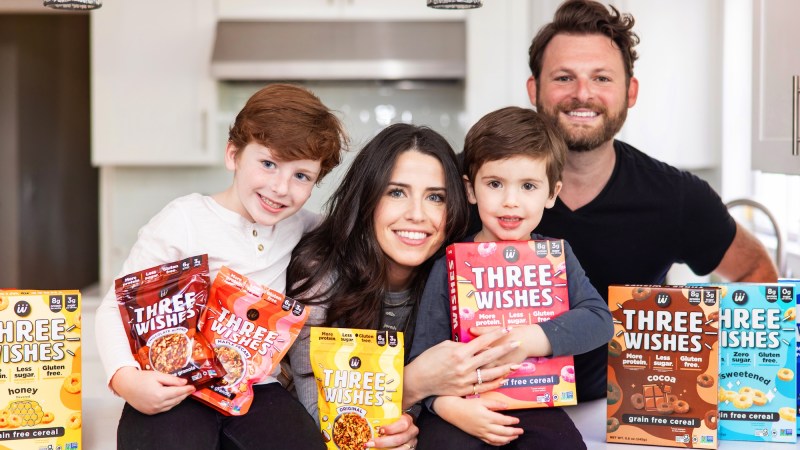
That lightbulb moment became Three Wishes Cereal, a grain-free, high-protein breakfast brand the Wishingrads built from their one-bedroom apartment starting in 2019. Six years later, the brand is now sold in more than 15,000 grocery stores nationwide, including Whole Foods, Sprouts, Wegmans and select Costco locations.
But the biggest challenge wasn’t just cracking the cereal code. It was figuring out how to work together as married co-founders and parents of young kids without killing each other.
The Wishingrads joined the One Day with Jon Bier podcast to talk to me about it. Here are some of the highlights.
Getting Three Wishes off the ground took longer than either of them expected. Ian figured they’d have a product “in two minutes.” Margaret had a more realistic perspective—more like two years.
That’s how long it took just to develop the recipe in their tiny one-bedroom apartment in New York City. They tasted more than 100 versions, trying to nail what they called their “three wishes”: high protein, low sugar and grain-free without tasting like cardboard. The couple bootstrapped the initial development with $250,000 of their own money.
During this time, the work dynamic started getting messy. This wasn’t their first rodeo—they’d worked together before at Ian’s ad agency and the hierarchy was clear: he was the boss; she was number two.
At Three Wishes, Margaret’s operational skills and strategic thinking made her the natural leader. “We kind of started equal, but then I took off and really ran the business,” she says.
At first, it was tough. “He wasn’t prepared to be number two, so it took him a minute to get there, but I think now he’s like, I trust her. She does a great job with building this brand. Go!”
For Ian, an “alpha” personality used to being in charge, this required genuine humility. “We’ve had to really learn to stay in our lanes,” he says, “because if not, it could just get so messy.” The lanes became clear over time. Ian handles creative and marketing as CMO. Margaret runs operations and strategy as CEO.
Related: The Truth About Being in Business With Your Spouse — How to Navigate Work and Life Together
It hasn’t always been smooth sailing. The marriage nearly didn’t survive the early years of Three Wishes. About two years into building the company, they hit what Ian calls “tough marital times.” Margaret withdrew. Ian pushed. They tried salsa dancing lessons to reconnect, but it didn’t work.
The dance instructor told them: “I’ve never had this before: two alphas both trying to lead.”
What saved them was the same thing that saved the business: defining roles, respecting boundaries and accepting that they bring different strengths to the table. “Ian paints with words, and I paint with pictures,” Margaret says.
Their advice to other married co-founders? Lean into your lane and stay there. Accept the awkwardness of working out power dynamics in real time. And remember that it’s all right to disagree, if you also bring solutions to the table.
Early on, Ian recalls Margaret “assassinating” a lot of his ideas. He didn’t mind her criticism, but he told her, “You can’t just crap on my ideas, you have to bring solves.” After she did that, she says she “earned a seat at the table.”
Standing in that cereal aisle six years ago, Margaret couldn’t have predicted she’d build a successful brand carried in 15,000 stores. Now when she picks up a box of Three Wishes cereal off the shelf, she sees her photograph on the back.
“It’s such a surreal thing – it’s like a fever dream. It’s not real, and somehow it worked out, and I really don’t even get how it all happened.”
Key Takeaways
- Margaret and Ian Wishingrad launched Three Wishes Cereal from their one-bedroom apartment in 2019 after finding zero healthy cereal options for their baby.
- The grain-free, high-protein brand is now sold in more than 15,000 stores after they bootstrapped it with $250,000.
- The couple had to completely redefine their power dynamic to save both their business and their marriage.
Margaret Wishingrad remembers standing in the cereal aisle of her grocery store, reading ingredient labels. It was sugar and grains for days. She had a baby boy who just started on solid foods, and there wasn’t a single option she felt comfortable feeding him.
She told her husband, Ian, who ran an ad agency building brands for other companies. Faster than you can say snap, crackle, pop, a lightning bolt struck. “It was like, Oh my God, there’s no one doing cereal yet,” Ian says. “That’s a perfect big category, ready for disruption. I don’t know how we’ll do it, but that’s the one.”
That lightbulb moment became Three Wishes Cereal, a grain-free, high-protein breakfast brand the Wishingrads built from their one-bedroom apartment starting in 2019. Six years later, the brand is now sold in more than 15,000 grocery stores nationwide, including Whole Foods, Sprouts, Wegmans and select Costco locations.