Companies That Fail to Align These 3 Things Will Lose the AI Race
I work with thousands of companies transforming their workforce with AI. The ones succeeding are taking decisive steps to bring HR, IT and finance together and drive real change.
Opinions expressed by Entrepreneur contributors are their own.
Key Takeaways
- HR must evolve from support role to strategic driver of measurable business outcomes.
- Companies that unify people, data and decisions will outperform slower, siloed competitors.
Generational threats have a way of forcing people inside companies to find different — and better — ways of working together.
We saw it during Covid, when HR, IT and finance teamed up to manage the transition from office life to remote teams. It wasn’t easy — but with no other choice, companies found new ways to collaborate and get work done, more efficiently than before.
In hindsight, that was almost a dress rehearsal for what’s happening now with AI.
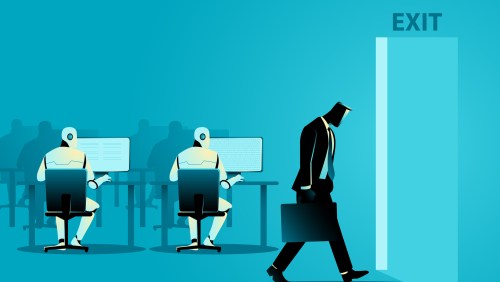
AI is already rearranging the business landscape faster than anyone anticipated. Its ultimate impact will be much bigger than the internet, the shift to the cloud or the mobile revolution. As much as $100 trillion could be up for grabs.
But only for companies able to keep up. Those that can’t will get crushed by smarter, nimbler rivals using AI to gain an edge. And the difference may come down to a department that’s traditionally overlooked in the AI discussion: HR.
The AI leadership vacuum
Right now, at most businesses, no one is in charge of AI. Six out of 10 senior leaders say it has no clear owner.
The challenge is that AI’s implications extend across departments. It’s fundamentally changing how people do their jobs. But it’s also intimately wrapped up with IT and has profound implications on finance and planning functions.
And that’s precisely why HR finds itself in a pivotal moment. As the people side of the org, it’s a natural fit to drive AI transformation — but not alone. Truly harnessing AI will require HR to do something new and different. Specifically, building bold new bridges with departments not normally allied with HR: IT and finance.
It won’t be easy. Organizational silos don’t vanish on goodwill alone. If HR, IT and finance really want to meet the AI challenge, they need a strategy.
I work with thousands of companies transforming their workforce with AI. The ones succeeding are taking decisive steps to bring HR, IT and finance together and drive real change. Here’s how.
Step 1: Bridge cultural and organizational barriers
As a technologist, I believe in the power of tools. So it might be surprising to hear this from me, but the No. 1 barrier to successful AI adoption isn’t technological. It’s cultural. In fact, in a recent survey of executives, half cited organizational and cultural hurdles as a critical barrier to AI success, while only about 40% flagged technical limitations.
CHROs, CIOs and CFOs have traditionally each operated in their own fiefdom, with their own priorities and preferences. Building a productive working relationship in the AI era starts with breaking down these walls — and rallying around a clear North Star.
For most companies today, that North Star is survival. In the face of fierce competition, shifting geopolitics and tech uncertainty, only the strong — and aligned — will survive.
What does this kind of collaboration look like in practice? An extreme example is pharmaceuticals giant Moderna, which wedded HR and IT, putting its CHRO in charge as chief people and digital technology officer. The new boss has expertise in digital transformation as well as HR.
Labels aside, breaking down barriers also requires a mindset shift. HR must stop thinking of itself as just an administrative or support function — and ask how it can help drive business results.
For CHROs, that means finding new and better ways to connect talent with outcomes. Turnover figures alone are instructive but not actionable, for example. The real power lies in showing how churn impacts spending and revenue targets.
Connecting those dots, however, is easier said than done, which brings us to Step 2.
Step 2: Connect talent with outcomes
Right now, almost every company is collecting the data needed to make the right decisions about how and where to leverage AI. It’s all there — in HRM systems and CRMs and ERM platforms and dozens of other places.
But the problem is it’s not connected. HR data lives in its silo (or, more accurately, silos). Financial and performance data in another. Customer and sales data in yet another. So opportunities to truly connect talent with outcomes are missed.
Does paying more for our sales talent boost revenue? Can those support reps be replaced by bots without compromising customer retention? Does more manager training equate to higher performance? In most companies, the honest answer is, “Your guess is as good as mine.”
Even good-faith attempts to share insights across departments are undermined by data misalignment. Total Cost of Workforce, for instance, means one thing to HR and something very different to finance. For most companies, problems with poor data quality costs 15% to 25% of annual revenue.
What’s needed is a single source of truth that connects talent with business outcomes. Instead of siloed, proprietary data sets, companies need one reliable authority for insights on their workforce. Especially in the AI era, such insights are only as good as the underlying data they’re based on.
The companies I see leading AI transformation have found ways to bring their data together. CHROs are working alongside CIOs and CFOs to not only share pivotal data, but standardize and normalize it — all in ways that are unlocking bold new insights.
For example, a bank was considering replacing the majority of its customer support department with chatbots. By aligning performance and CRM data, HR and finance discovered that team members with three to five years’ experience consistently achieve exceptional customer satisfaction and net promoter scores. So rather than proceeding with mass layoffs, the bank kept that high-performing cohort while also boosting its retention bonuses.
For businesses, combining all of this data themselves can get expensive. Instead, they can leverage the experience of vendors who specialize in it.
Step 3: Use AI to bridge the last-mile gap
There’s still one roadblock to overcome in unlocking real AI transformation. Even when HR finds ways to build bridges and connect talent with outcomes, a “last-mile” problem needs to be solved — getting these insights into the hands of managers who need them most.
Historically, even for companies wanting to link talent to results, information has been buried in dense graphs, reports and dashboards. Unless you’re an analyst, insights often remain out of reach.
That leaves frontline managers in the lurch — wait for a report to come back or rely on gut instinct for critical hiring and promotion decisions? In the age of AI, those decisions need to be made exponentially faster, and delays can be fatal.
It’s here, however, that smart companies are treating AI as a workforce solution, not merely a challenge. The companies I work with are leveraging it to give managers real-time insights when they need them.
New tools enable managers to ask questions about their people in plain language and swiftly get a clear, reasoned answer. “Who’s my top performer?”, “Why are people quitting?”, or “Is our star player underpaid?”
Because HR, IT and finance have brought data together in meaningful ways, responses are reliable, contextualized and updated in real-time. Managers get concrete, data-backed suggestions and recommendations but remain in the driver’s seat to make the final call.
But none of this can happen unless HR, IT and finance form a united front. In an era where tech moves at warp speed, relationships and mutual respect have never been more important. The goal should be more collaboration between departments, not less. That puts HR, with its deep understanding of what makes people tick, in a strong position to connect talent with results.
Key Takeaways
- HR must evolve from support role to strategic driver of measurable business outcomes.
- Companies that unify people, data and decisions will outperform slower, siloed competitors.
Generational threats have a way of forcing people inside companies to find different — and better — ways of working together.
We saw it during Covid, when HR, IT and finance teamed up to manage the transition from office life to remote teams. It wasn’t easy — but with no other choice, companies found new ways to collaborate and get work done, more efficiently than before.
In hindsight, that was almost a dress rehearsal for what’s happening now with AI.
AI is already rearranging the business landscape faster than anyone anticipated. Its ultimate impact will be much bigger than the internet, the shift to the cloud or the mobile revolution. As much as $100 trillion could be up for grabs.