What Makes a Killer Meta Ad, According to Experts
Check out these four real life side-by-side examples.
This story appears in the July 2026 issue of Entrepreneur. Subscribe »
Do you run ads on Meta? Have the results been unpredictable lately? There’s a good reason for that.
Late last year, Meta added an update called Andromeda. It’s a major shift in how ads are delivered. In the past, Meta ads were all about targeting: You refined the audience you wanted to serve, and then hit them with ads. But in Meta’s new system, targeting is automated — and Meta is now watching closely for performance. If your ad doesn’t immediately resonate with people, it’ll get filtered out. As a result, brands need to produce a lot more creative. You’ll win by constantly testing new ideas and comparing them. And these ads must look and feel very different from each other — because if Meta thinks they’re too similar, it won’t test them individually.
What does that look like, and what can you learn from these tests? We put together this case study.
Nove8 makes consumer-facing apps, and relies heavily on digital advertising. “Ninety-five percent of our success is performance marketing,” says cofounder Natalia Shahmetova. It has helped grow the company to $35 million in annual revenue. “We’ve run thousands of tests with different creative, and thanks to Meta algorithms, we know whether the ad is good or not within the first hour of a campaign.”
Shahmetova shared with us the results of some of those tests from Nove8’s dog-training app Woofz and fashion app Stylio. Then we asked the performance marketing agency Pilothouse Digital (which was not involved in making the ads, and could look at them with fresh eyes) to weigh in on why the winners succeeded. By understanding what worked for Nove8, you can improve your ads too.
(click on images to enlarge)
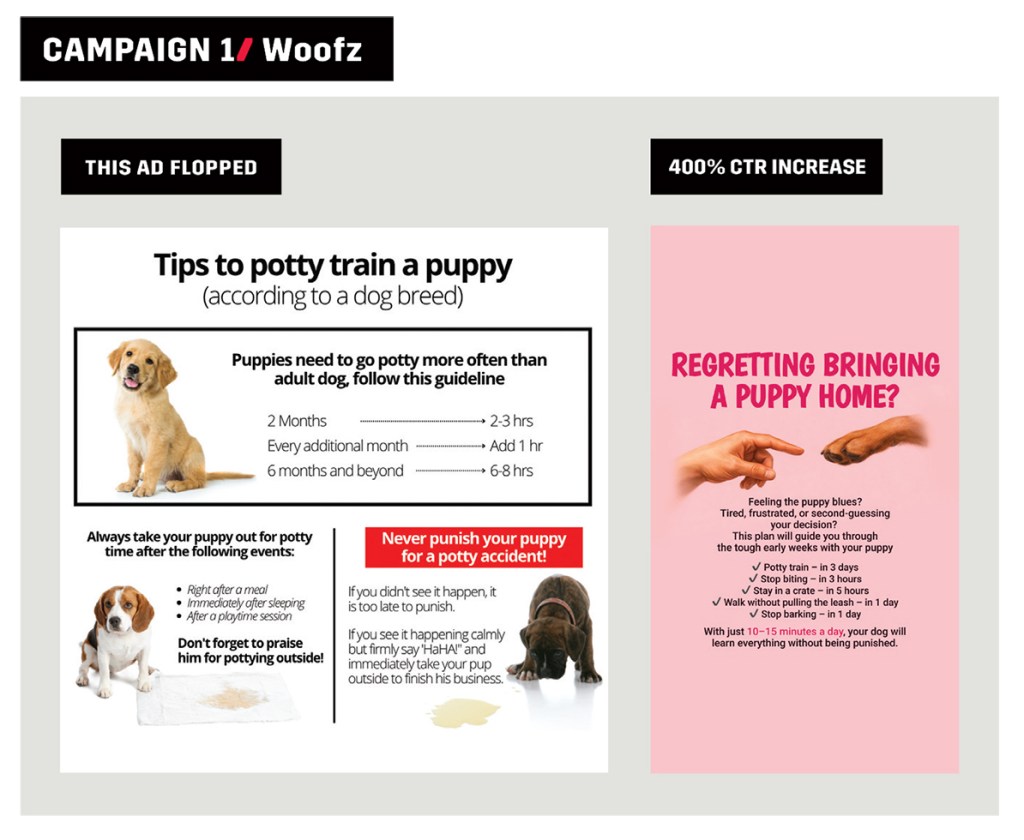
The first ad shared potty training tips. The second ad spoke more personally to dog owners. “Instead of focusing on the pet’s behaviors with complex guides, we focused on the owner’s emotions, reassuring them that the tough moments are normal and easily overcome,” says Nove8.
The result: The second ad drove a 400% increase in click-through rate (CTR).
WHY IT WORKED: Pilothouse says: The weaker ad makes puppy ownership feel like a lot of work, with overwhelming details (take the puppy out every two to three hours, add a play session, etc.). The winning ad immediately reframes the chaos as containable: “Potty train in 3 days.”
But the real breakthrough is the line: “Regretting bringing a puppy home?” That names the taboo emotion most pet brands refuse to touch. It recognizes that the deeper job to be done here is not really “teach my dog where to pee.” It is instead “help me stop feeling overwhelmed, guilty, and incompetent.” The first ad explains the product, but the second markets relief.
Consumers often search at the symptom layer but buy at the identity layer. In other words, while they type in potty training questions, they are really asking: Is this normal? Did I screw up my life?
THE BIG LESSON: Stop answering only the problem customers are willing to ask out loud. The strongest performing creative names the private crisis beneath it.
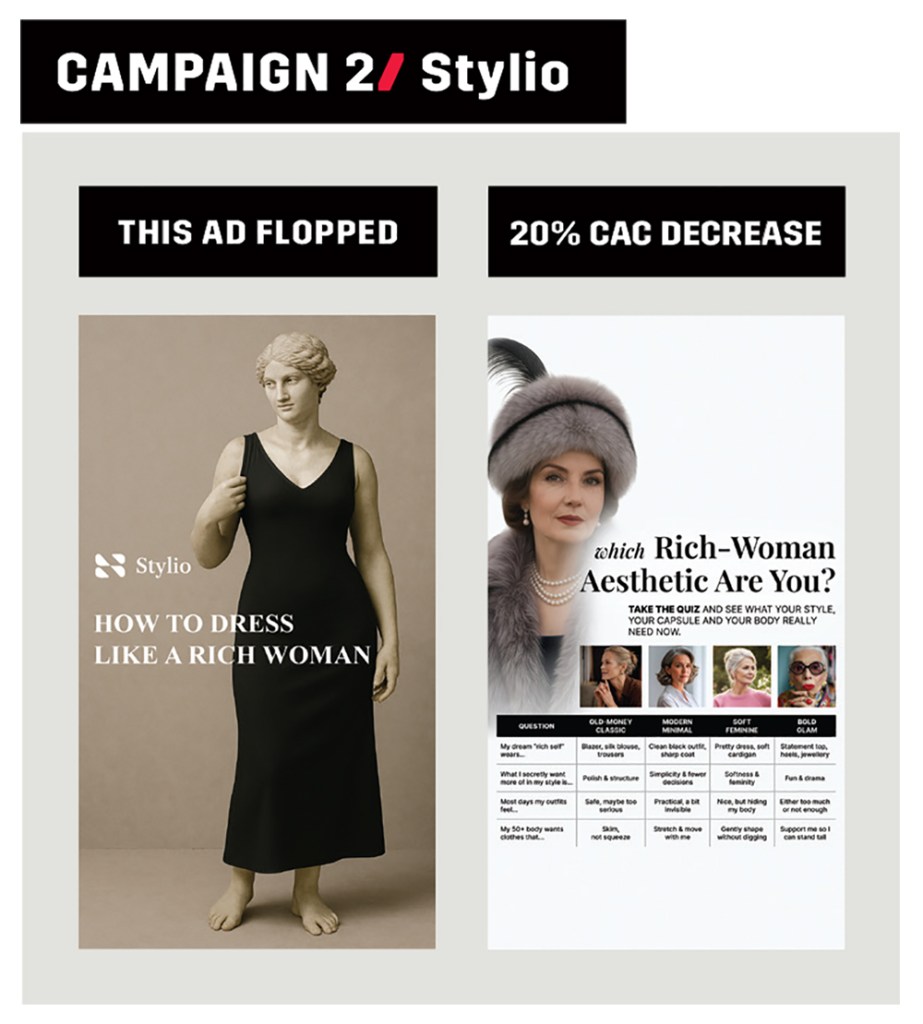
The first ad promised information on “how to dress like a rich woman.” The second was a quiz, asking users what kind of rich woman they dress like. “Most potential customers don’t click through to learn what you offer, so instead of relying on a short call to action to hook them, we demonstrated the expertise Stylio offers directly in the ad,” explains Nove8.
The result: The second ad drove a 20% decrease in customer acquisition cost.
WHY IT WORKED: Pilothouse says: The better ad also succeeds because as soon as a user reads “Old-Money Classic” or “Modern Minimal,” she is sorting herself. Categorization creates powerful psychological buy-in and makes the brand feel like an interpreter of identity. The smartest move is language like a “50+ body,” “skim, not squeeze,” and “nice, but hiding my body”—which proves that the brand understands not just style, but also the user’s lived experience, while helping Meta classify who should receive the ad.
THE BIG LESSON: Stop asking people to click for value you could have demonstrated in-feed.
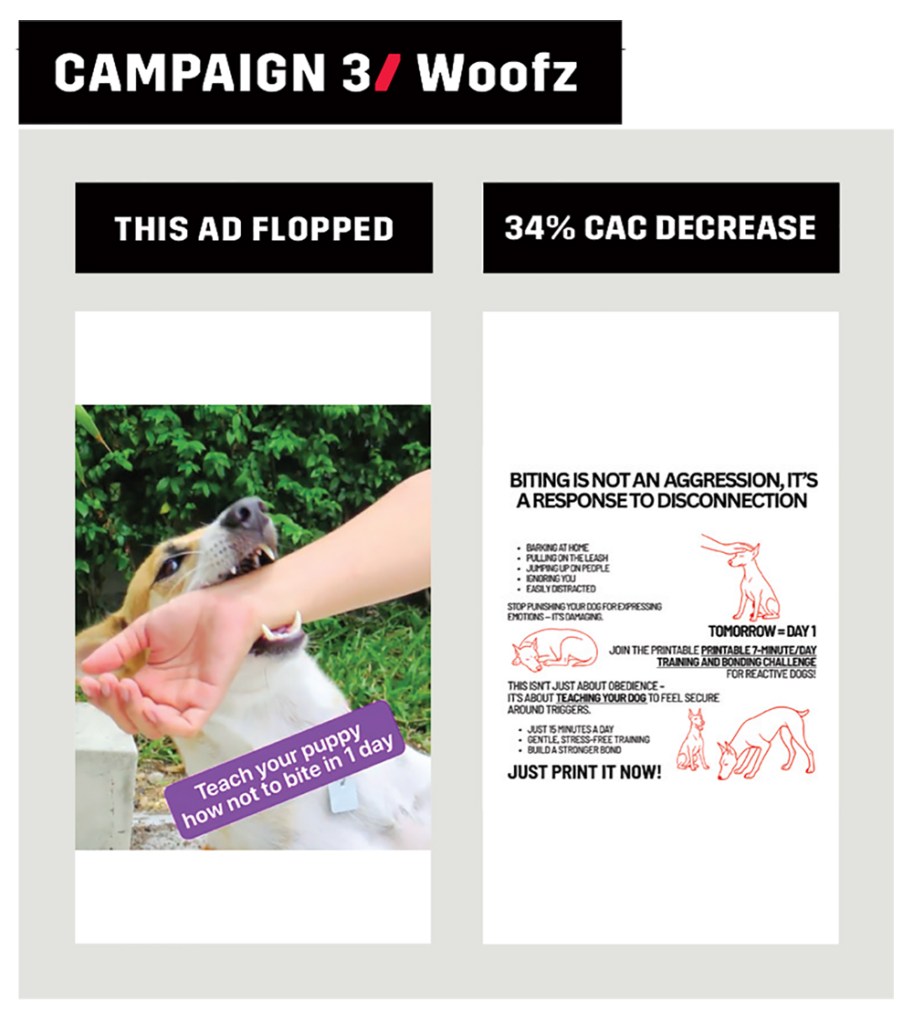
The first ad promised to stop puppies from biting. The second explained why dogs bite in the first place. “Instead of focusing on correcting behaviors, we focused on explaining the behaviors—because there are countless videos, websites, and products promising to stop negative behaviors, but few address the underlying cause,” says Nove8.
The result: The second ad drove a 34% decrease in customer acquisition cost (CAC).
WHY IT WORKED: Pilothouse says: In-feed, diagnosis beats instruction. Also, that first ad risks sounding like another hack. (Teach your dog not to bite in one day? Really?) On Meta and TikTok, it casts a broad, noisy net around urgency. The second ad’s instructional visual format feels measured, expert, and low-threat. It prequalifies the right user before the click and gives the platform cleaner data about who finds this relevant.
THE BIG LESSON: In modern performance creative, the winning ad often interprets the customer more accurately, rather than explain the product more aggressively.
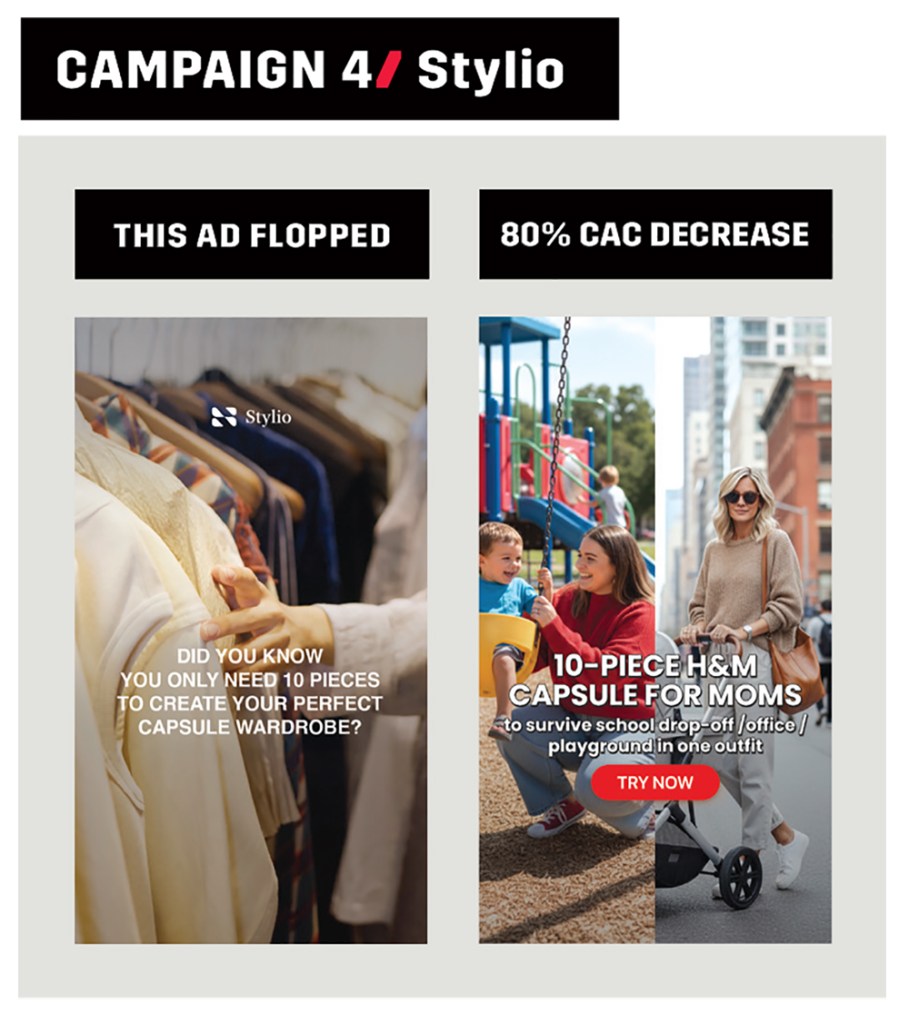
The first ad shared a fact: You only need 10 pieces to create the perfect wardrobe. The second ad was specifically for moms. Why? “If you try to speak to all customers, most won’t feel spoken to at all. So instead, we focused on a specific person,” says Nove8.
The result: CAC was down by 80%.
WHY IT WORKED: Pilothouse says: The underperforming ad sold a fashion framework, but the winning ad sold relief for a very specific kind of woman living a very specific kind of day. And when consumers feel uniquely seen, they’re much more interested.
On Meta, the first ad might have reached more people. But that’s expensive, because Stylio would be paying for all that reach. By defining a cleaner pool of high-intent customers, they’re reaching fewer people but converting more, and saving money.
THE BIG LESSON: It’s not that brands should blindly niche down. The specificity only becomes powerful when it captures a real tension in a human problem and makes the customer feel understood.
Do you run ads on Meta? Have the results been unpredictable lately? There’s a good reason for that.
Late last year, Meta added an update called Andromeda. It’s a major shift in how ads are delivered. In the past, Meta ads were all about targeting: You refined the audience you wanted to serve, and then hit them with ads. But in Meta’s new system, targeting is automated — and Meta is now watching closely for performance. If your ad doesn’t immediately resonate with people, it’ll get filtered out. As a result, brands need to produce a lot more creative. You’ll win by constantly testing new ideas and comparing them. And these ads must look and feel very different from each other — because if Meta thinks they’re too similar, it won’t test them individually.
What does that look like, and what can you learn from these tests? We put together this case study.