This Nostalgic Apple Product Is Making a Major Comeback — and You Can Thank Gen Z For It
It first launched 25 years ago and was discontinued in 2022. Now it’s attracting a new generation of fans — many of whom weren’t even born when it debuted.
Key Takeaways
- Gen Z and young adults are buying old iPods to get away from streaming fatigue, opting to own their music libraries instead.
- The iPod’s single‑purpose design lets users focus solely on listening to music.
- Former iPod designer Tony Fadell argued the trend shows demand for “digital that’s not connected, but not necessarily analog.”
Welcome back, iPod.
The Apple product, which first launched 25 years ago and was discontinued in 2022, is attracting a new generation of fans — many of whom weren’t even born when it debuted. Like old-school digital cameras and other early-2000s gadgets, it’s riding a wave of nostalgia among young music listeners for a time when life felt a lot simpler than it does now, The New York Times reported this week.
Last year, people typed “iPod” into eBay’s search bar over 8% more often than they did in 2024, and listings for some models jumped by around 30%, according to the Times. In 2025, certain generations of iPods were selling for about 60% more on average than in 2023, with some refurbished ones listed for close to $600. Most mainstream iPod models sold for $100 to $400 in retail stores, depending on generation, storage and form factor. For example, the 2005 iPod Nano launched for $199 for 2 GB of storage.
One iPod adopter, 25-year-old Angeline Richard, told the outlet that she bought a silver third-generation iPod Nano from eBay for $40 in January as part of a resolution to “get off as many streaming services as possible” and “own the things” she listens to. She has downloaded about a dozen albums to her iPod, and says adding music has been “so fun” and “like a little meditation.”
The Gen Z content creator says the iPod helps her stay focused by blocking other notifications. The iPod “just grounds me, and it feels convenient to be in one place at one time, instead of everywhere at once,” she told the Times.
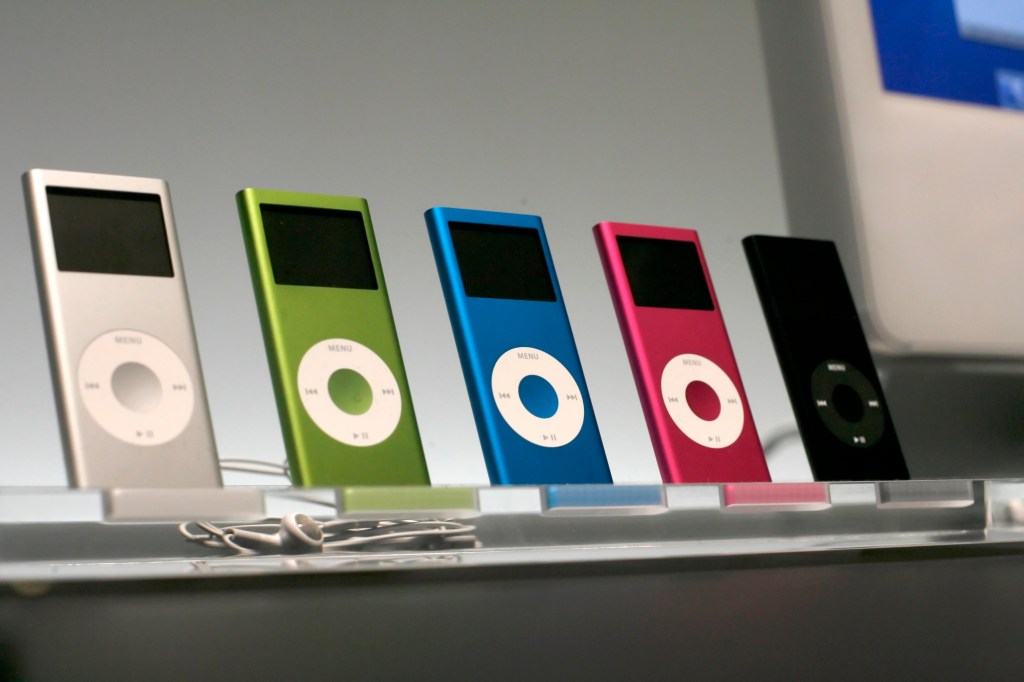
Apple rolled out the iPod in 2001, a digital music player that went on to reshape both gadgets and the music business. Before that, most players could only hold a few dozen tracks. The first iPod, with its steel body, white front and clickable wheel, could squeeze in about 1,000 songs and sold for $399.
Over the next 20 years, Apple introduced more than 20 different iPod models. The company slowly shifted its attention to the iPhone and phased out the iPod. By the product’s final year in 2022, Apple had sold an estimated 450 million of them, per the New York Times.
The iPod’s comeback shows that “people want digital that’s not connected, but not necessarily analog,” Tony Fadell, a former Apple executive who helped shape the iPod, told the outlet. If the choice is “1,000 songs in my pocket, or unlimited songs in my pocket and 1,000 notifications every hour,” most people will choose the first option, he predicted.
The iPod has one purpose and one function, a narrow focus that makes it attractive to young listeners. Theresa Bertrand, head of strategy and planning U.S. at the New York City-based strategic communications company Zeno, told Quartz that the iPod “turns music back into an intentional act.”
“Using an iPod is almost a quiet sort of rebellion against the idea that every moment needs to be optimized, shared, or monetized,” she told the outlet.
Sign up for the Entrepreneur Daily newsletter to get the news and resources you need to know today to help you run your business better. Get it in your inbox.
Key Takeaways
- Gen Z and young adults are buying old iPods to get away from streaming fatigue, opting to own their music libraries instead.
- The iPod’s single‑purpose design lets users focus solely on listening to music.
- Former iPod designer Tony Fadell argued the trend shows demand for “digital that’s not connected, but not necessarily analog.”
Welcome back, iPod.
The Apple product, which first launched 25 years ago and was discontinued in 2022, is attracting a new generation of fans — many of whom weren’t even born when it debuted. Like old-school digital cameras and other early-2000s gadgets, it’s riding a wave of nostalgia among young music listeners for a time when life felt a lot simpler than it does now, The New York Times reported this week.
Last year, people typed “iPod” into eBay’s search bar over 8% more often than they did in 2024, and listings for some models jumped by around 30%, according to the Times. In 2025, certain generations of iPods were selling for about 60% more on average than in 2023, with some refurbished ones listed for close to $600. Most mainstream iPod models sold for $100 to $400 in retail stores, depending on generation, storage and form factor. For example, the 2005 iPod Nano launched for $199 for 2 GB of storage.