Jersey Mike’s Sold for $8 Billion. Their New CEO Is Ready to Double Their 3,200 U.S. Locations.
Jersey Mike’s is #1 on the Franchise 500 for the first time, with a new CEO. He plans to scale at an ambitious pace, while preserving the brand’s 50-year legacy.
This story appears in the January 2026 issue of Entrepreneur. Subscribe »
To view our entire 2026 Franchise 500 list, including category rankings, click HERE.
How big can Jersey Mike’s get? The world of franchising is about to find out.
Until recently, Jersey Mike’s was a story of homespun grit. It began as a tiny sandwich shop, was purchased by a young employee named Peter Cancro, and then Cancro spent 50 years growing it into the brand it’s become.
Now, a new chapter has begun. In November 2024, Cancro sold the brand to the private equity firm Blackstone for $8 billion — and a few months later, in April 2025, announced that he was stepping down as CEO. The brand’s new leader is Charlie Morrison, a veteran of franchising with a reputation for growth. He was the CEO of Wingstop, which he grew from fewer than 500 to 2,000-plus locations, as well as the CEO of Salad and Go, where he grew the brand’s store count sevenfold.
“I think we have a ton of opportunity to continue to grow Jersey Mike’s,” Morrison says. “We’re at about 3,200 stores now. We could probably double that in the U.S. as we go forward. And we have a huge opportunity to grow the brand overseas.”
That mandate is already showing up in the numbers. Jersey Mike’s has been on the Franchise 500’s Top 10 list for eight straight years, and was No. 2 last year. Now, for the first time in its history, it has reached No. 1. “I can’t take credit,” Morrison says. “But what I can tell you is this is a culmination of 50 years of really hard work.”
Related: Jersey Mike’s Grew From Hometown Hero to National Powerhouse By Adopting This Mindset
As he enters his first full year of Jersey Mike’s leadership, he says he wants to be mindful of that legacy. He’s seen other brands make mistakes in the name of growth — like forgetting why people love the brand or degrading a product that works. At Jersey Mike’s, he says, he’s not there to fix anything. He’s just there to accelerate it.
Here, Morrison shares his philosophy on growth, legacy, and building trust amid change.
As a new CEO, you represent a lot of change. How do you think about maintaining a brand’s legacy while also moving it forward?
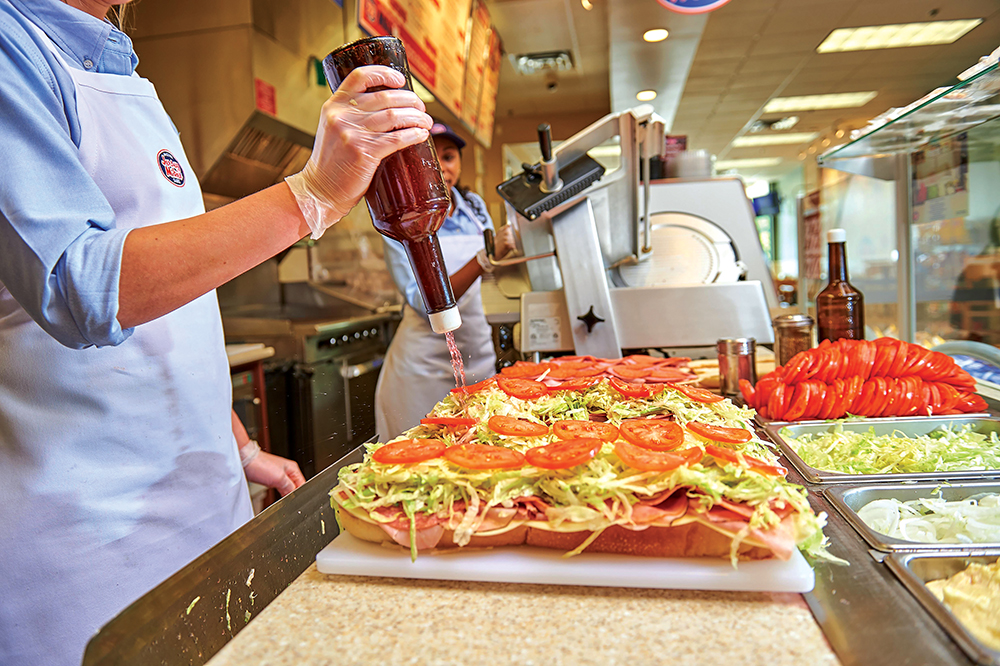
At any brand you lead, you first need to learn a lot about what it is that got you to where you are today. It’s incumbent upon you to understand: What is it that makes Jersey Mike’s so special? Certainly the food. We’ve been doing this the same way for many, many years — hand-slicing every tomato every morning, the lettuce, the onions, baking the bread. There’s an art and a lot of love that’s put into this.
But it all centers back on the people themselves and who they are and what they’ve done, and the challenges they’ve faced to get to this point. So, when I learn that, it makes me think: OK, what do I need to do now to continue this growth, to amplify it perhaps at a different level, but not lose sight of the true heritage and roots of this organization that exist?
I’ve seen other food brands lose sight of what the product was, what it meant to the consumer in their early days. They focused on cost control or other types of measures, to the detriment of the preference of the consumer, and then they applied marketing strategies to try and bring the customer back.
I want to hand-slice every sub the way we’ve done it for 50 years and more. Why would we change what’s working so well?
How do you build trust as a new CEO?
I’ve learned this over a long period of time: The best way to build trust is to demonstrate real vulnerability. Just be you. Be honest, be engaging, thoughtful. Listen effectively. Hear what people have to say. And then be candid in your response.
When I first got here, I met with our largest franchise operators and what we call our area directors, people who manage groups of franchisees. I got ’em all together in one room, and we sat and talked. And it was just me. I didn’t have the team behind me. I said, “I want to hear what’s on your mind. What are the biggest things that concern you? What are you worried about with regard to the Blackstone acquisition, or whatever else you’re wondering about?” And we just had an honest conversation. It’s my job to follow up with them and give them an ear with our team members.
I also put a box in the office that on the outside of it says, “Ask Charlie.” It’s under lock and key. At any point, if you want to write a little handwritten note to me to ask me a question, you can put it in that box. But the thing I do differently is: I don’t look at it until I get in front of the entire company, face to face. Then my assistant hands me the box, and I answer every single question, regardless of what the question is, how difficult it is, how painful it might be.
By not preparing your answers ahead of time, you’re essentially saying to them: There are no barriers between us, and I’ll just tell you what I think.
Yes. It’s the idea of being vulnerable and saying, “Look, I really do appreciate the real questions, the tough questions that people won’t raise their hand in a big room and ask you about.” And it gives everyone an opportunity to see that I care and that I want to earn their trust. And earning their trust is the best way to build a really high-functioning team that’s going to be able to carry this brand from where we’ve been to the journey forward.
What have people asked you about?
Change is the biggest challenge on anybody’s mind. What can we do to avoid anything that ultimately degrades the concept? There’s this misperception that private equity will do that, and I’m trying to ease the anxiety around that. I think building that trust and having that conversation with them directly helps.
But there were also lots of changes happening even before Blackstone showed up or Peter sold the company. Franchisees were saying, “Hey, can we slow the pace?” Some of it was just about new product-related ideas, like adding a sauce or a dressing or something for the subs that seemed like, Is it really moving the needle for the organization?
This is a constant tension in franchising. Franchises want to drive growth and innovation, but that means rolling it out to a wide spectrum of franchisees, who may be happy with how things are. How do you navigate that?
There is always pressure to figure out how we can add something to enhance our sales and grow it. Some businesses have done a great job of adapting to change that’s constant. And that’s fine. But I think you’ll generally see that brands go through cycles of immense change followed by compression — trying to simplify and reestablish themselves and the roots of where they came from and then they go back into the complexity cycle again.
My firm belief is that we have a wonderful lineup of products. I don’t know that we need to add a lot more to make the brand more appealing to anybody else. At the end of the day, we need to keep it simple and focus on our long-term success. Let’s go execute. And execute really, really well.
That’s what the customer’s really looking for: consistency, high quality. Don’t skimp on ingredients. Don’t modify the product such that it starts to erode dramatically. Give people a great value, and they’ll come back and return over and over and over again.
If you look over time, the best brands are those that have not added complexity by way of change. I think complexity kills. The operators get dissatisfied because so much change is hitting them all the time. So if I can do one thing, it would be to ward off that pressure to feel like you have to institute change in order to grow. I think you can grow by just doing what you do, doing it extraordinarily well, and keeping it simple.
How else do you plan to grow?
There are a couple factors at play. When I first came in, I told our franchise owners that my number-one priority is their return on investment.
So as I think about growth, everything we do should be pointed at what we call a “cash-on-cash return”: How much do you invest, and how much do you give back, such that franchisees not only earn a good living off of running the store or stores that they operate, but they actually create extraordinary value and have a strong desire to continue to grow the business well into the future? That’s at the core of franchising. So our focus is to make sure that we maintain our great unit economics.
Related: Ground Floor to Sky High — The Unmatched Potential of Investing in Emerging Franchises
What’s the other factor?
Awareness of the brand and engagement of the consumer — the frequency in which they come and visit us — are critical.
Our brand enjoys 92% aided awareness, which is among the best in class for big brands, which is great. But there are probably 80 or 90 million people in the United States alone that have tried our product but only use us with limited frequency. So we’ve got to capture them. We can expand the audience with digital marketing strategies and leveraging social media and other tactics. Let’s increase their frequency — get them to enjoy and love our sandwiches and to move away from places where they’re not getting as good quality. And we’re doing that.
What do you think future Jersey Mike’s franchisees will look like?
Over time, as franchise brands get bigger, they don’t necessarily add net new franchisees to the system. Instead, they grow from within. So we really want our existing franchisees to grow with us and build their legacies for their families and their organizations.
There is a reinvestment cycle that you want from your existing operators. It’s easiest to sell another store to an existing player or existing customer, right? There have been brands over the years who have said, “OK, good job, you’re in. You’ve got your store. Now let me go find one more.” And they find the next person. That’s a lot of work. You have to qualify that person. You have to make sure they show up. Whereas if we find you, and you’re successful and you do really well, then let’s grow with you. Let’s do more. Let’s continue to expand. That’s the secret to great franchising: You find great owners and you run with them and make them a partner as you grow.
You’ll see us continue to bring new folks in, but the commitment I’ve made with our existing franchisees is: We want to grow with you into the future. They have choices to make and choices of how to deploy their capital, and the profits that they’ve generated from their first, second, third, 10th stores. It’s incumbent upon us to make sure that we continue to deliver a great product for them. Again, they are the primary customers of a franchisor.
Now I understand your point about unit economics above. The greater the economics, the more likely that existing franchisees will want to buy more units.
I just got back from the restaurant finance conference in Las Vegas recently, and everywhere I went, I had more people coming up saying, “I want to be a part of Jersey Mike’s. I want to grow with Jersey Mike’s.” Existing operators, new operators. And that’s a great position to be in. It’s why we got to the top of the Franchise 500. It’s why we’re going to stay at the top, because they see the value in this model and building this model.
As you look to the year and years ahead, what do you see?
It’s an interesting time. We have this overhang of tariffs. We have all these different things affecting businesses throughout America. We’re really focused on playing offense in our business, not a defensive strategy. I think customers want value, and we’re going to present ways to demonstrate our product has great value without sacrificing an ounce of quality. In fact, we might invest in quality as a way to do that. If there’s any time where execution matters and doing what you do really, really well matters, it’s right now.
Related: Unlocking Growth — The Power of KPIs in Driving Franchise Brand Success
Sign up for our weekly Franchise newsletter to get the latest franchise news, advice and opportunities. Get it in your inbox.
