The Packaging Mistake Most CPG Founders Make
Skip setbacks with these hard-won lessons.
This story appears in the March 2026 issue of Entrepreneur. Subscribe »
So you have an amazing idea for a product or Consumer Packaged Goods (CPG) company. Once you have your business plan, and funding, you get down to the work of branding, marketing, and selling to retailers. Here’s what to keep in mind.
The Packaging Mistake Most Founders Make
Early-stage founders often put the wrong language on their packaging. Why? Because they’re using the words that make sense to them — and they forget how foreign it might sound to their consumer.
Olipop’s evolution is instructive. The brand went through many iterations, and is now reportedly on track for $500 million in sales.
Look closely at those cans, and how the product description changed over time:
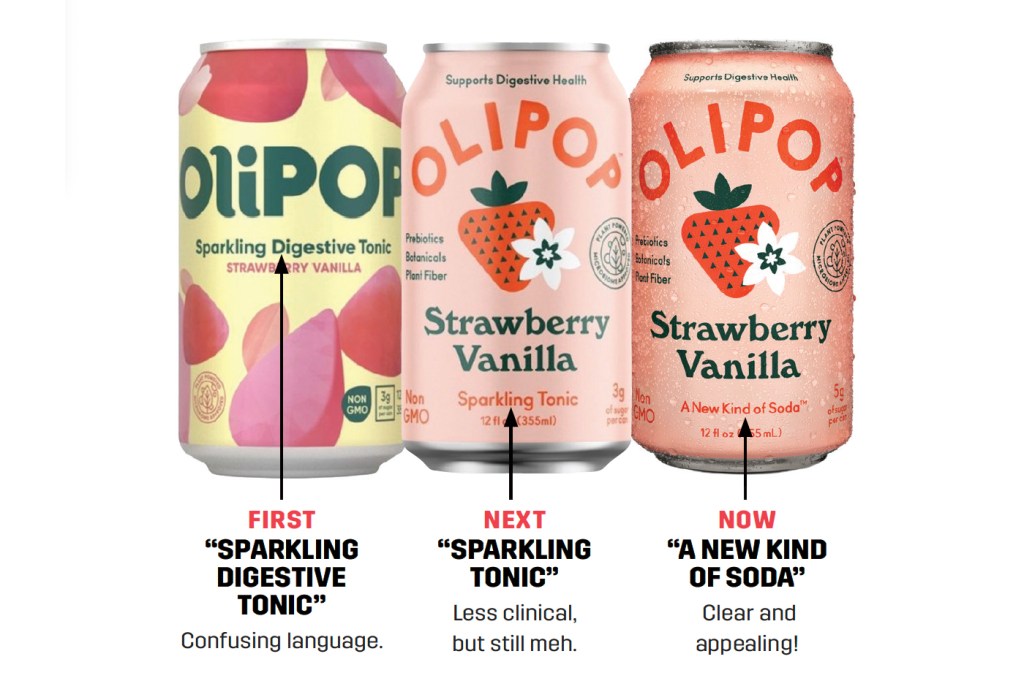
Along the way, Olipop also added “Supports Digestive Health” at the top of the can.
Your consumer doesn’t speak your language. They speak their language. They care about their problems, their desires, their familiar territory — so that’s what you need to care about too.
Not sure if your language is clear enough? Try this three-second test: Show your package to a stranger. If they can’t immediately say what it is and why it’s worth choosing, your language is wrong.
Related: How Food and Beverage Startups Can Leverage AR Packaging to Boost Sales
What to do at a retail buyer meeting
You’ve landed a first meeting with a retail buyer. Here’s how to impress them, and ultimately get your product on their shelves, according to former Target buyer (and now vice president of food and beverage at The Genesis Company) Matt Adelmann.
- Ask MORE questions.
Too many founders talk nonstop. Your real goal is research. Understand the buyer’s strategy and category priorities. That helps you position your product as their solution. - Keep the deck simple.
Retailers value brevity. In fact, many explicitly ask brands to limit the number of slides in their deck. Follow that signal. Concise, structured information wins every time. - Get explicit on success metrics.
Ask how they measure success: category role, velocity, margin, sales per store per week. Every retailer has targets. Know what you must deliver to stay on the shelf.
Remember: Buyers see lots of brands. Your job is to help them grow sales and grow the category. That’s how you win.
Related: Retail Expansion Isn’t Scary — Here’s 6 Ways to Make It Work for You
Warning: Don’t over-email subscribers!
Many CPG brands offer subscriptions. But it’s easy to lose subscribers by over-emailing them.
Do this instead:
In the first 10 days: Send a few onboarding emails to reaffirm their decision to subscribe, explain the product, share why customers love it, and set proper expectations (like how often shipments will arrive). After that: No marketing emails. If you send any, they might cancel.
WHY IT MATTERS: Subscribers are already committed to your product. Constant emails feel like pestering rather than adding value. They want the product to work, not to be sold to.
Related: Email Isn’t Dead — But Your Strategy Might Be. Here’s How to Revive It
So you have an amazing idea for a product or Consumer Packaged Goods (CPG) company. Once you have your business plan, and funding, you get down to the work of branding, marketing, and selling to retailers. Here’s what to keep in mind.
The Packaging Mistake Most Founders Make
Early-stage founders often put the wrong language on their packaging. Why? Because they’re using the words that make sense to them — and they forget how foreign it might sound to their consumer.
Olipop’s evolution is instructive. The brand went through many iterations, and is now reportedly on track for $500 million in sales.


