They Bet Everything to Turn a Simple Snack into a Restaurant Brand. Now They’re on Track for $20 Million in Revenue.
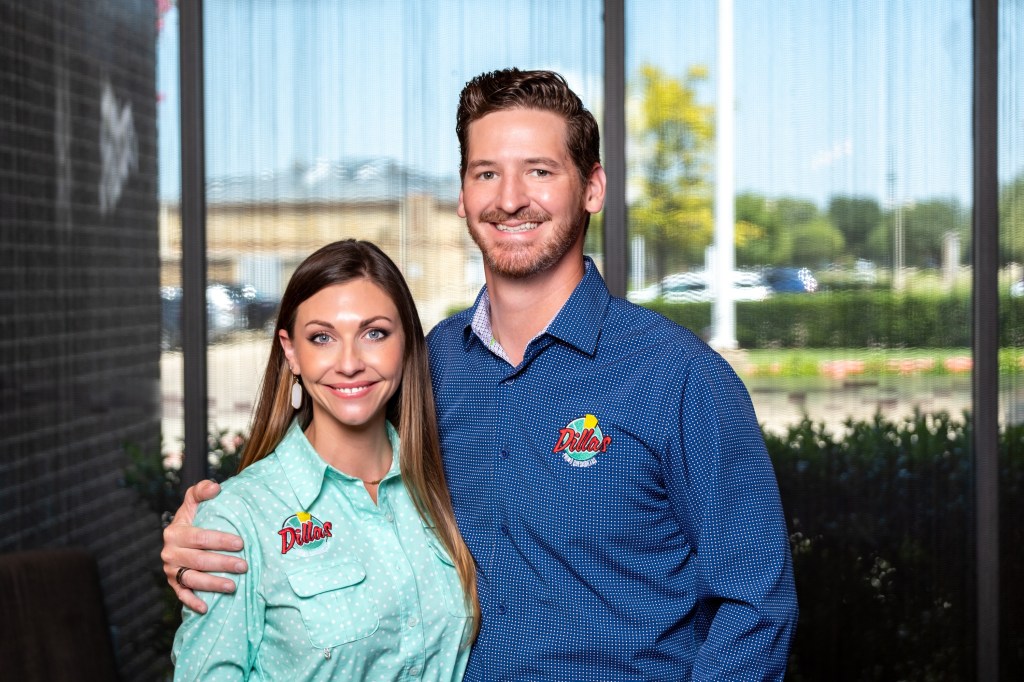
Kyle and Maggie Gordon wanted to elevate this food from a mere side note or appetizer to the main dish.
Key Takeaways
- More than a decade ago, Kyle and Maggie Gordon set out to define a category of fast food.
- The husband-and-wife duo bet their entire savings on the belief that this food could be the next big category.
- They began franchising in 2021 after they were confident in the systems they had built.
In 2013, Kyle and Maggie Gordon opened the first Dillas Primo Quesadillas in Plano, Texas, dedicating their resources to a restaurant solely focused on quesadillas. The husband-and-wife duo believed that the quesadilla could be the next chicken fingers — a simple, universally adored food category. They were willing to bet the family’s savings on it, even though, at the time, they were in their late 20s and had young children.
They planned to spend $200,000 to get the first Dillas location up and running, but Kyle tells Entrepreneur that it ultimately cost around $500,000.
“We passed the hat around,” Kyle says. “It was friends and family and Maggie’s and my savings. We couldn’t get a bank loan, so that’s how you had to do it back in the day.”
Thirteen years later, their bet is paying off. Dillas has 11 locations across Texas and Louisiana, with average annual sales revenue of around $2 million per location. The top location is approaching $2.5 million in sales revenue. The company’s projected 2026 revenue is $20 million.
“We knew that we had a unique space,” Maggie says. “We’re the only quesadilla-focused concept, putting that front and center. There’s no one else doing it, so that was something super unique.”
The following Q&A with Kyle and Maggie has been edited for clarity and concision.
Backgrounds and early careers
Could you tell me more about yourselves? What are your educational backgrounds and early work histories?
Maggie: I graduated from the University of Texas at Austin in 2006 with a PR degree from the advertising school. I went straight into the corporate advertising world as a media planner. When we started a family, I shifted into freelance marketing work for a while until we started Dillas. Fun fact: I was also an esthetician for a period in the middle there before Kyle and I launched Dillas in 2013. We’ve been working together on the brand ever since.
Kyle: Maggie and I met at the University of Texas at Austin — that’s where I went to school as well. My major was in government, but I knew I wasn’t going to pursue a traditional path in that field. After graduating, we moved to Dallas, and I got a job at Raising Cane’s, the chicken finger restaurant concept. I started as an hourly shift leader, eventually became a general manager, and then a managing partner there. That was the only job I had until I left to start Dillas in 2013, when I decided to pursue my dream of building something of my own.
Origin of Dillas
Take me back to the moment Dillas came to be. Who came up with the idea, and how did you communicate it?
Kyle: The idea for Dillas started back in college in the early 2000s. I wasn’t the most academically aligned student, so I was always trying to figure out what I would do after graduating, especially since I knew I wouldn’t use my government degree directly. Around that time, fast-casual concepts like Chipotle were emerging, and I was drawn to that space. I came up with a concept for a quesadilla-focused restaurant called Dillas because I saw the quesadilla as a flexible vehicle that people loved. I felt it deserved to be featured as the main event, not treated as a side. It became a long-term dream, and over the years I stacked smaller enabling goals to eventually make it a reality.
Maggie: When I met Kyle at UT, his family was living in Austin and still does. There was a local restaurant they’d gone to their whole lives, and the first time I met his family, we went there. Kyle always ordered quesadillas — and in lots of different ways. Because they knew the waiter so well, he could customize them with whatever ingredients he wanted. I remember him saying, “Chipotle is good because it’s better quality food than regular fast food, but quesadillas are so much better than burritos — we need to do this with quesadillas.” That’s how I remember him first articulating the idea: Take that upgraded fast-casual approach and apply it to quesadillas.
Menu brainstorming and early experiments
How did you start brainstorming the menu and flavors for a quesadilla-focused concept?
Maggie: One of my favorite memories from the early days is a road trip we took to Houston because we needed a chair from Ikea, and we didn’t have one in Austin. On that drive, we started brainstorming all the different flavor combinations you could put into a quesadilla. That trip was really the inception of the menu — just the two of us dreaming up all the possibilities of what a quesadilla could be beyond the standard fillings.
Kyle: The versatility of ingredients was a big part of what motivated me. Chipotle was very “down the lane” in terms of options — you could have beans, onions, and green bell peppers, but that didn’t feel very adventurous. I wanted our quesadillas to offer much more adventurous flavor profiles. That’s why we concepted Dillas as a place where the quesadilla is front and center and can carry almost any combination of ingredients.
Adventurous flavors
What are some of the more adventurous flavors you’ve offered over the years?
Kyle: In the beginning, we experimented with a lot of flavors that didn’t ultimately make the cut. One example was the Philly Dilla, a cheesesteak-inspired quesadilla. Another was a buffalo chicken quesadilla with bacon that we called Buffalo Bacon. That one had to leave the menu eventually, even though Maggie absolutely loved it. Over time, we’ve had to “pour one out” for a number of Dillas as we refined the menu.
Maggie: Buffalo Bacon was like taking American buffalo wings with traditional bacon, buffalo sauce and blue cheese, and putting it all into the quesadilla as the vehicle. We use a tortilla and a cheese that’s flavorful but mild enough that it doesn’t overpower whatever’s in the middle. That lets us put almost anything inside without the cheese swinging too strongly in one direction — it’s a great base for all kinds of flavors.
What’s one of the most adventurous items on the menu today?
Kyle: Today, probably the most adventurous and extremely popular quesadilla on our menu is called the Fluffy. It has cheese, a black bean spread, French fries inside, a queso drizzle, steak, bacon, and pico de gallo. It’s thick, basically two meals in one quesadilla, and absolutely delicious. It proves that the humble quesadilla deserves to be showcased because you can put almost anything inside it.
Building an original concept
What’s been the hardest part of creating your own concept instead of buying into a franchise?
Kyle: Creating a concept from scratch rather than buying an existing one is extremely difficult. It probably adds two, three or even four more years to the process compared with purchasing a concept or franchising someone else’s brand. Everything we designed and built happened in our little kitchen in Richardson, Texas — from every sauce to every combination and all our custom seasoning blends. None of it was taken off the shelf; it all had to be created, tested, paired together and grown organically before we could present it to customers and build from there. That’s something I’m really proud of.
Maggie: There are so many more details than you realize when you’re creating a new brand. You don’t just select a menu — you’re making decisions about operations, presentation and guest experience at a granular level. It requires constant learning and adjustment as you discover what works and what doesn’t in a live environment.
Recognizing franchise potential
When did you realize that Dillas had franchise potential?
Maggie: I don’t have a restaurant background, so I grew into this space as Kyle and I built Dillas together. Early on, with his experience from Cane’s, his mindset was very much shaped by corporate growth — we would grow organically as a company-owned brand and avoid franchising to keep tight control. When his former boss from Cane’s reached out and said he loved what we were doing and believed his community would love it, our first reaction was, “We’re not franchising.” Instead, we structured a joint venture and license agreement to test if Dillas could work in a market we weren’t managing directly.
Kyle: That joint venture began in 2018, right after we opened our third location in McKinney. About three years later, around 2021, we felt we were truly ready for franchising. The concept always had franchise potential because it’s a very focused brand, and operational efficiency is the hallmark of franchising. If you can’t take someone off the street, train them to run your system and empower them to operate from afar, you’re not franchise-ready. We worked hard to build systems, infrastructure, a streamlined menu and operational efficiency.
Once our joint-venture partner had successfully opened and operated three stores in another state, we knew the model translated beyond our backyard and started formalizing our franchise program.
Franchise strategy
So the franchise really locked in around 2021? What was the strategic thinking behind that timing?
Maggie: The inflection point was when our joint-venture partner had three stores open and running well. That showed us the concept could succeed outside Dallas and without us directly managing every detail.
Kyle: Around 2021, we completed our Franchise Disclosure Document (FDD) and felt we had enough systems, training and site-selection experience to scale responsibly. While you could say we were “franchise-able” from day one in 2013, we weren’t realistically ready to scale through franchising until we’d spent nearly a decade building infrastructure, systems and controls.
Were there any naysayers or opposition when you decided to expand through franchising?
Kyle: The list of naysayers was definitely longer than the list of sayers. Everybody has an opinion about franchising, and many of the negative stories come from people who didn’t design deep enough systems and got into franchising too early. They lose control, sign up the wrong partners and then conclude the model itself is flawed. On the other hand, there are many extraordinary success stories — Wingstop, McDonald’s and countless others that were built on a strong franchise model.
Maggie: We didn’t want franchisees improvising because our systems were incomplete. The risk with franchising too early is that you hear, “There was no system for this, so I did it my own way,” which leads to inconsistency and brand drift. Our goal was to be able to say, “Here’s the system, and you need to do it our way,” so franchisees can color within the lines and everyone can have confidence in where the brand is heading.
