Two Customers Died. An Apology Could Have Cost This Brand Everything. Here’s How to Respond In a Crisis.
Good leaders learn to handle crises by keeping a strategic eye on the future. Here’s how to calm your brain and carry on.
This story appears in the November 2026 issue of Entrepreneur. Subscribe »
It was the nightmare scenario for any restaurant chain: In just over a week, two customers at different locations fell sick after eating raw oysters. Then they died.
The press was all over the story, and the company was in a panic. What happened? Who was to blame? What should they say? Nobody knew, but everyone was demanding action.
I’m an executive coach, and I was working with the restaurant’s CEO at the time. So I was in the team’s conference room as they figured out their response. The place was buzzing with urgent activity as everyone hurled themselves into immediate damage control. The PR advisers were drafting a statement for the CEO to apologize, take responsibility, and promise to do better in the future. The lawyers were discussing a strategy to reach quick settlements with the bereaved families before lawsuits made things even worse. The idea was to acknowledge accountability as fast as they could so that they get out of the heat and move on.
But I immediately thought, Wait! Time out! Because I’ve seen these situations many times. This was a classic dilemma that every business owner will face at some point:
It was a case of today versus tomorrow.
When we’re in a moment of crisis, we experience what I call an amygdala hijacking. Our brain’s emotional center begins to take charge, and its goal is to reduce our stress as fast as possible. Therefore, we may feel internal pressure to do whatever it takes to feel better quickly. That’s understandable, but it comes with a problem: A simple solution today could end up harming us more tomorrow.
So before we decide what to do, we need to assess how our decisions will play out in the long run. Our job as leaders isn’t to make life easy today. It’s to protect the long-term well-being of our company.
We cannot rush to take rash action. Focusing on today’s needs at the expense of tomorrow’s can be a fatal mistake. On the other hand, focusing too much on tomorrow can also be the worst possible move. That’s why leadership in a crisis is so challenging.
And I’ve learned how to navigate it.

Weighing priorities
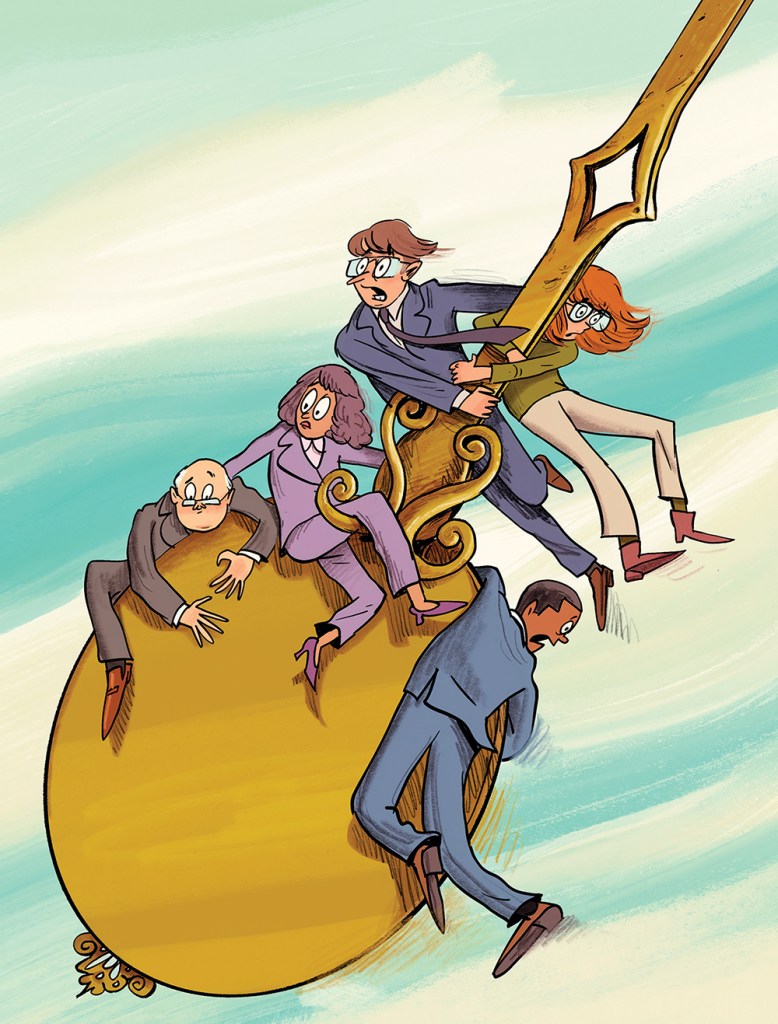
Imagine a pendulum swinging back and forth. On one side, you have today’s priorities. On the other side, you have tomorrow’s priorities. Ideally, we swing naturally between the two — taking care of today’s problems while focusing on our company’s long-term health. But sometimes, especially in high-stress situations, the pendulum gets stuck on one side or the other.
Some companies get stuck on long-term planning (tomorrow!) but don’t notice changing market trends that are starting to hurt results (today!). Others get stuck in their immediate reaction to today’s problem or crisis, and then make short-term decisions that don’t benefit tomorrow. This is how companies end up chasing foolish trends or responding poorly in bad situations.
A leader’s job is to get the pendulum unstuck so it can swing freely again.
How? Run decisions through a simple filter. You should be constantly looking at your to-do list and asking the following questions:
- If I could only accomplish four priorities at the expense of everything else on the list, which four would I choose?
- Do my four priorities reflect the right balance of today’s needs and tomorrow’s?
- If a priority only applies to the following week or month, will it do any damage to our intermediate or long-term goals?
- Are we overly focused on tomorrow, planning for a future we might not survive long enough to see if we can’t solve today’s problem?
Once you have the answers, make sure everyone’s action steps and calendar are aligned with your new balance of today’s and tomorrow’s priorities. Every task or commitment is a promise, so you can stress that the team has made promises to their own future selves. Those promises are just as important as promises to any customers or other stakeholders.
This is exactly how we ended up handling the crisis at the restaurant.
Remember, the team was racing to take responsibility. On one side of the conference room, the PR team urged the CEO to publicly apologize. On the other side, the lawyers wanted to reach quick settlements. In both cases, their responses were all about taking immediate action to reduce the blowback.
But to me, this felt like too much emphasis on today over tomorrow.
The company was acting as if its restaurants were guilty of negligence, but it didn’t know that for a fact. Maybe those deaths weren’t the restaurants’ fault, or at least not entirely their fault. If the company rushed to take full responsibility and pay settlements, it might defuse the negative headlines that week, but it could damage the chain’s long-term reputation.
I wasn’t the only one with concerns. I overheard one of the lawyers say, “Do we know anything about their preexisting health conditions?” That was a good question. So I asked everyone to pause for a time-out. I said we should wait to respond until we had more information.
Instead of releasing an immediate apology, the PR team issued a statement of sympathy and condolences to their families. They said the company was launching an investigation and would report back as soon as possible. The investigation took several weeks, while negative press and angry social media continued — none of which was good for “today.” But as painful as that was, we were still focused on tomorrow.
Then, finally, we got answers.
We received the medical records of the deceased. It turned out that both people had preexisting cases of hepatitis C, which made eating raw seafood extremely dangerous for them. Both of their doctors had warned them to avoid oysters and other types of food, but they’d ignored those warnings. There was no evidence of any failure by the restaurant staff, and no other customers had gotten sick.
When we announced these findings (again with condolences for the families), we made it clear that our food was safe, as long as people followed their personal medical guidelines. Then the bad press finally subsided.
Now imagine if the restaurant had acted based on its “today” needs. What if the CEO had issued a public apology? What if the company had moved toward quick settlements? In both cases, it could have hurt the restaurant’s long-term reputation. It could have solidified the impression that the restaurant was at fault. But as we’d later learn, the restaurant was not at fault.
We needed to wait, for the benefit of tomorrow.
The pendulum of today and tomorrow
When we’re balancing today versus tomorrow, we’re often reacting to what feels known versus unknown. We know what today feels like and what the current situation is. Tomorrow feels less certain, and therefore harder to focus on.
But what if tomorrow becomes extremely uncertain? What if the entire world is changing, and it’s truly impossible to know what tomorrow will bring?
The answer: You still must balance the two and keep the pendulum swinging.
Here’s an example. In 2009, during the global financial crisis and recession, companies nationwide saw sales decline. At the time, my strategy execution firm was working with a major retailer whose sales dropped by more than 40% — and it had no contingency plan for how to manage the decline.
Instead of adjusting to the new reality, the company insisted that all unit heads continue to hit the targets of its five-year growth plan. This plan, of course, was created before the crash. It was not based on market realities. And therefore, most unit heads were unable to reach their targets. Then the company fired them.
The economy eventually recovered. But while other retailers grew, that company continued to struggle. What happened? Its top talent was all gone, and those people were now working for the retailer’s competitors — and strongly motivated to outperform the people who’d fired them.
This is why, instead of anchoring yourself to five-year plans, I believe companies should always be operating in 90-day sprints. It’s an opportunity to identify your strategic objectives and focus your energy on what matters most at any one time.
During noncrisis situations, I recommend that no more than 15% to 20% of a sprint’s activities should focus on short-term, day-to-day problems or routine work. But during a crisis, we might dial short-term tactical activity up to 60% to 75% of everyone’s time and effort. Even then, I almost never recommend going all the way to 100% on crisis response. We maintain a baseline of activity on long-term strategic objectives, so it will be easier to dial back up to a higher concentration of long-term activity as the crisis subsides.
Imagine if the retailer had followed that formula. Even during a financial crisis, it would have been thinking about how decisions today position it for success tomorrow. I believe its decisions would have been very different.
It starts with the leader
Most of what I’ve learned about crisis leadership comes from 22-plus years working in counterterrorism. I’ve survived crises, and you can too.
So where do you start when a crisis hits? The first and most urgent step is to stop your amygdala hijack — and then stop your team from experiencing the same thing. More than ever, you need to get everyone’s brains thinking objectively.
One quick hack is to breathe deeply. A method I’ve found effective is to do each of these for a count of four: inhale, hold, exhale, hold. Repeat the cycle four or five times or until you feel the grip of panic dissipate.
Another hack is to ask yourself simple factual questions, like: What did I eat for breakfast yesterday? What color is my underwear? That focuses and grounds your mind. You can also remind yourself about previous situations when things seemed much worse than they are now, yet ended up not so bad in the end.
You can use all these tools to help your team as well. If you’ve pulled through tough situations in the past, that’s a great way to get them thinking clearly. Say things like: “Hey, remember last year when we got dropped by Client X? Remember how we won those new clients before we ran out of cash? That was a lot worse than today’s jam, so I know we can beat this one too.”
However you do it, the faster you get everyone grounded, the better equipped you’ll be to resolve the crisis — not just for today, but also for tomorrow.
This essay was adapted with permission from Bombs, Bacon, and Bankruptcy: The Art of Crisis Leadership by Henry J. Evans (November 10, 2026; BenBella Books).
It was the nightmare scenario for any restaurant chain: In just over a week, two customers at different locations fell sick after eating raw oysters. Then they died.
The press was all over the story, and the company was in a panic. What happened? Who was to blame? What should they say? Nobody knew, but everyone was demanding action.
I’m an executive coach, and I was working with the restaurant’s CEO at the time. So I was in the team’s conference room as they figured out their response. The place was buzzing with urgent activity as everyone hurled themselves into immediate damage control. The PR advisers were drafting a statement for the CEO to apologize, take responsibility, and promise to do better in the future. The lawyers were discussing a strategy to reach quick settlements with the bereaved families before lawsuits made things even worse. The idea was to acknowledge accountability as fast as they could so that they get out of the heat and move on.