I Asked 75,000 People About Their Biggest Regrets. These 6 Patterns Changed How I Think.
I was haunted by a business decision, so I sought out the missed opportunities and professional regrets of others.

This story appears in the January 2026 issue of Entrepreneur. Subscribe »
I’ve been plagued by a professional regret, which I’ve kept to myself for years.
But I’ll tell it to you now. Why? Because it’s helpful to share. As we start a new year, it’s important to let go of what anchors us to the past — and hearing other people’s regrets can help us do that.
I’ll explain. But first, here’s my regret.
Outside of my job as editor in chief of Entrepreneur magazine, I have spent years building a personal newsletter where I share the best lessons I’ve learned. (Find it at jasonfeifer.com/newsletter). A few years ago, I met a fellow newsletter writer who’d built an impressive audience, and he made me a nice offer:
He would add me to his recommendations list — which is to say, whenever someone subscribed to his newsletter, they’d get a pop-up recommendation to subscribe to mine. But he was on one newsletter platform, and I was another. To make this work, I’d need to switch to his.
That sounded like a hassle. So I thanked him, but passed.
Then his popularity exploded. He has more than 1 million subscribers. Meanwhile, I have 75,000—which I’m proud of, but it’s a fraction of what he could have gotten for me.
I’ve kept this story to myself for years, because it seems silly and frivolous. Like, Oh, woe is me. But it really eats at me! Newsletters drive significant financial opportunities, and my entire business could be bigger today…if only I’d said yes to that guy.
Related: 5 Lessons for Leaders in the Age of Constant Change
Recently, as I texted with a friend who also writes a newsletter, I shared this with him. He was the first person I’d told. And his response took me back:
“Here’s the worst for me,” he wrote. “A client told me to invest in Bitcoin in 2015.”
Oh, no, I said.
“It was about $250 a Bitcoin,” he continued. “Don’t do the math. It’s painful.”
Yes. Millions and millions of dollars’ worth of painful. And this client was a savvy investor whose name you probably know. Back when the client made that recommendation, it was worth taking seriously, but my friend didn’t.
When my friend said this, something switched in my brain. I suddenly realized: I am not the only person to miss a big opportunity. And that felt like a small but important revelation.
Regrets blossom in darkness. When we lack information, and we keep regrets to ourselves, they feel big and embarrassing, as if we should have known better. But the more we share them with others, the more we recognize how common they are — and how small they are by comparison.
So I had an idea: What if we all shared our regrets with each other? What if we compared notes, saw patterns, and appreciated our shared experience?
That’s why I asked my 75,000 newsletter subscribers: What missed opportunity do you still regret?
I got a flood of responses, which I’ve divided into six common themes. Now I’m sharing them with you, along with my thoughts. It’s time to feel less alone together — and move into 2026, unburdened from whatever came before.
Related: The Top 5 Mistakes Smart Entrepreneurs Keep Making
Here they are.
Theme 1: Giving up on a winning idea
I heard many versions of this story: I had an idea, but someone else succeeded with it.
Here are two examples:
Jayson says: “I had an idea for an outdoor product. I started developing it, but didn’t get far. A couple years passed, and I was watching Shark Tank, and I saw my same concept being pitched to the sharks! I couldn’t believe it. Now that product is sold on Amazon. I regret not developing it sooner or getting it to market. I feel like I missed out on millions.”
Patrice says: “Years ago, I started a restaurant review site as a hobby. It got tons of visits. But I had no idea I could make a living off it. My day job was busy, so I stopped reviewing restaurants. Fast-forward, and another company launched the same concept and was acquired for millions. I still die a little inside any time someone brings it up.”
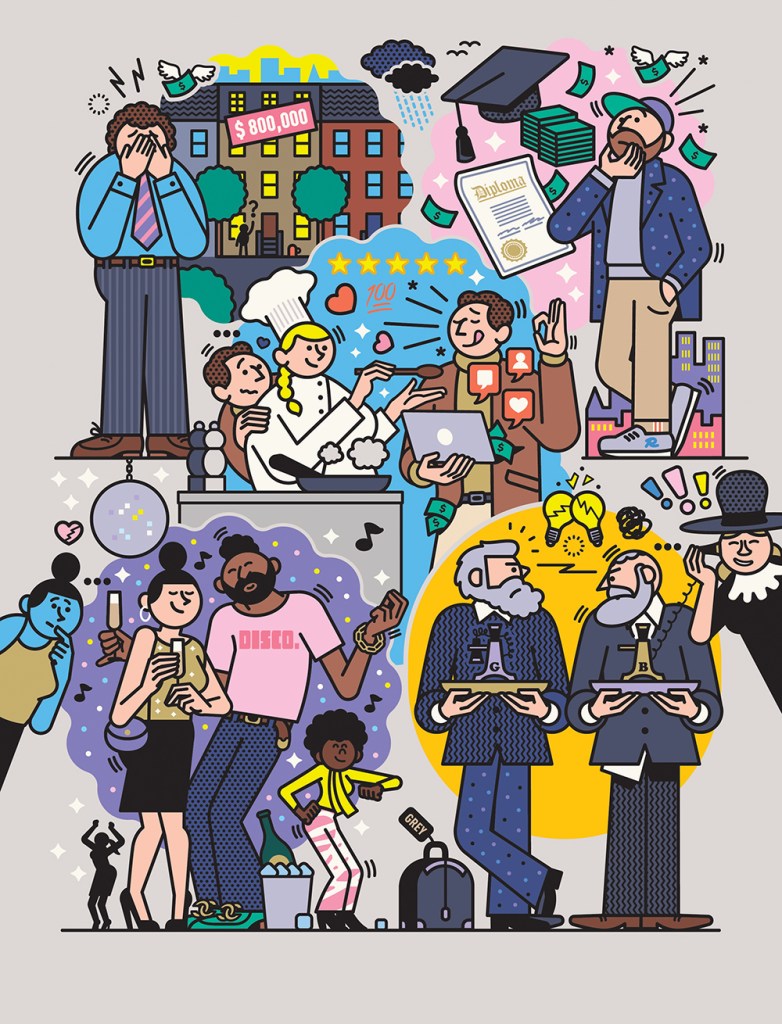
My take: I have my own version of this. When I was in high school, I came up with a story about a man who discovers that everything around him is a TV show. I never did anything with it. Then The Truman Show came out.
If you have a similar regret, then here’s what to know: This is insanely common. There’s even a term for it: multiple discovery. Across time, multiple independent people tend to develop world-changing ideas at roughly the same time.
Image Credit: Rami Niemi
• Both Isaac Newton and Gottfried Wilhelm Leibniz independently developed the principles of calculus in the late 1600s.
• Alexander Graham Bell and Elisha Gray filed patents for the telephone on the same day in 1876.
• Thomas Edison, Joseph Swan, and Hiram Maxim were among several inventors who created practical incandescent bulbs around the same period.
Examples go on forever. Ideas are great, but they’re not unique. Even the law recognizes this: It’s why you can’t patent an idea; you can only protect your unique execution of that idea. So do not beat yourself up. Even if you pursued your idea, that doesn’t mean you’d have been the winner. Many others likely had it too. All this means is that you’re a smart thinker, and that will continue to serve you well.
Related: The 3 Biggest Mistakes That Made Me a Better Entrepreneur
Theme 2: The grass is always greener
If you regret something you did or didn’t do, it’s safe to assume there are many people out there who regret having made the exact opposite decision. Take a look:
Justyn says: “I graduated college in 2023 with no debt and an opportunity to work full time at a midsize New York firm. However, the firm’s industry did not align with my career goals. So I took a risk to attend NYU for my master’s, taking out a loan to cover my tuition. I have graduated now, but have yet to secure a job in my desired field. Meanwhile, everyone from my undergrad is enjoying the start of their professional careers. I feel behind.”
Chris says: “I was an undereducated, socially isolated child, and attending college was my first ‘real school’ experience. I thrived there, and some professors encouraged me to go on to grad school. I even met with the chair of the department I wanted to be part of. Then I opted to stay at my job and not go to grad school. I’ve regretted it ever since. Now I’m not even in that job any longer. Oof.”
My take: So Justyn regrets going to grad school, and Chris regrets not going to grad school.
But let’s be realistic about what happened here. Justyn could have declined grad school, taken that unsatisfying job, and today might be employed but miserable. Chris could have attended grad school, but might have ended up saddled with debt and no job.
The lesson: Whatever you regret doing, someone else regrets not doing it.
No decision is obvious. No path is predictively correct. You simply couldn’t have known what was right — and in the future, the “wrong” decision might turn out to be the right one.
Related: 6 Leaders Reveal This Year’s ‘Gut Punch’ Low Moments, and What They Learned
Theme 3: The missing money
There were so many regrets about money.
Here’s a sampling:
CC says: “I was CEO of a startup and had the opportunity to make a strategic investment into a company with three employees. It is now worth $22 billion.”
Natalie says: “I passed up on Apple stock in 2004 because I thought a dollar a share was too much.”
Ben says: “I could have bought a 3-bedroom, 1,500-square-foot flat in Chelsea, NYC for $800,000.
I passed because the area
was a little beaten down. Would have sold that 10 years later for $2.5 million.”
My take: When I regret something, I try holding myself to this standard: “Did I make a rational decision based on the information I had at the time?”
If the answer is yes, then I can’t fault myself. In the examples above, every decision was rational. There was no way to predict success.
Should you sometimes take risks? Should you sometimes do the irrational thing? Yes, and yes. But you can’t do it all the time, or you’ll invest in nonsense and run out of money.
All life is a form of gambling. We can’t regret having played and lost.
Related: How a Night in the Jordanian Desert Taught Me a Business Lesson I’ll Never Forget
Theme 4: The ‘What if…’ stories
I heard so many Sliding Doors moments, when life could have taken a different turn.
A sample:
Jim says: “A friend of mine, a billionaire, discouraged me from investing further in a business partnership I was in, because he didn’t like my partner. He offered to help me start a business of my own. I didn’t accept. My partner later betrayed me, and it nearly left our family in ruin.”
S says: “The year I graduated college, my professor offered me a university lecturer gig in my hometown. He was going on a yearlong sabbatical, and I could fill in. I assumed these opportunities would always come, so I said no — because I wanted to attend art school overseas. My parents were mortified. After four more years of study, I finally entered the workforce and feel stunted compared to my peers.”
Bill says: “As a decent high school basketball player, I was recruited by Coach K to attend West Point. I declined. The next year, he left for Duke. I could have been in his first graduating class and a foundational player as he built that epic program.” [For non-basketball fans: Coach K is a retired legendary college coach, and his Duke program was dominant for decades.]
Copper says: “I turned down a fantastic job opportunity that involved moving to Italy for a minimum of three years and a huge salary increase — because my ex-husband wouldn’t relocate with me. He and I divorced a few years later because he said I outgrew him. I so, so, so wish I had said yes! Never got over it!”
My Take: We call these “What if…?” stories, but psychologists have a fancier term for it: counterfactual thinking. It’s what happens when you imagine different outcomes for past events.

But here’s the thing to remember: You genuinely are imagining those outcomes. You don’t really know how things would have turned out, and they might have turned out much worse. That’s why, to combat the trap of counterfactual thinking, we must add more counterfactual thinking. Consider all the other ways that things could have turned out.
Image Credit: Rami Niemi
For example: Jim’s friend offered to fund a new business, so Jim imagines that the business would have succeeded. But it could have also failed, and Jim’s billionaire friend could have turned on him. S imagines taking that university gig, then having a long and wonderful career. But S could have taken it, then felt stuck in their hometown. Bill imagines being on Coach K’s Duke team, but he also could have been cut before the season began.
If you’re stuck asking “what if,” try asking it in a more positive way. What if you dodged a bullet? What if you learned something critical? What if you’re actually on the right path?
Theme 5: Wasted time
This theme resonates with me personally the most.
Here are examples:
Linnea Says: “I stayed at the same job for 10 years because I thought they would recognize how great my work is and reward me for it.”
Ajay Says: “I missed out on so much free learning at my previous job. If I had been just more forward and asked for opportunities and kept an open mind, I would’ve been more experienced now.”
Jane says: “I missed out on being lighthearted and partying when I was the age where you would start with those experiences.”
My take: Jane, that was me too. I was too insecure in high school. Then I was in a long-term relationship through college and most of my 20s. I never just let loose when everyone else did.
So here’s what I’ve learned for myself, which I hope you’ll take to heart: Your time hasn’t passed. Your time is now.
This is how I’ve chosen to live today, crafting the life I want without exceptions. I travel a ton. I optimize for experience. I’m on a constant quest to meet new people. In my wife, I found someone equally down for great adventures.
“The past has served its purpose perfectly,” someone said on a wonderful recent episode of the podcast Heavyweight.
“But most people are cherry-pickers: Well, I wish that would’ve changed, or I wish this were [different]. No. The purpose of the past…there’s only one purpose: to bring you and me right here and now.”
True words.
Related: Always Waiting for the Best Option Is Holding You Back. Here’s Why.
Theme 6: ‘I never followed up’
Here was a common scenario: Someone received a great offer, but they didn’t follow up.
Here are two examples.
Shannon says: “I always wanted to work with tigers. One day, I met the owner of a tiger show, who told me: ‘Write me a letter, tell me why you want to work with tigers, and if it’s compelling enough, I will bring you on my team and teach you everything I know.’ But I didn’t do it. I regret it every day.”
B.P. says: “I was an aspiring clarinetist. After a performance, a Grammy-nominated violinist told me, ‘You’re a fabulous player. We should play together again sometime.’ But I never reached out; I just thought she was being nice. I soon gave up music. Could that have been the break I was looking for? I’ll never know.”
My take: Consider that phrase from B.P.: I just thought she was being nice.
It’s so relatable. We’ve all been burned before. Someone said, “We should do this again,” but never called. Colleagues said “I’m happy to help,” then ignored you when you asked. Politeness can masquerade as genuine interest, and this has taught us not to trust offers of help.
But still: Even if they’re lying, what’s the worst that can happen by following up?
Consider the math. If 10 people make you an offer, let’s say nine of them are “just being nice.” One of them could change your life.
If you don’t follow up with them, then you avoid nine embarrassing interactions and you miss something huge. And if you do follow up, you get ignored nine times and then make the connection that changes everything.
Here’s what I’ve learned: Many times, people really are making genuine offers — but they’re also expecting some upfront effort from you. They want you to take the lead, or to be clear and reasonable in your ask. They want you to say, “Based on your expertise, here are three specific things I’d love your feedback on, and we’ll get it done in an hour.”
We need to stop believing that we’re not worth other people’s time. Let’s start with a different assumption instead: People are genuinely interested in us. And that’s because we are genuinely interesting. We are worth their time, and their attention, and their partnership.
Related: Always Waiting for the Best Option Is Holding You Back. Here’s Why.
And now, my favorite regret
Of all the regrets I read, this one stood out the most — because it’s the only one with a complete ending. Most regrets hang in the air like an unfinished sentence; we never truly know what could have been.
But this woman knows. Here’s her regret:
KGJ says: “I was living with my mom after graduating from college, where I spent four years as a varsity softball starter. One day, my mom read in the paper about local auditions for a movie where they were looking for ‘girls who could throw a baseball,’ and suggested that could mean me. Because it was my mom and I was so busy waiting tables at Applebee’s (and maybe a little fear), I declined to take a shot at being an extra in A League of Their Own. Oh, what could have been…
But years later, I told a colleague at work about this, and they had a friend who did attend those auditions. That person ended up being Madonna’s ‘bitch for a year’ (her words). Did I want that too, or did I dodge a bullet? Who knows, but it makes me laugh and remember how much I love my life. Regrets and all.”
My take: I love this so much, KGJ. You got to see the path your life could have taken. And it was just as complex and unpredictable as the life you actually got to live.
Big moments can mean nothing. Small moments can change our lives. The good can become bad, and the bad can become good, and it’s simply impossible to predict what will actually matter in life.
So here’s the best we can do: We can carry forward with gusto, making the most of our time, building the things that matter, pursuing what matters most to us, and living as if there’s nothing to regret.
Related: Entrepreneurs, Stop Putting Your Life on Hold. Here’s Why Embracing Joy Fuels Success
Sign up for the Entrepreneur Daily newsletter to get the news and resources you need to know today to help you run your business better. Get it in your inbox.
I’ve been plagued by a professional regret, which I’ve kept to myself for years.
But I’ll tell it to you now. Why? Because it’s helpful to share. As we start a new year, it’s important to let go of what anchors us to the past — and hearing other people’s regrets can help us do that.
I’ll explain. But first, here’s my regret.