She Launched Her Brand With $300 and a Sewing Machine. Then She Bootstrapped It to a 7-Figure Acquisition.
Here’s how Jessica Liao Mayers grew her brand without taking a penny of external investment.
Key Takeaways
- Jessica Liao Mayers launched Slate Swim in 2015 with $300, a sewing machine and made-to-order products.
- Slate’s minimalist, seamless swimwear stood out because Mayers resisted chasing trends.
- Mayers bootstrapped the company, putting revenue back into production, inventory, branding and operations rather than taking outside capital.
She created a product that filled a gap in an industry — and scaled it to a seven-figure business.
That’s the trajectory Jessica Liao Mayers took over the course of 11 years. Mayers grew up outside Dallas in a family of medical professionals. Fashion was not an obvious career choice. Still, a high school fashion class, one she initially took because she thought it would be easy, changed her path.
“I ended up really, really loving it,” Mayers says. She competed in state and national fashion design and construction competitions, then moved to Los Angeles to attend the Fashion Institute of Design & Merchandising, where she studied product development.
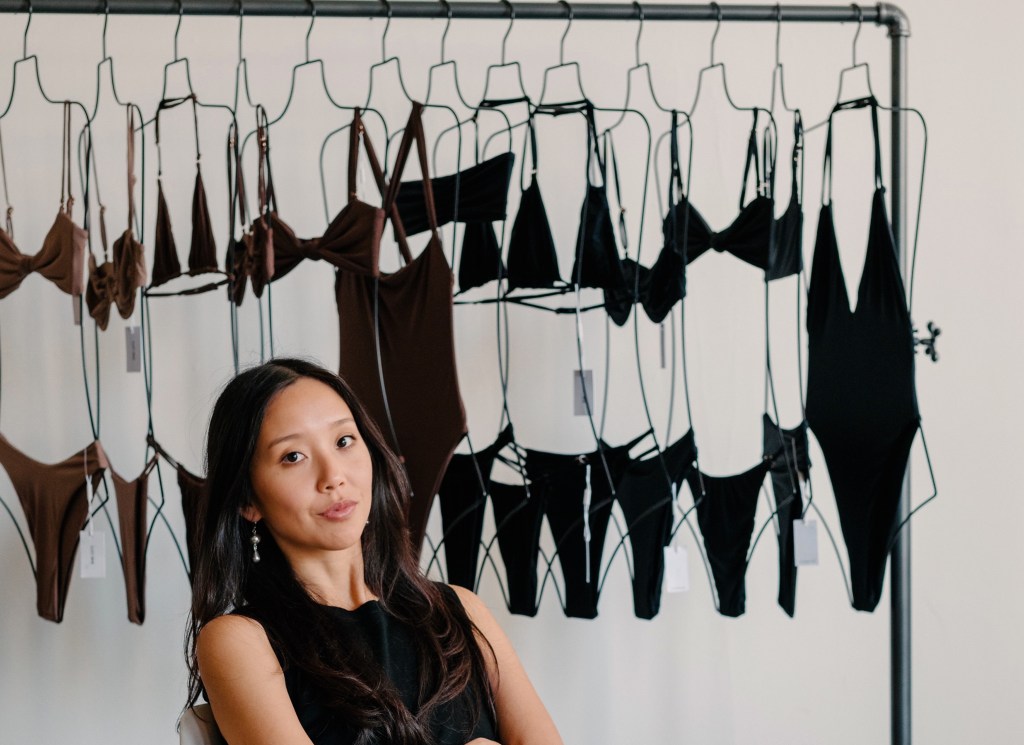
After graduating in 2014, Mayers quickly found work as a designer and product developer at lifestyle brand BCBG. She learned fashion design at the company, then switched gears, jumping to apparel company Tobi as a buyer and learning the wholesale retail side of the industry.
At Tobi, Mayers encountered a problem that was good to have: She was quickly completing work.
“I was very quick,” she says in a new interview with Entrepreneur. “My boss would give me the week’s worth of work on a Monday, and I would finish it in a few hours. I’d be so bored. So I was like, What do I do? I started my own business.”
Identifying a gap in the market
Mayers started Slate Swim in her home in November 2015. She spent $300 on fabric, then made products to order using a sewing machine she already owned.
Mayers would work on Slate on the side during lunches, running around the Fashion District to purchase fabric. Then she would sew when she got home. She was just 21 years old.
“I needed to start the brand because I needed something for myself,” Mayers says. “I got the idea because when I would go to buy swimsuits, I never really found something that was super comfortable.”
Mayers identified a gap in the swimwear market. Mass-produced, thick nylon swimsuits on one end, and high-end, trendy brands on the other. She found nothing minimalist.
“There wasn’t anything more cool and reserved, and that’s very much my style,” Mayers says. “I like to wear very clean silhouettes, neutrals. I didn’t want to put on a swimsuit and not feel like myself.”

She differentiated her brand from the start. Slate offers swimsuits with minimal seaming, so everything lays flat and smooth on the body. The company uses a thin, soft fabric that feels like a second skin. The first fabrics she experimented with were actually lining fabrics, which was unusual at the time.
Mayers says that in the 11 years she has led Slate, she has seen the industry change tremendously.
“I think I came in at a really good time when social media really wasn’t being used for brands,” she says. “I think that’s part of why we grew so quickly as well.”
A major leap
Before Mayers had inventory or a manufacturer, Agenda Trade Show discovered Slate’s early Instagram account, which Mayers used to share inspiration and teasers. The surf- and skate-focused show wanted to bring in swim brands and invited her to exhibit.
Mayers accepted. She signed up for the show even though she was actually supposed to go to that same show as a buyer for her company, Tobi. She had to tell her employer with a week’s notice that she had to quit because she was going to be showing there as a brand.
“They had no idea,” Mayers said. “It was really insane.”
However, the timing of the show created a problem.
Mayers had no production operation in place. To prepare, she made 30 samples herself in her apartment, cutting and sewing every one. At the trade show, Slate landed in 22 retailers, including Diane’s Beachwear.
The orders were a major validation, but they also introduced an immediate operational challenge. Mayers didn’t have a manufacturer yet. At the show, she met someone who connected her with a small Los Angeles production shop. That arrangement helped Slate fulfill its early wholesale orders.
Eventually, Mayers moved production overseas and partnered with a small, family-owned manufacturer run by a contact she already knew through Tobi. The relationship became central to Slate’s growth. Unlike the first local factory, which could be inconsistent, the overseas partner provided more dependable quality and production capacity.
The business expanded gradually. Mayers reinvested revenue into better production, branding, photography and ecommerce rather than trying to build every capability at once.
That deliberate pace was a feature. “Everything kind of grew at a slower pace, but very, very manageable,” she says.
Why she chose focus over expansion
For 11 years, Slate stayed in its lane. Mayers resisted suggestions to expand into menswear, resortwear or other adjacent categories. She believed the brand would be stronger by specializing.
“I would much rather be successful at one thing than mediocre at many things,” she says.
That focus also protected the brand’s identity. Slate was founded around a specific aesthetic: minimalist silhouettes, neutral tones and flattering fits. Mayers learned firsthand that chasing trends could dilute that point of view. She recalls experimenting with trend-forward colors, including neon yellow, in one collection. The products performed poorly.
“After that, I was like, Okay, never again. I’m just going to do my thing,” she says.
Her marketing approach followed the same principle. In Slate’s earliest days, photographers reached out to pull suits for beach shoots and test shoots. Mayers received high-quality imagery in exchange for credit and tags, allowing her to establish an elevated visual identity before she could afford major campaigns.
One influencer posted a photo wearing Slate, which generated 30 orders overnight, an enormous moment for a tiny, early-stage company. Mayers also began gifting products to people who fit the brand, building relationships one by one rather than chasing a single viral breakthrough.
“It didn’t really go so viral in a sense of one thing that happened or blew it up,” she says. “I think it was just consistently investing in those small relationships.”
The compounding effect of that strategy helped lay the groundwork for later growth.
Where she waited too long
Mayers now says she waited too long to embrace paid advertising.
Until 2021, Slate had not invested in ads. When Mayers finally hired an advertising team, the business accelerated. She says in the first year using paid marketing, Slate grew about 76%. The ads used polished campaign imagery to sell the feeling and world of the brand.
Her first outside hire was an ad team with an engineering background, an unconventional choice that appealed to Mayers because of their ability to understand Meta’s systems and data.
In retrospect, she says, “doing ads way sooner” is the one thing she would change about her business journey.
The growth from paid marketing created a chain reaction. More orders required a warehouse or third-party logistics provider. More fulfillment capacity made it easier to handle larger wholesale orders. Delegating allowed Mayers to build beyond the limits of a one-person operation.
Bootstrapping a sellable business
Slate’s financial model remained simple: selling swimwear directly to consumers and through wholesale partners. Mayers says 92% of the business came from direct-to-consumer sales and 8% from wholesale.
More notably, she never raised outside capital. Instead, she reinvested what the company earned. This meant moving carefully with inventory and avoiding premature expansion into too many stock-keeping units. It also gave Mayers more ownership and flexibility when it came time to sell.
Over Slate’s final three years under her ownership, the company grew 36% year over year, she says. In July 2026, Mayers completed a seven-figure acquisition after listing the brand with an online brokerage shortly after Slate’s 10-year anniversary.
The decision to sell was not just financial. Mayers had long thought of Slate as her “baby,” but she also felt ready to pursue her original passion: contemporary womenswear. She wanted a buyer who would understand the business, value its identity and maintain the relationships she had built.
She found that in a buyer with a swim background, fashion knowledge and strong instincts for marketing and media. Mayers says the fit brought a sense of calm.
“It was like an inner peace,” she says.
Because Slate was organized, profitable and supported by contractors rather than full-time salaried employees, the acquisition moved quickly. Her lawyer, she says, described it as the fastest acquisition he had seen.
Plans to launch a new brand
Mayers is staying involved with Slate to support the transition, but she’s turning her attention to Knitte, a contemporary minimalist womenswear brand she plans to launch in spring 2027.
“Womenswear and clothing is where I think my creativity shines the most, because I’m able to create without bounds,” she says. “With swim, it’s been so incredible, but there’s only so much fit-wise you can do with swimwear because it all has to be tight and formed to your figure.”
Mayers is going to be playing with silhouettes and different materials and fabrics that she wasn’t able to do for so many years. “I’m extremely excited about that,” she says.
Her advice for founders reflects the way she built Slate: Start with a genuine point of view, be resourceful and stay committed for the long haul.
“You have to have that passion that’s going to wake you up every morning,” Mayers says. “If you don’t have that, you’re just not going to get far.”
Key Takeaways
- Jessica Liao Mayers launched Slate Swim in 2015 with $300, a sewing machine and made-to-order products.
- Slate’s minimalist, seamless swimwear stood out because Mayers resisted chasing trends.
- Mayers bootstrapped the company, putting revenue back into production, inventory, branding and operations rather than taking outside capital.
She created a product that filled a gap in an industry — and scaled it to a seven-figure business.
That’s the trajectory Jessica Liao Mayers took over the course of 11 years. Mayers grew up outside Dallas in a family of medical professionals. Fashion was not an obvious career choice. Still, a high school fashion class, one she initially took because she thought it would be easy, changed her path.
“I ended up really, really loving it,” Mayers says. She competed in state and national fashion design and construction competitions, then moved to Los Angeles to attend the Fashion Institute of Design & Merchandising, where she studied product development.